When evaluating the application value of House Party Protocol (HPP), the central question is not simply what the protocol can accomplish, but how its distinct modules individually handle computation, verification, strategy execution, data sourcing, and asset analysis.
This challenge spans five dimensions—Noösphere, ArenAI, Booost, Alpha Quark, and multi-module collaboration—which collectively form HPP’s foundational infrastructure for AI and Web3 applications.
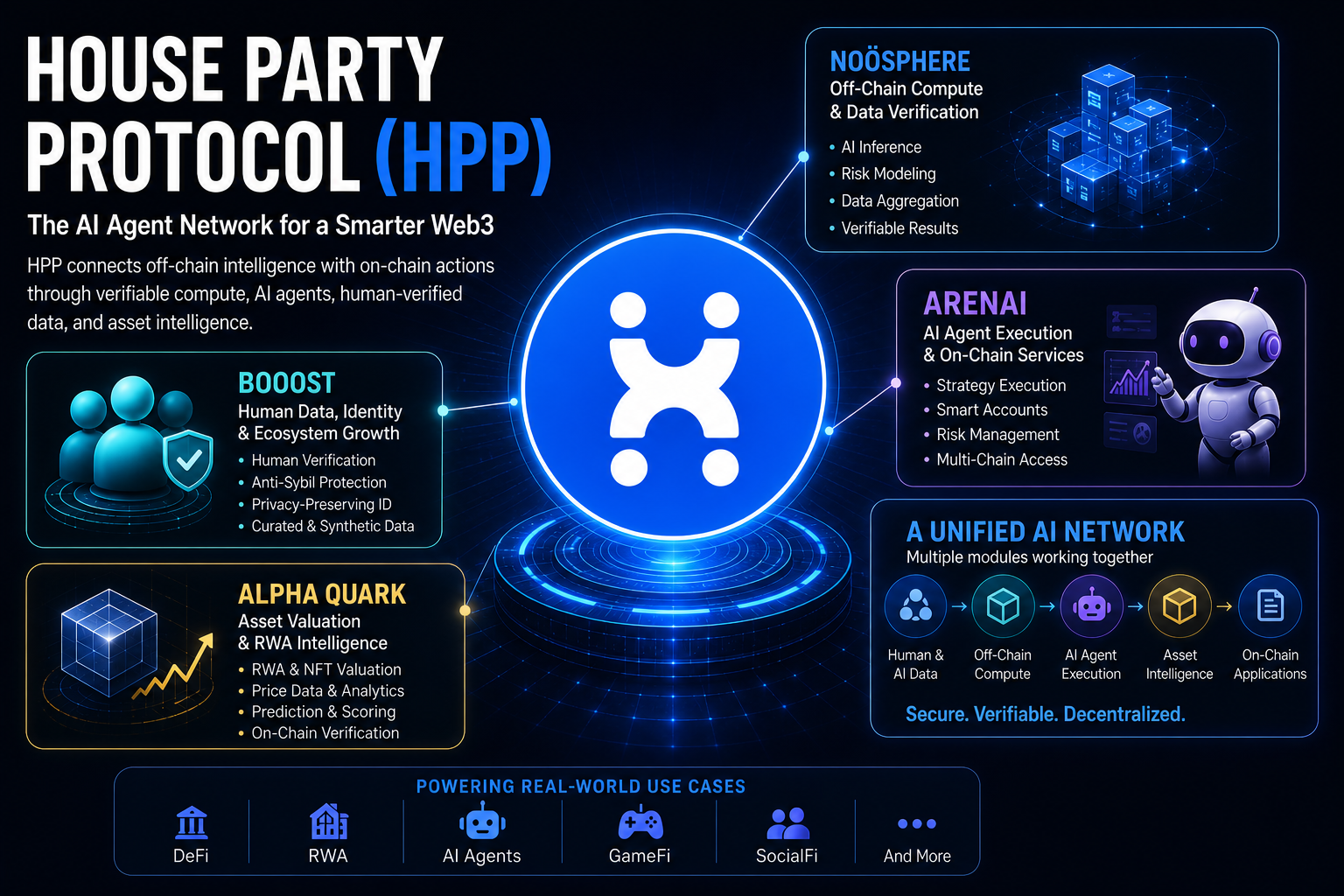
HPP Use Cases and Architectural Overview
HPP’s use cases can be viewed as a modular network built around AI services, data verification, and on-chain execution. Its core strength lies in integrating off-chain computation, intelligent agents, identity verification, and asset analysis into a unified, AI-native infrastructure.
Structurally, Noösphere handles off-chain intelligent computation and verifiable data paths; ArenAI manages AI Agent strategy execution; Booost provides human and synthetic data layers; and Alpha Quark focuses on intelligent analysis of RWA and NFT assets. The official white paper describes HPP as an AI-first data and blockchain ecosystem bridging enterprise-grade systems with decentralized technology.
The process begins when users or developers submit task requirements—such as invoking AI inference, verifying data, or executing on-chain strategies. The system then calls the relevant module based on the task type. Each module performs computation, verification, or execution. The results can subsequently be used in on-chain applications, data marketplaces, or asset analysis scenarios.
| Official Module |
Core Functionality |
Typical Use Case |
| Noösphere |
Off-chain computation and verification |
AI inference, risk scoring, data aggregation |
| ArenAI |
AI Agent execution |
Automated strategies, on-chain financial services |
| Booost |
Data and identity layer |
Human verification, synthetic data, anti-sybil |
| Alpha Quark |
Asset intelligence |
RWA valuation, NFT valuation, risk analysis |
This table illustrates that HPP is not a standalone product, but an application network supported by multiple official modules.
Off-chain Computation and Data Verification Powered by Noösphere
Noösphere is HPP’s off-chain intelligent framework, connecting deterministic blockchain environments with dynamic real-world computational tasks. It enables smart contracts to request and verify off-chain operations such as AI inference, risk modeling, and multi-source data aggregation.
In practice, users or smart contracts initiate off-chain computation requests—like risk scoring or model inference. Noösphere executes the task via decentralized agents. The system returns results through verifiable paths and integrates outputs into EVM-compatible environments. On-chain applications then leverage these verified off-chain intelligence results.
This mechanism allows static smart contracts to gain enhanced data interpretation and computational capabilities. For DeFi, DeSci, RWA intelligent analysis, and inference markets, off-chain computation reduces the cost and latency associated with executing complex AI tasks directly on-chain.
AI Agent Strategy Execution and On-chain Services Driven by ArenAI
ArenAI serves as HPP’s intelligent execution layer, enabling users to deploy on-chain strategies and risk management tasks via AI Agents. ArenAI encapsulates AI strategy execution capabilities as on-chain services accessible to users.
Mechanistically, users select or configure an AI Agent, managing it through smart accounts and session permissions. The Agent then executes tasks based on market data, strategy rules, and risk parameters. The system ensures transparency, verifiability, and user control on-chain. Users can access automated strategy services without writing code. Official documentation confirms that ArenAI allows users to leverage AI-driven trading strategies and enables strategy providers to release strategies as AI Agents.
This transforms AI Agents from off-chain analytics tools into execution units that interact with on-chain accounts, DEX, CEX, and multi-chain liquidity layers.
Booost’s Role in User Incentives and Ecosystem Growth
Booost functions as the human and synthetic data layer within the HPP ecosystem, supporting identity verification, anti-sybil systems, privacy-preserving identity tools, and curated datasets. Its primary purpose is to provide reliable data sources and user interaction foundations for the AI network.
Operationally, users enter ecosystem interaction scenarios through identity or behavior verification. Booost’s verification capabilities identify genuine users and mitigate sybil attack risks. Curated human or synthetic data is leveraged for AI training and application optimization. The ecosystem gains more reliable user participation data for social, gaming, metaverse, or governance scenarios.
This design ensures HPP’s AI applications rely not only on model computation, but also on trustworthy data entry. Booost enhances identity credibility, data quality, and ecosystem growth efficiency for applications requiring authentic user participation.
Asset Valuation and RWA Use Cases Enabled by Alpha Quark
Alpha Quark focuses on intelligent asset analysis within HPP, covering RWA, NFT, on-chain valuation tools, price data, and predictive analytics. It uses AI models to improve pricing, verification, and financialization of on-chain assets.
Structurally, users or applications submit asset-related data—such as NFTs, tokenized real estate, collectibles, or financial instruments. Alpha Quark combines AI valuation models, on-chain verification, and real-time price data for analysis. The system outputs asset valuations, risk scores, or predictive analytics. These results are applied in lending, staking, insurance, or market pricing scenarios. Official sources confirm Alpha Quark supports AI-driven RWA and NFT valuation, on-chain verification, and financial tools.
This addresses the core challenges of RWA and NFT assets—opaque valuation, unquantifiable risks, and hard-to-verify off-chain data—by providing a structured path for intelligent asset analysis.
AI Application Network Structure Through Multi-Module Collaboration
Multi-module collaboration is central to HPP’s application network. Each module specializes in computation, execution, data, identity, or asset analysis, forming a complete application chain via a unified protocol.
A typical workflow: users submit AI service requests through an application; Noösphere handles off-chain computation or data verification; ArenAI executes strategies or on-chain operations; Booost provides user identity and data credibility; Alpha Quark delivers asset valuation or risk analysis. The system then returns results to on-chain applications, enterprise systems, or decentralized markets.
This structure enables HPP to cover the entire path from data generation, verification, computation, and execution to commercialization. Officially, its business model is segmented into data-as-a-service, computation and AI deployment, verification-as-a-service, and AI-driven asset intelligence.
Key Constraints in HPP Application Deployment
HPP’s deployment faces constraints from off-chain computation complexity, data verification costs, Agent execution risks, and multi-module coordination challenges. As HPP’s modules become more comprehensive, demands for system coordination, verification efficiency, and user comprehension increase.
In application workflows, users must define task types and permission scopes. The system must match resources and verify results across modules. Applications must address data sourcing, model reliability, execution permissions, and on-chain recordkeeping. Only when computation outcomes, user control, and economic incentives are aligned can the AI Agent network operate reliably.
These constraints do not diminish application value; they underscore that HPP’s success relies on engineering execution, data quality, verification mechanisms, and ongoing collaboration among ecosystem participants.
Summary
House Party Protocol’s use cases are built around official modules—Noösphere, ArenAI, Booost, and Alpha Quark. Noösphere manages off-chain computation and data verification; ArenAI handles AI Agent strategy execution; Booost provides identity and data layers; Alpha Quark enables intelligent analysis of RWA and NFT assets.
The implementation path includes users initiating requests, the system invoking modules, executing computation or verification, outputting results, and serving on-chain applications. HPP’s value lies in multi-module collaboration, while its main constraints are computation costs, verification efficiency, data quality, and execution risk.
FAQ
What are the use cases for House Party Protocol?
House Party Protocol’s use cases include off-chain AI inference, data verification, AI Agent strategy execution, user identity verification, synthetic data, RWA valuation, NFT valuation, and on-chain asset analysis.
What is Noösphere’s role in HPP?
Noösphere manages off-chain computation and data verification, allowing smart contracts to call AI inference, risk scoring, and multi-source data aggregation, and integrates results into on-chain applications via verifiable paths.
How does ArenAI support AI Agent applications?
ArenAI enables users to manage AI Agents via smart accounts and session permissions, allowing automated strategy execution, risk management, and on-chain operations, while maintaining transparency and user control.
How does Booost relate to HPP applications?
Booost supplies HPP with human data, synthetic data, identity verification, and anti-sybil capabilities, improving user interaction quality, data reliability, and ecosystem growth efficiency.
What is Alpha Quark primarily used for?
Alpha Quark is primarily used for intelligent valuation, on-chain verification, price analysis, and risk scoring of RWA, NFT, and other tokenized assets, facilitating their integration with DeFi, lending, and insurance scenarios.







