In the past, Web3 games relied heavily on standalone clients, wallet connections, and complex on-chain interactions. That model, however, has always struggled to attract everyday users at scale. At the same time, the rapid rise of Telegram Mini Apps, WeChat Mini Games, and LINE social gaming platforms has shown that “lightweight experiences + social distribution” is the most effective path to user growth in the mobile internet era.
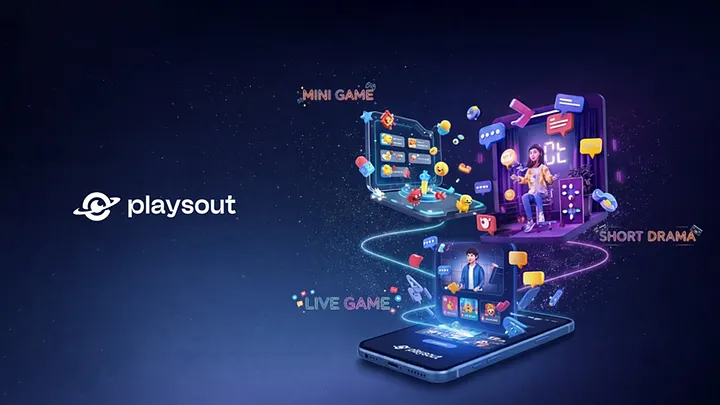
The biggest advantage of Mini-Games is instant access. Users do not need to download or install anything, nor do they need to learn complicated controls. They can start playing simply by tapping a link. This low-barrier model is gradually making mini-games an important gateway for Web3 user acquisition.
What Is the PlaysOut Mini-Game SDK?
The Mini-Game SDK is one of the core developer tools of PlaysOut. Its main goal is to help developers create and deploy mini-games quickly.
Traditional mini-game development usually requires developers to handle user login, payment systems, social sharing, multi-platform compatibility, and on-chain asset management on their own. The PlaysOut SDK packages these capabilities into a unified framework. Developers can use one set of interfaces to integrate their mini-games while supporting multiple Super App ecosystems, reducing both development and operational complexity.
How Does the PlaysOut SDK Work?
At its core, the PlaysOut SDK acts as a middle layer connecting mini-games, Super Apps, and on-chain systems.
After completing a mini-game, developers can use the SDK to connect with PlaysOut’s account system, social distribution tools, and reward mechanisms. The platform then embeds the mini-game into Telegram Mini Apps, LINE, or other Super Apps.
The process usually includes the following stages:
| Stage |
PlaysOut’s Role |
| Game development |
Provides SDKs and APIs |
| User login |
Social accounts and custodial wallets |
| Game operation |
Embedded inside Super Apps |
| User interaction |
Social sharing and task systems |
| On-chain interaction |
Token and reward mechanisms |
| Data analytics |
User growth and behavior statistics |
Developers can use PlaysOut’s infrastructure directly without building Web3 functions from scratch.
How Does PlaysOut Integrate with Telegram?
Telegram Mini Apps are currently one of the most important ecosystems for PlaysOut.
Telegram already has a large Web3 user base, and Mini Apps provide embedded application capabilities, which means users can launch games without leaving the chat interface.
Through the SDK, PlaysOut packages mini-games as Telegram Mini Apps and connects them with Telegram’s user system and social graph.
This model has several key advantages:
| Telegram Capability |
How PlaysOut Combines It |
| Group sharing |
Game virality and invitations |
| Mini Apps |
Instant play |
| Bot system |
User tasks and notifications |
| Web3 communities |
Token incentives |
For Web3 projects, Telegram is already a natural traffic gateway. PlaysOut takes this one step further by converting that traffic into a mini-game ecosystem.
How Does PlaysOut Support LINE and WeChat?
Beyond Telegram, PlaysOut also aims to support more Super App platforms, including LINE and WeChat.
LINE and WeChat Mini Games have already validated the commercial viability of the Super App + Mini-Game model. These platforms have mature social graphs, mini-game ecosystems, user payment systems, and advertising and recommendation systems. PlaysOut’s goal is to combine Web3 incentive capabilities with these mature ecosystems, allowing mini-games not only to reach Web2 users but also to gradually build an on-chain user system.
For this reason, PlaysOut is not centered on a single platform. Its core positioning is cross-platform Mini-Game infrastructure.
How Does PlaysOut Enable Walletless Login?
Wallet friction has long been a major obstacle to Web3 game growth.
PlaysOut’s solution is a custodial account system. This means users can first enter a game directly with Telegram, LINE, or another social account, without having to create an on-chain wallet right away.
In the background, the system automatically handles wallet creation, private key custody, on-chain account mapping, and gas fee management. For ordinary users, this experience feels closer to a Web2 game than a complex blockchain application.
As users become more familiar with the ecosystem, they can gradually engage with NFTs, tokens, and on-chain transactions.
How Does PlaysOut’s On-Chain Incentive System Work?
PlaysOut is not just a mini-game platform. It also integrates a complete on-chain reward mechanism.
Through task systems, check-ins, leaderboards, and social sharing mechanisms, the platform can provide users with PLAY Token or on-chain point rewards.
The core logic of this model is:
User behavior → social sharing → game growth → on-chain incentives
Compared with traditional GameFi, which often relies on high returns to attract users, PlaysOut places more emphasis on lightweight interaction and long-term retention.
Traditional blockchain games often exist only within a single app or blockchain ecosystem. PlaysOut, by contrast, is closer to a content distribution platform.
Mini-games can be integrated into multiple Super Apps at the same time and acquire users through different social platforms.
This model has several important advantages:
| Traditional Blockchain Games |
PlaysOut Model |
| Single entry point |
Multi-platform distribution |
| Independent operations |
Unified SDK management |
| High user acquisition cost |
Social traffic virality |
| Heavy on-chain interaction |
Lightweight experience |
| On-chain interaction |
Token and reward systems |
| Data analytics |
User behavior and growth tools |
As Web3 user growth becomes increasingly dependent on social platforms, cross-platform capabilities will become an important competitive advantage for mini-game infrastructure.
Traditional mini-game platforms mainly solve distribution and monetization problems, while PlaysOut also integrates Web3 capabilities.
The main differences include:
| Traditional Mini-Game Platforms |
PlaysOut |
| Web2 user system |
On-chain account system |
| Centralized payments |
Token incentives |
| Platform-owned assets |
User-owned on-chain assets |
| Pure advertising monetization |
Web3 ecosystem economy |
| Single-platform operations |
Cross-platform Super App support |
This structure makes PlaysOut more than a mini-game platform. It positions the project as infrastructure for Web3 social entertainment.
Conclusion
Through its Mini-Game SDK, Super App integration, custodial wallets, and on-chain incentive system, PlaysOut is building a mini-game infrastructure layer for Telegram, LINE, and Web3 social platforms.
Unlike traditional GameFi, PlaysOut places greater emphasis on lightweight experiences, social distribution, and low-barrier user growth. Its core competitive strength lies in helping developers deploy mini-games quickly while allowing Web2 users to enter the Web3 ecosystem without friction.
FAQs
What Is the PlaysOut SDK?
The PlaysOut SDK is a mini-game development toolkit that helps developers quickly connect with Super Apps such as Telegram and LINE while integrating Web3 functions.
How Does PlaysOut Integrate with Telegram?
PlaysOut packages mini-games as Telegram Mini Apps and combines them with bots, groups, and social sharing features to drive user growth.
Why Does PlaysOut Support Walletless Login?
Because ordinary users often find blockchain wallets difficult to understand. Walletless login lowers the entry barrier for Web3 games.
What Are PlaysOut’s Core Functions?
Its core functions include the Mini-Game SDK, on-chain account system, token incentives, Super App integration, and cross-platform distribution.
What Is the Biggest Difference Between PlaysOut and Traditional GameFi?
Traditional GameFi focuses more on financial returns, while PlaysOut focuses on mini-game experiences, social distribution, and long-term user growth.