For users of Telegram Mini Apps, TON wallets, or EVM applications, the key value of TAC lies in hiding the underlying complexity of cross-chain operations, allowing users to call Solidity contracts from within the TON environment.
This usually involves six layers: the TON Adapter, cross-chain messages, the Sequencer network, the TAC EVM Layer, Solidity contract execution, and the user interaction path.
TAC’s Overall Operating Mechanism
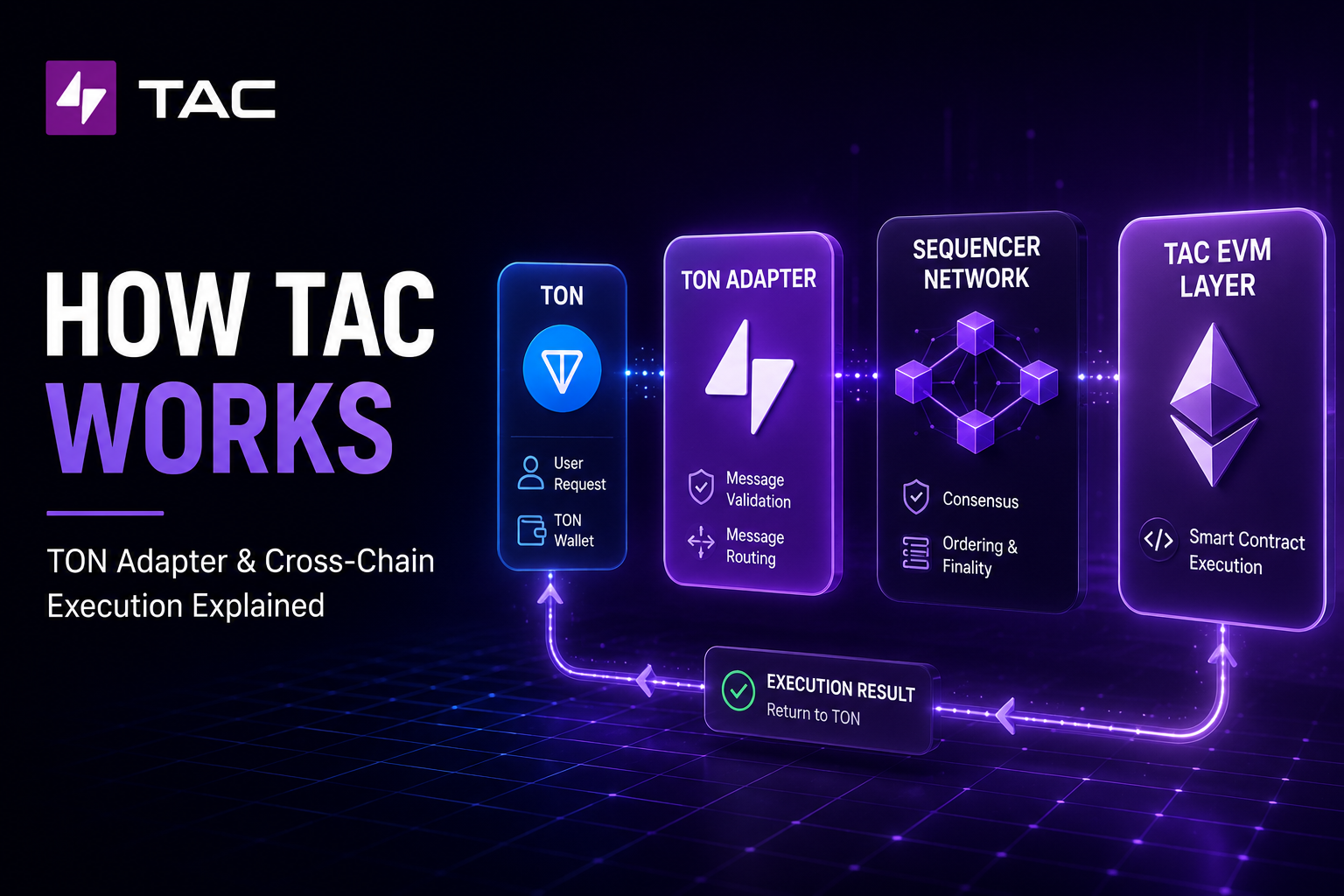
TAC’s operating mechanism can be understood as a cross-chain execution process that connects TON users with EVM contracts. Its core purpose is to enable a Telegram frontend to call Solidity applications on the TAC EVM Layer. TAC’s official documentation describes it as an EVM Layer 1 built for Telegram, connecting Ethereum dApps with Telegram users through a TON-specific cross-chain layer.
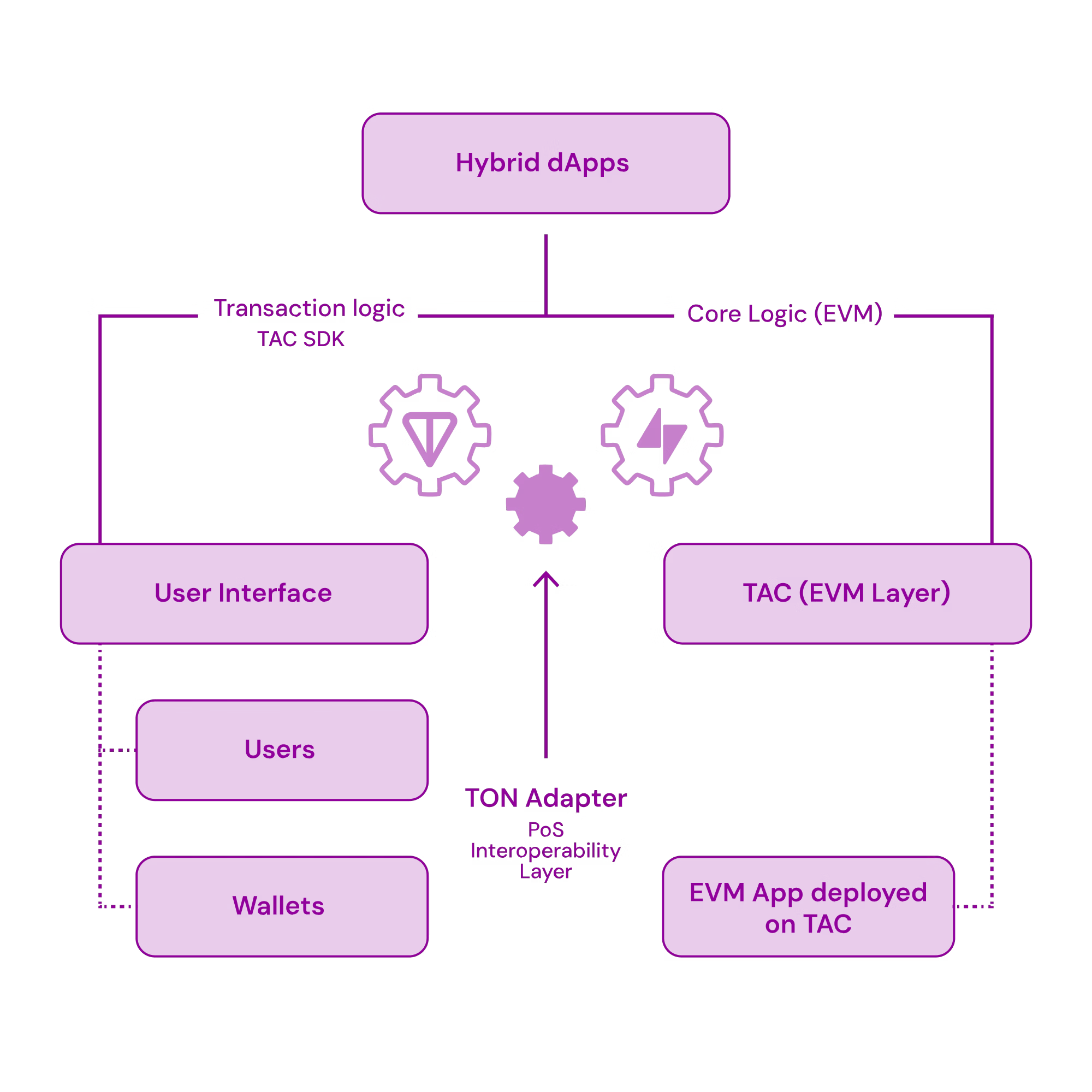
Structurally, users do not directly switch to an EVM network. Instead, they initiate actions through a Telegram Mini App or TON wallet. First, the user submits a transaction, swap, lending request, or another application request. The Hybrid dApp then converts that request into a processable cross-chain message through the TAC SDK. Next, the TON Adapter receives and verifies the message, while the Sequencer network handles ordering and consensus. Finally, the TAC EVM Layer executes the corresponding Solidity contract and returns the result to the TON side.
The importance of this mechanism is that it separates the user experience from the contract execution environment. Users remain within TON or Telegram as their entry point, while developers can build applications with EVM tools. For the application ecosystem, this reduces user migration costs and lowers the technical barrier for EVM projects entering Telegram-based use cases.
The Role of TON Adapter in the System
TON Adapter is TAC’s core cross-chain messaging component. It is mainly responsible for transmitting, verifying, and coordinating application-level messages between TON and the TAC EVM Layer. It is not a traditional cross-chain bridge that only moves assets; rather, it is a messaging system built for application interactions and EVM contract calls.
In practice, the user first initiates a request in a TON wallet or Telegram application. The TON Adapter then receives the message from the TON side and passes it to the distributed Sequencer network for processing. Next, the system verifies the message based on its content, signature, and state, then routes valid messages to the TAC EVM Layer. Finally, the EVM contract execution result is returned to the user interface through the corresponding path.
Structurally, TON Adapter sits between TON and the TAC EVM. It is the key middle layer that makes cross-chain execution possible. Its impact is that developers do not need to design complex cross-chain communication logic for each application individually; instead, they can rely on a unified component for message transmission, verification, and execution coordination.
How Cross-Chain Messages Are Verified and Executed
Cross-chain messages are the foundation of TAC’s Hybrid dApp model. They convert user actions on the TON side into instructions that the TAC EVM Layer can understand and execute. TAC documentation states that its cross-chain messaging system enables secure communication between TON users and EVM smart contracts through message creation, verification, and execution.
More specifically, the user first submits an action on the frontend, such as calling a DeFi contract or completing an application task. The Hybrid dApp then creates a message containing the user’s intent, target contract, and execution parameters. Next, the TON Adapter and Sequencer network verify the message source, format, and execution conditions. Finally, the validated message is sent to the TAC EVM Layer and triggers the corresponding Solidity contract.
| Process Stage |
User Action |
System Action |
Result |
| Request initiation |
Operates in a TON wallet or Telegram app |
Generates a cross-chain message |
User intent is recorded |
| Message receipt |
Waits for the app to process |
TON Adapter receives the message |
Request enters the cross-chain layer |
| Verification and ordering |
No manual action required |
Sequencer verifies and orders the message |
Message meets execution conditions |
| Contract execution |
Views the result |
TAC EVM executes the Solidity contract |
Application state is updated |
| Result return |
Confirms the result on the frontend |
System synchronizes the execution result |
User completes the interaction |
This table shows that TAC’s cross-chain process is not a simple asset transfer. Instead, it forms a complete path around user intent, message verification, and contract execution. Its value lies in packaging complex cross-chain operations into application interactions that users can actually understand and experience.
How the Sequencer Network Reaches Consensus
The Sequencer network is the verification and ordering layer in TAC’s cross-chain execution process. Its core role is to process messages from the TON Adapter and ensure that they enter the TAC EVM Layer in the correct order. In practical terms, the Sequencer network handles coordination and consensus for cross-chain messages.
In terms of how it works, after the TON Adapter receives a user request, it passes the message to the Sequencer network. The Sequencer then verifies, orders, and packages the message. Next, the network confirms the message’s validity through a consensus process and sends it to the TAC EVM Layer. Finally, the EVM contract executes according to the confirmed order, helping prevent message conflicts or duplicate execution.
TAC’s official architecture documentation describes the TON Adapter as a cross-chain message routing system made up of a distributed Sequencer network, used to transmit messages securely between TON and EVM. The documentation also notes that the TAC EVM Layer is based on Cosmos SDK and Tendermint consensus, with economic security implemented through DPoS.
The importance of this mechanism is that cross-chain execution requires more than message delivery. Message order, state, and execution conditions must also remain consistent. The Sequencer network is the key layer that helps cross-chain applications operate reliably.
How EVM Contracts Run on TAC
The core logic for running EVM contracts on TAC is to deploy Solidity contracts to the TAC EVM Layer and trigger their execution through cross-chain messages. The TAC EVM Layer handles application logic and state, allowing existing EVM dApps to be called in Telegram-based scenarios.
Structurally, developers can deploy unmodified Solidity contracts and use familiar tools such as Hardhat, Remix, and MetaMask for development. First, the developer deploys the contract to the TAC EVM Layer. The user then submits an action through a Telegram Mini App or TON wallet. Next, the TON Adapter passes the request to the EVM layer. Finally, the corresponding contract completes execution and sends the state change back to the application interface.
Official documentation states that the TAC EVM Layer is a Cosmos SDK-based blockchain capable of running unmodified Solidity contracts, with DPoS supporting finality of about 2 seconds. The documentation also explains that the EVM Layer is responsible for all application logic and state, while the TON Adapter handles cross-chain communication.
The impact of this design is that TAC lowers the cost for Ethereum developers to enter the TON ecosystem. Developers do not need to rewrite contract logic or fully adapt to TON’s native development environment.
How Users Complete Cross-Chain Interactions
When users complete cross-chain interactions through TAC, they usually do not need to directly understand cross-chain bridges, gas conversion, or EVM network switching. The core experience is that they operate through a Telegram Mini App or TON wallet, while TAC handles cross-chain messaging and EVM execution underneath.
In the specific flow, the user first opens a Hybrid dApp in Telegram and selects a function such as swap, lending, staking, or another feature. The user then signs and confirms the action with a TON wallet. Next, the TAC SDK, TON Adapter, and Sequencer network jointly handle message verification and execution routing. Finally, the TAC EVM Layer executes the contract, and the result is returned to the Telegram interface.
TAC’s official blog also emphasizes that users can access EVM DeFi protocols directly through Telegram without downloading a new wallet, configuring a new network, or mastering complex technical knowledge. The importance of this interaction model is that it wraps EVM applications into a Telegram-native experience, making cross-chain execution feel much closer to using an ordinary application.
Conclusion
TAC’s operating flow revolves around user requests, the TON Adapter, the Sequencer network, and the TAC EVM Layer. The user first initiates an action in Telegram or the TON environment. The system then creates and verifies a cross-chain message, the Sequencer network handles ordering and consensus, and the EVM contract finally executes and returns the result.
Looking at the overall mechanism, the TON Adapter is the core of cross-chain communication, the Sequencer network handles verification and ordering, and the TAC EVM Layer is responsible for Solidity contract execution. This flow allows TON users to use EVM applications without directly handling complex cross-chain operations.
FAQs
How Does TAC Work
TAC receives TON user requests through the TON Adapter, uses the Sequencer network for verification and ordering, then executes Solidity contracts through the TAC EVM Layer and returns the results to the Telegram or TON user interface.
What Is TON Adapter
TON Adapter is TAC’s cross-chain messaging system. It transmits, verifies, and routes application-level messages between TON and the TAC EVM Layer, allowing TON users to call EVM contracts.
What Role Does the Sequencer Network Play in TAC
The Sequencer network verifies, orders, and coordinates cross-chain messages, ensuring that requests from TON enter the TAC EVM Layer in the correct order and trigger contract execution.
How Does TAC Execute EVM Contracts
Developers deploy Solidity contracts to the TAC EVM Layer. After user requests are passed in through the TON Adapter, the EVM layer executes the corresponding contract logic and synchronizes the result back to the user interface.
Do Users Need to Switch Wallets to Use TAC
Usually, no. TAC is designed to let users interact through Telegram Mini Apps or TON wallets, while the system handles the underlying cross-chain messages and EVM execution.