As the on-chain perpetual contract market grows rapidly, Hyperliquid has gradually become one of the most watched order book derivatives infrastructures in DeFi. On top of this foundation, more Builders are beginning to use Hyperliquid’s HIP-3 architecture to build vertical trading platforms. TradeXYZ is one important example.
Because both involve perpetual contracts, order books, and on-chain trading, many users tend to see TradeXYZ and Hyperliquid as the same type of product. In reality, however, they differ clearly in positioning, functionality, and ecosystem role.
A Brief Look at Hyperliquid and TradeXYZ
As a high-performance perpetual trading platform built around an on-chain order book model, Hyperliquid’s core goal is to deliver matching speed, liquidity, and trading efficiency close to that of centralized exchanges in an on-chain environment. Compared with traditional AMM models, Hyperliquid places more emphasis on professional trading capabilities and a high-frequency order book market structure.
Beyond its own native perpetual markets, Hyperliquid has also gradually developed into a broader on-chain derivatives infrastructure. Its HIP-3 Builder architecture allows third-party projects to build independent markets based on its liquidity and order book system.
As an on-chain perpetual market built on the Hyperliquid HIP-3 Builder architecture, TradeXYZ focuses more on real-world asset, or RWA, trading scenarios such as stocks, commodities, indices, and Pre-IPO markets. TradeXYZ’s core goal is to use on-chain perpetual markets to provide users with stock price trading, commodity price trading, Pre-IPO market trading, and 24/7 access to global markets.
TradeXYZ does not directly build the underlying matching network. Instead, it uses the liquidity and order book infrastructure provided by Hyperliquid to establish its own vertical market brand and asset system.
What Is HIP-3 Builder?
HIP-3 Builder is a market-building framework provided by Hyperliquid.
Its core logic is to allow third-party projects to build independent markets based on Hyperliquid’s underlying order book and liquidity system, without having to create a complete derivatives infrastructure from scratch.
In the traditional financial system, building a derivatives trading platform usually requires a matching engine, clearing system, risk engine, liquidity network, and market maker structure. HIP-3 Builder attempts to modularize and open up these underlying capabilities.
TradeXYZ’s market structure is, in essence, a vertical asset market built using this framework.
What Are the Core Differences Between TradeXYZ and Hyperliquid?
The biggest difference between TradeXYZ and Hyperliquid lies in their ecosystem roles.
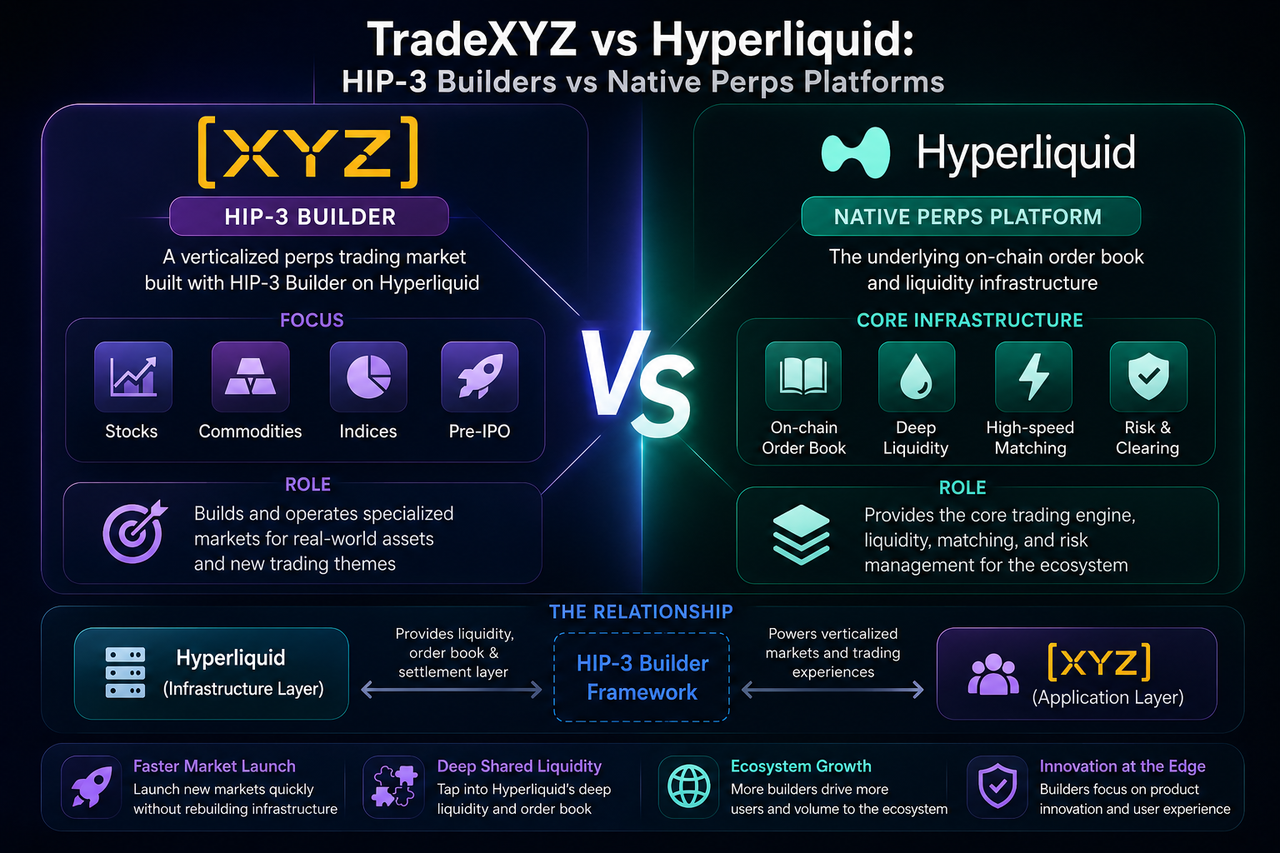
Hyperliquid is closer to the infrastructure layer, while TradeXYZ is closer to an application-layer market.
Hyperliquid provides the order book, liquidity, matching system, and on-chain trading infrastructure. TradeXYZ, by contrast, builds specific asset markets, introduces new trading themes, shapes market narratives, and focuses on RWA and stock trading scenarios.
The relationship between the two is somewhat similar to this:
| Role Layer |
Hyperliquid |
TradeXYZ |
| Ecosystem Positioning |
Infrastructure layer |
Application-layer market |
| Core Function |
Order book and liquidity |
Vertical asset markets |
| Market Direction |
General-purpose perpetual contracts |
Stocks and RWA markets |
| User Focus |
Trading performance |
Asset themes and market scenarios |
| Technical Role |
Underlying system |
Builder project |
As a result, TradeXYZ’s growth also depends, to some extent, on the development of the Hyperliquid ecosystem.
Why Does the Builder Model Matter?
The Builder model means that the on-chain derivatives market is beginning to shift from “competition between individual platforms” toward an “infrastructure plus application ecosystem” model.
In the past, most on-chain trading platforms had to build a full system themselves, which created high barriers in both development and liquidity.
Under the HIP-3 Builder model, projects can directly use Hyperliquid’s deep liquidity, order book system, liquidation mechanism, and trading infrastructure to build new markets quickly.
This structure is somewhat similar to:
The infrastructure layer provides the network and underlying capabilities, while the application layer focuses on specific markets and user scenarios.
Why Does TradeXYZ Focus More on Stocks and Pre-IPO Markets?
TradeXYZ’s differentiation mainly lies in markets related to real-world assets, or RWAs.
Compared with most on-chain perpetual platforms, which primarily trade crypto assets such as BTC and ETH, TradeXYZ places greater emphasis on:
This strategy is effectively expanding the asset boundaries of on-chain derivatives markets.
Its goal is not to replace traditional stock exchanges, but to build an on-chain risk trading market around the prices of real-world assets.
In that sense, TradeXYZ is more like an “on-chain gateway to traditional financial markets.”
How Could the Builder Model Affect DeFi?
The HIP-3 Builder model reflects DeFi’s gradual move into a stage of “modular finance.”
In the past, a protocol usually had to handle infrastructure, liquidity, user interface, and risk systems all at once. Now, these capabilities are beginning to be separated.
In the future, the on-chain financial ecosystem may gradually take shape as follows:
| Layer |
Main Function |
| Infrastructure layer |
Matching, clearing, liquidity |
| Builder layer |
Market construction and asset design |
| Application layer |
User experience and community operations |
This structure helps increase the pace of market innovation and lowers the barrier for new projects to enter.
The relationship between TradeXYZ and Hyperliquid is a representative example of this trend.
Are TradeXYZ and Hyperliquid Competitors?
Strictly speaking, they are not direct competitors.
Hyperliquid is more like the underlying market network, while TradeXYZ is a vertical market built on top of it.
Of course, some user trading activity may still overlap, but from an ecosystem perspective, the two are closer to a cooperative relationship.
As the Builder model expands, more vertical market projects similar to TradeXYZ may emerge in the future.
Conclusion
Although TradeXYZ and Hyperliquid are both part of the on-chain perpetual contract ecosystem, they differ clearly in positioning and role.
Hyperliquid is closer to on-chain order book and liquidity infrastructure, while TradeXYZ is a vertical asset trading market built on the HIP-3 Builder architecture.
FAQs
What Is the Core Function of HIP-3 Builder?
HIP-3 Builder allows third-party projects to build their own trading markets based on Hyperliquid’s order book and liquidity system.
Does TradeXYZ Have Its Own Order Book?
TradeXYZ’s core order book and liquidity infrastructure mainly come from the Hyperliquid ecosystem.
Why Does TradeXYZ Focus More on Stocks and Pre-IPO Markets?
Because its core positioning is to expand on-chain trading scenarios related to real-world assets, or RWAs, rather than limiting itself to crypto asset markets.
Why Does the Builder Model Matter?
The Builder model lowers the barrier to building on-chain derivatives markets, allowing more projects to quickly create new markets based on shared infrastructure.
Are TradeXYZ and Hyperliquid Competitors?
The two are closer to a cooperative relationship between infrastructure and the application layer, rather than direct competitors.