Traditional DAO governance typically relies on token voting to determine proposal outcomes, but this approach is prone to low participation, emotional decision-making, and inefficiencies. MetaDAO aims to reflect governance expectations through Market Price and uses “Trade” rather than “Vote” as its core decision-making method.
Structurally, MetaDAO is built around Futarchy, prediction markets, Treasury management, the STAMP financing mechanism, and the META token system. Its goal is to establish a more market-driven governance system on-chain.
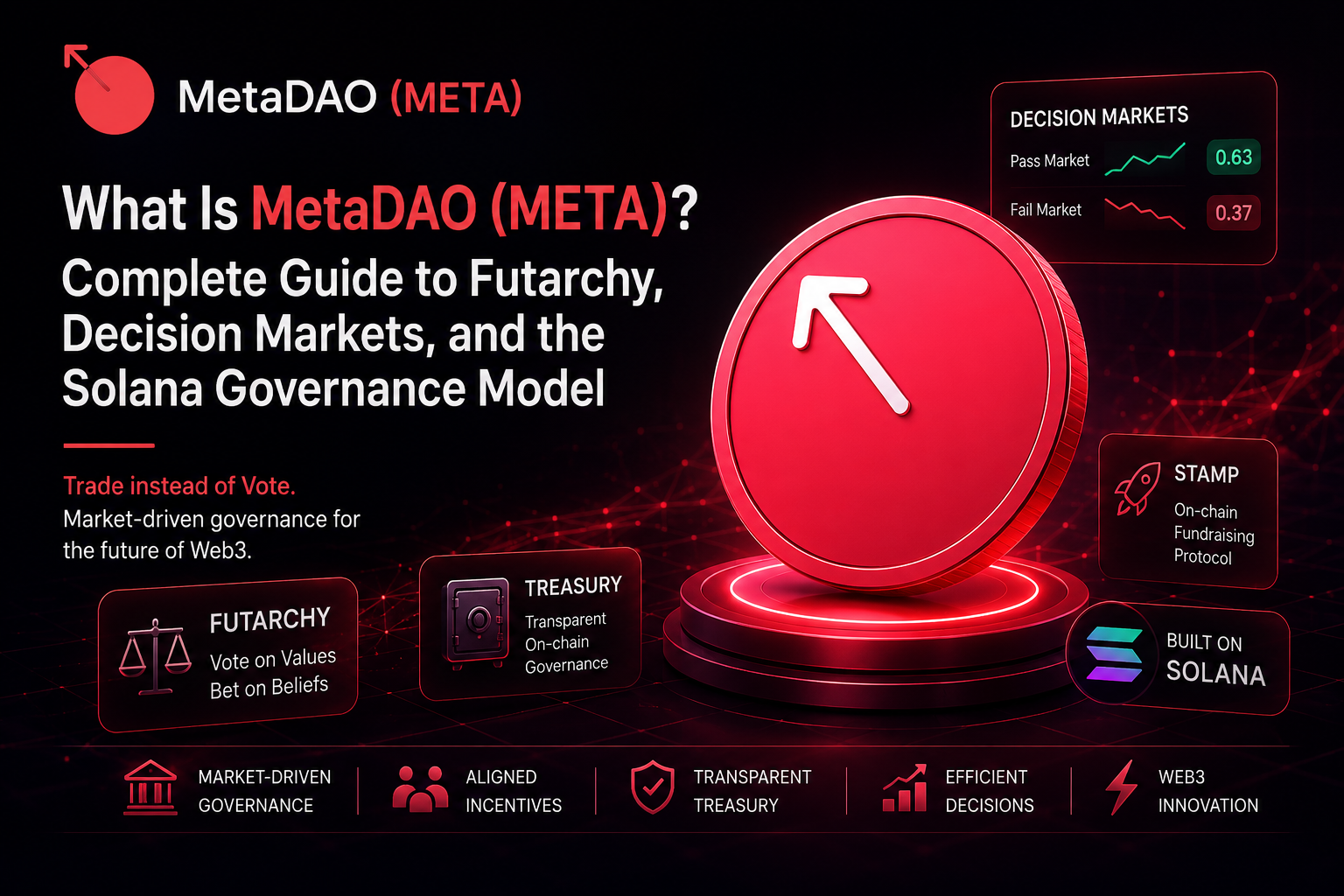
MetaDAO is an on-chain governance protocol built on Futarchy theory, designed to determine DAO proposal outcomes through market activity rather than traditional voting. The official core principle is “Trade instead of Vote,” meaning trading replaces token voting as the decision-making mechanism.
MetaDAO operates on the Solana network and builds its governance system around prediction markets. Community members submit governance proposals, and the system creates markets for different outcomes. Users express their expectations by trading, and Market Price ultimately determines whether a proposal is executed.
This mechanism shifts governance from “expressing opinions” to “price discovery.” For DAOs, Market Price is considered a more accurate indicator of true expectations, rather than voting power based on token holdings.
Futarchy is the foundational governance theory of MetaDAO, leveraging market predictions to determine governance Side. Instead of direct voting, Futarchy lets the market use price competition to assess which proposal offers greater value.
Within MetaDAO, community members submit governance proposals. The system creates two markets for each proposal—one for approval and one for rejection. Traders act based on their expectations for future outcomes. The system determines the execution Side using price, liquidity, and TWAP mechanisms.
MetaDAO documentation emphasizes the core idea of Futarchy: “Vote on values, bet on beliefs.” The community sets objectives, while the market decides how to achieve them.
This structure binds governance outcomes to market incentives. Participants who make incorrect judgments incur economic costs, while those who are correct may earn Return. This makes the governance process resemble a prediction market more than traditional voting.
How Prediction Markets Replace Traditional DAO Voting
Prediction markets are the core execution layer of MetaDAO’s governance system, converting proposals into tradable markets. Market Price becomes a governance signal, not just an asset valuation tool.
The system creates Proposal Pass and Proposal Fail markets for each proposal. Users Trade based on their assessment of the outcome. Market Price gradually forms expectations for governance results. The protocol decides whether to execute the proposal based on TWAP and market outcomes.
| Comparison Dimension |
MetaDAO Prediction Market |
Traditional DAO Voting |
| Governance Method |
Market Trade |
Token Voting |
| Core Signal |
Market Price |
Vote Count |
| Participation Cost |
Trading risk required |
Usually risk-free |
| Outcome Formation |
Price discovery |
Vote tally |
| Incentive Logic |
Correct judgment earns Return |
Voting power determines influence |
This comparison shows that MetaDAO focuses on economic incentives and price discovery, while traditional DAOs emphasize token holding weight. Governance participants must bear market risk for their judgments, not just express opinions.
The META token is the core asset in MetaDAO’s governance system, enabling governance participation, Treasury management, market incentives, and protocol control. It connects prediction markets to DAO governance.
META holders participate in protocol governance and proposal processes. Prediction markets generate price signals around proposals. Treasury management and resource allocation are influenced by governance outcomes. META token holders help adjust protocol direction through market and governance mechanisms.
Official documentation states META has no fixed Hard Cap; additional issuance must go through governance proposals and market decisions. Mint permissions are controlled by governance procedures, not by a centralized team.
This mechanism ties META supply changes directly to governance. Compared to fixed supply models, MetaDAO prioritizes market-driven management of protocol resources and token issuance.
MetaDAO’s Treasury management is based on Futarchy and prediction markets, using market judgment to decide when Treasury funds should be used.
Community members submit proposals involving Treasury, such as ecosystem grants, team expenditures, or market incentives. The system creates relevant prediction markets. Traders Trade around proposal outcomes, forming Market Price. The protocol decides whether to execute Treasury fund operations based on market results.
This structure means Treasury control is no longer solely dependent on token voting, but also incorporates market constraints. For DAOs, this helps reduce resource allocation issues caused by emotional governance and cost-free voting.
How the STAMP Financing Mechanism Works
STAMP is MetaDAO’s on-chain financing mechanism, designed to create a more market-driven project launch process in the Solana ecosystem. STAMP integrates financing, Ownership Coin, and Treasury management within the same governance system.
Projects create a financing structure through STAMP. The system issues Ownership Coin and opens them for market trading. The Treasury receives funds and governance control. Subsequent resource allocation, additional issuance, and governance actions are managed through Futarchy prediction markets.
MetaDAO documentation notes that STAMP combines ICO, Treasury, and Futarchy mechanisms, emphasizing that funds raised on-chain remain subject to governance constraints.
This mechanism links financing to long-term governance, rather than just completing a one-time token sale.
Main Application Scenarios for MetaDAO
MetaDAO’s main applications include DAO governance, Treasury management, on-chain financing, and prediction markets. Its core value is replacing inefficient voting processes with market mechanisms.
DAOs can use Futarchy to manage Treasury and governance proposals. Projects can complete on-chain financing via STAMP. Ownership Coin and prediction markets establish ongoing governance for the protocol. Market Price becomes a key factor for resource allocation.
MetaDAO is not just a governance tool, but an on-chain governance framework centered on market decision-making. Its applications focus on protocols requiring ongoing resource management and long-term governance.
MetaDAO’s core difference from traditional DAOs is its shift from “token voting” to “market trading” as the governance mechanism.
| Comparison Dimension |
MetaDAO |
Traditional DAO |
| Core Governance Logic |
Futarchy |
Token Voting |
| Decision Method |
Market Price |
Vote Count |
| Governance Incentive |
Trading Return and risk |
Token holding weight |
| Treasury Management |
Market constraints |
Community voting |
| Proposal Execution Basis |
TWAP and market result |
Vote approval rate |
Traditional DAOs rely on the number of token holders and voting participation, while MetaDAO emphasizes market signals and economic incentives. Governance participants must bear real market risk, not just engage in low-cost voting.
MetaDAO’s advantages include improved governance efficiency through Futarchy and prediction markets, and the introduction of market incentives into DAO decision-making. Governance outcomes depend more on market judgment than token quantity.
Market participants must bear trading risk, so governance results may better reflect true expectations. Treasury management and financing also operate within a unified governance framework.
Potential limitations include insufficient market liquidity, higher participation thresholds, and prediction markets possibly being influenced by short-term sentiment. If Market Depth is lacking, prices may not reflect long-term governance value.
Summary
MetaDAO is a Futarchy governance protocol on Solana, featuring prediction markets, Treasury management, the STAMP financing system, and META token governance. Through Proposal Pass and Proposal Fail markets, MetaDAO replaces traditional DAO voting with price discovery.
MetaDAO’s core innovation is binding governance to market incentives, requiring participants to express expectations and bear risk through trading. Its focus is on DAO governance, Treasury management, and on-chain financing.
FAQ
What is MetaDAO
MetaDAO is a Futarchy governance protocol on Solana that replaces traditional DAO voting mechanisms with prediction markets and Market Price.
What does Futarchy mean in MetaDAO
Futarchy is a mechanism that uses market predictions to determine governance outcomes. In MetaDAO, proposal results are formed through market trading and pricing, not direct voting.
What is the function of the META token
The META token is used for governance participation, Treasury management, market incentives, and protocol control, and is tied to the token issuance mechanism.
What are the differences between MetaDAO and traditional DAOs
Traditional DAOs rely on token voting, while MetaDAO emphasizes market trading and price discovery, using Futarchy to determine governance direction.
What is STAMP
STAMP is MetaDAO’s on-chain financing mechanism, combining Ownership Coin, Treasury, and Futarchy to facilitate project financing and subsequent governance.







