As Telegram Mini Apps and the TON ecosystem expand, more Developers are seeking to bring established EVM applications into the Telegram environment. However, differences in Smart Contracts, programming languages, and execution environments between TON and Ethereum create complexity for cross-ecosystem integration.
TAC is architected around the TON Adapter, EVM execution layer, Hybrid dApp, and a cross-chain messaging system, with the goal of connecting Telegram users to the Ethereum application ecosystem.
What Is TAC (TAC)
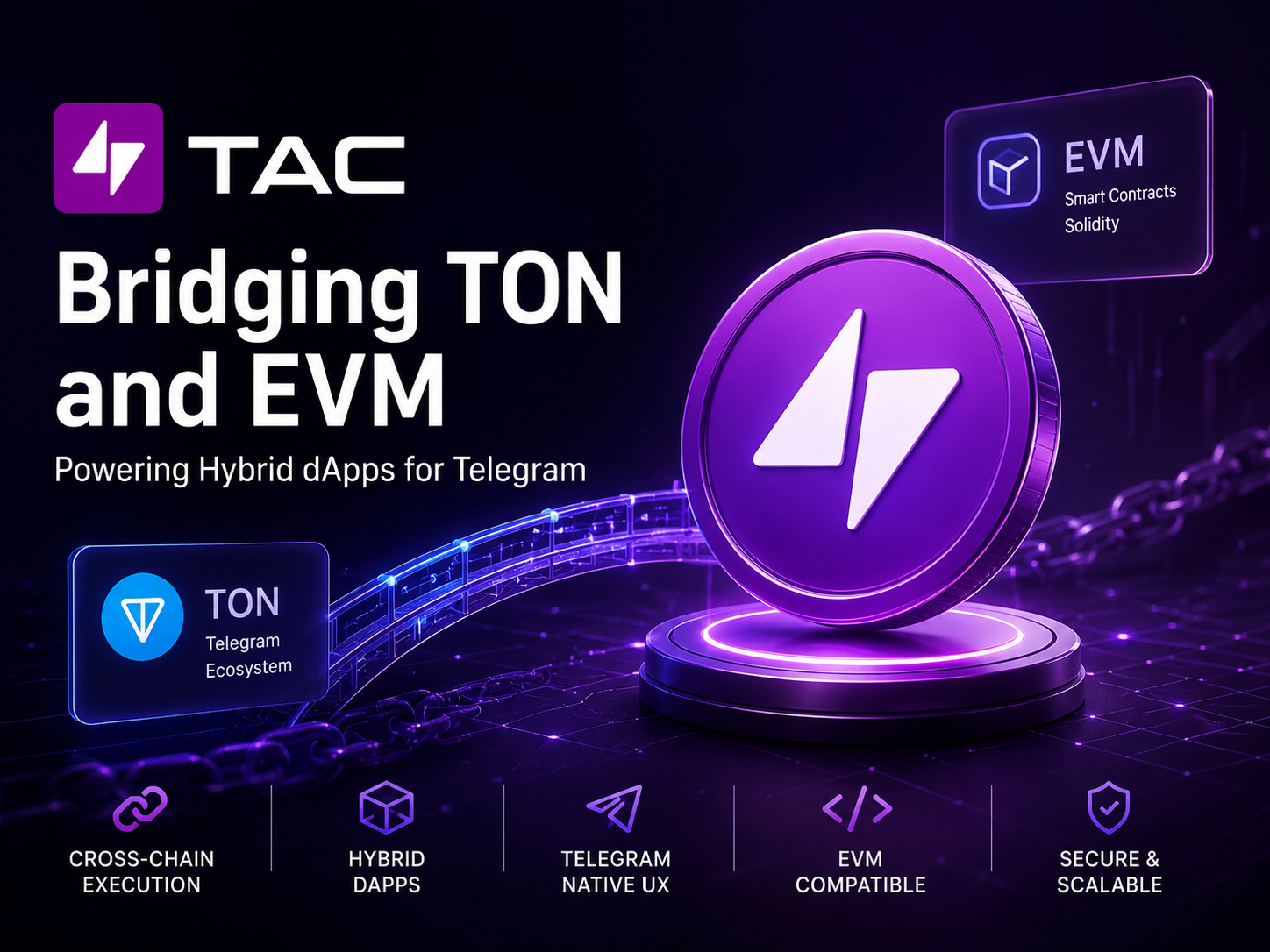
TAC serves as an EVM execution network bridging TON and Ethereum. Its primary function is to enable EVM applications to enter the TON ecosystem without disrupting the Telegram user experience. Official documentation describes TAC as Telegram’s EVM execution layer, highlighting its compatibility with Solidity and the EVM toolchain.
Operationally, when users initiate actions in Telegram Mini Apps or TON Wallets, requests are routed through the TON Adapter to the TAC network. The TAC EVM layer then executes Solidity contracts and returns results to TON users. This process relies on cross-chain message validation and execution mechanisms.
This structure allows Developers to integrate their applications into the Telegram user base without rewriting code, while users avoid learning new Wallets or navigating complex cross-chain workflows.
TAC Core Architecture and Operation
TAC’s core architecture comprises the TON Adapter, Sequencer Network, TAC EVM Layer, and Hybrid dApp. The system unifies message validation, EVM execution, and Telegram frontend into a single platform.
The TON Adapter manages cross-chain message transmission and validation, the Sequencer Network handles consensus and order, the TAC EVM Layer executes Solidity contracts, and the Hybrid dApp provides the Telegram user entry point.
| Module |
Function |
Role |
| TON Adapter |
Cross-chain message validation |
Connects TON and TAC |
| Sequencer Network |
Message sequencing and consensus |
Ensures execution order |
| TAC EVM Layer |
Solidity execution |
EVM app compatibility |
| Hybrid dApp |
Telegram frontend |
User entry point |
This architecture distinguishes TAC as more than a simple Bridge—it operates as a full EVM network. Developers can continue using Solidity, Hardhat, Remix, and other familiar tools while accessing Telegram’s robust user ecosystem.
How TON Adapter Connects TON and EVM
The TON Adapter is TAC’s key cross-chain component, responsible for message validation and state synchronization between TON and TAC EVM. It enables seamless cross-chain communication and coordinated execution.
In practice, users initiate transactions or service requests through Telegram Mini Apps or TON Wallets. The TON Adapter receives these messages and validates and sequences them via the Sequencer Network. The system then generates proofs and forwards the messages to the TAC EVM layer for Solidity contract execution. Results are returned to the TON ecosystem and user status is updated.
The TON Adapter is not just an asset Bridging tool; it is integral to the cross-chain execution system. This enables TAC to deliver Ethereum’s DeFi and EVM application capabilities while preserving the Telegram user experience.
How Hybrid dApps Operate in TAC
Hybrid dApps represent TAC’s core application paradigm, combining the Telegram frontend with the EVM backend. Officially, they are defined as applications that leverage Telegram for user entry and rely on TAC EVM for execution logic.
Users interact with Hybrid dApps via Telegram Mini Apps. The dApp transmits user requests to the TAC EVM network, where Solidity contracts execute on-chain logic such as Swap, Lending, or Staking. Results are returned to the Telegram interface, allowing users to benefit from EVM functionality without directly engaging with cross-chain processes.
This structure lowers the barrier for mainstream users to access EVM applications. Developers retain mature Ethereum logic while gaining access to Telegram’s user traffic and engagement opportunities.
The Role of TAC Tokens in the Network
TAC tokens are the core economic Assets of the TAC network, serving functions such as Gas payments, node Stake verification, governance participation, and ecosystem incentives. They underpin settlement for the EVM execution layer.
Users perform actions on the Telegram or TON side, which are mapped to TAC EVM execution processes. Gas fees are settled using TAC tokens, which are also allocated for network validation and resource consumption. Some tokens are directed toward validation, incentives, or governance.
Users may not need to interact directly with TAC tokens, but TAC remains the foundational Gas Asset for the EVM execution layer. Its value is linked to cross-chain activity, Hybrid dApp usage, and EVM operations within the TAC network.
Why Developers Choose TAC for Application Deployment
Developers are drawn to TAC for its EVM compatibility and access to the Telegram user ecosystem, significantly reducing migration costs for EVM applications entering TON.
Developers can continue to build with Solidity, Hardhat, Remix, and other familiar tools. Integration with Telegram is achieved via the TAC SDK and TON Adapter. Hybrid dApp frontends are deployed within the Telegram Mini App environment. This eliminates the need to rewrite Smart Contracts to serve TON users.
TAC does not require Developers to learn TON-native languages or rebuild liquidity systems. EVM compatibility streamlines onboarding for existing Ethereum projects into the Telegram ecosystem.
Primary Application Scenarios for TAC
TAC’s use cases center on DeFi, payments, Telegram Mini Apps, and Hybrid dApps, focusing on bringing Ethereum application capabilities to Telegram users.
Users can access DeFi features—Swap, Lending, Staking—directly through Telegram. Hybrid dApps transmit interaction requests to the TAC EVM network, where Solidity contracts execute on-chain logic. Results are delivered in Telegram’s native interface.
This application structure positions TAC as more than a cross-chain tool—it is the gateway for EVM applications within Telegram, enabling TON users to access Ethereum’s ecosystem while retaining their Telegram experience.
Differences Between TAC and Traditional Cross-Chain Protocols
TAC differs from traditional cross-chain protocols by prioritizing cross-chain execution and Telegram integration over simple asset transfer.
| Comparison Dimension |
TAC |
Traditional Cross-Chain Protocol |
| Core Positioning |
EVM execution layer |
Asset Bridge |
| User Entry |
Telegram Mini App |
Multi-chain Wallet |
| Contract Environment |
Solidity EVM |
Multi-chain compatibility |
| Cross-chain Focus |
Message execution |
Asset transfer |
| Application Structure |
Hybrid dApp |
Independent dApp |
Traditional cross-chain protocols emphasize asset liquidity, while TAC focuses on execution environment and application entry. TAC embeds EVM logic into Telegram and TON user interactions.
TAC Advantages and Potential Limitations
TAC’s strengths include EVM toolchain compatibility, access to the Telegram user ecosystem, and lower DeFi adoption barriers via Hybrid dApps. Its core value is connecting TON users to Ethereum applications.
Developers can deploy in Telegram without rewriting Solidity contracts, and users avoid complex cross-chain operations. This boosts migration efficiency and user onboarding.
Potential limitations include the degree of Sequencer decentralization, cross-chain execution complexity, and reliance on TON and Telegram growth. If expansion of Telegram Mini Apps or the TON ecosystem slows, TAC network demand may decrease.
Summary
TAC is an EVM execution network connecting TON and Ethereum, comprised of the TON Adapter, Sequencer Network, TAC EVM Layer, and Hybrid dApp. Through cross-chain messaging, Telegram users gain direct access to the Ethereum application ecosystem.
TAC’s value lies in EVM toolchain compatibility, reduced migration costs, and embedding EVM capabilities into the Telegram user base via Hybrid dApps. Its development depends on the continued growth of Telegram, TON, and cross-chain applications.
FAQ
What Is TAC
TAC is an EVM execution network linking TON and Ethereum, allowing Telegram users to access Solidity applications and the EVM ecosystem through TON.
What Is the Role of the TON Adapter
The TON Adapter manages cross-chain message validation and synchronization between TON and TAC EVM, enabling user requests to be processed by the TAC network.
What Does Hybrid dApp Mean
Hybrid dApp refers to applications that combine Telegram frontends and EVM backends, where users interact in Telegram and Solidity contracts execute on the TAC network.
What Is the Role of TAC Tokens
TAC tokens are used for network Gas payments, node Stake verification, governance participation, and ecosystem incentives, serving as the core economic Asset of TAC EVM.
What Is the Difference Between TAC and Traditional Bridges
Traditional Bridges focus on asset transfer, while TAC prioritizes cross-chain execution and Telegram integration, enabling EVM applications to enter the TON user ecosystem.