In today’s AI industry, data acquisition and annotation account for a large share of development resources. Yet traditional models still face problems such as data silos, inconsistent annotation quality, and centralized control. Through a decentralized architecture and data authentication protocol, Tagger aims to solve the core pain points of data trustworthiness and circulation efficiency.
From the perspective of blockchain and digital assets, Tagger is not merely a data tool. It is also “data economy infrastructure.” It turns data production, annotation, and validation into measurable network activities, allowing data to become a tradable and incentive-driven value asset while advancing deeper integration between AI and Web3.
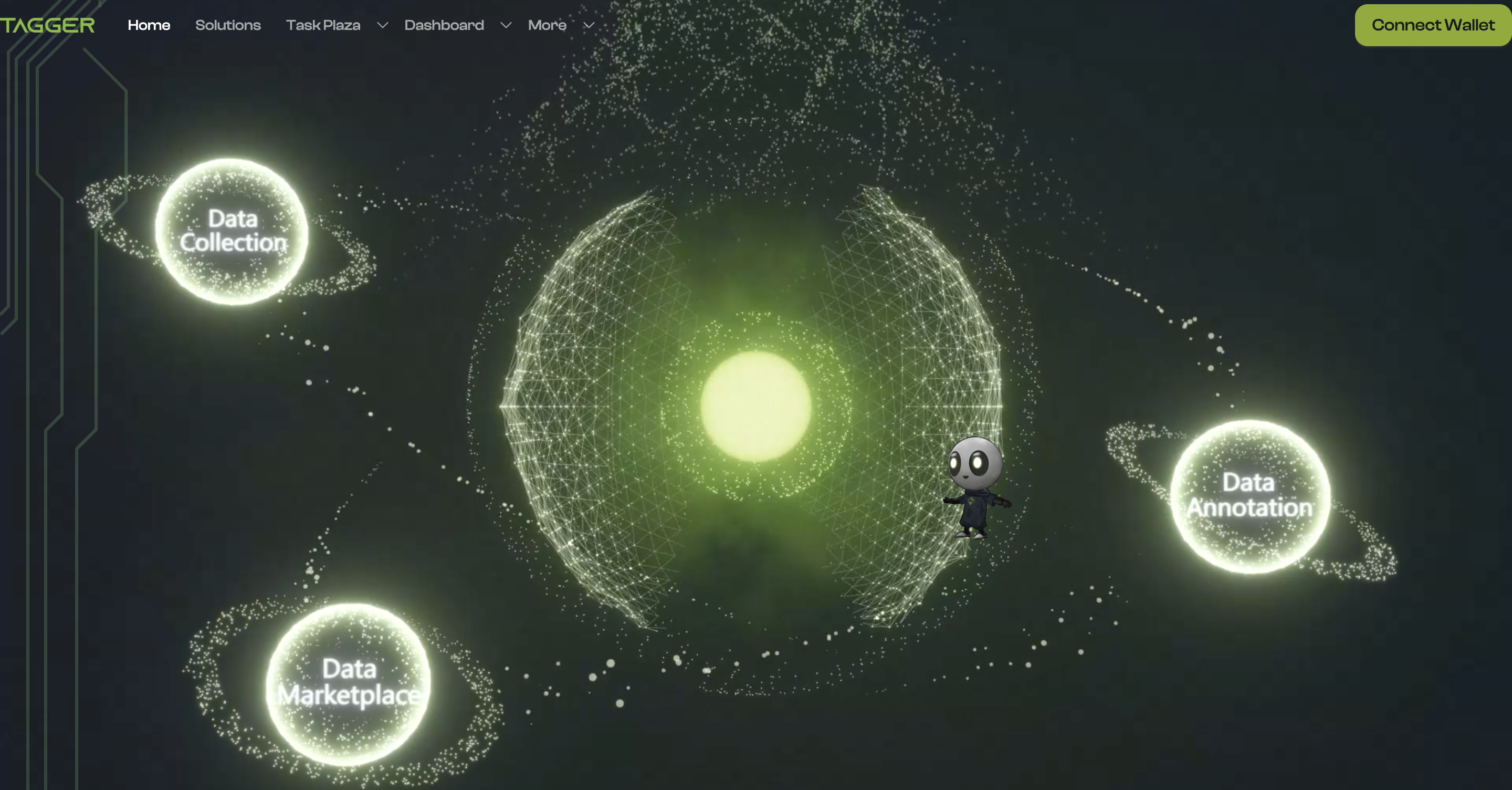
Source: tagger.pro
What Is Tagger (TAG)
Tagger is a decentralized platform built around the AI data lifecycle, covering data collection, annotation, validation, management, trading, and other key stages. Its core goal is to use Web3 technology to create a permissionless data collaboration network.
Unlike traditional data platforms, Tagger uses blockchain technology to establish a data authentication mechanism, making data sources, annotation processes, and usage rights verifiable. This structure helps improve data transparency and trustworthiness.
Within the system, participants can join the network as data providers, annotators, or validators, earning rewards by contributing data or completing tasks. This crowdsourcing model significantly expands data production capacity.
Overall, Tagger frees the AI data processing workflow from centralized platforms and builds an open, collaborative, decentralized data network.
Tagger’s Core Positioning: An AI Data Annotation and Data Value Network
Tagger’s core positioning is to connect AI data demand with global data supply, forming an open market for data annotation and circulation. In AI training, high-quality data directly determines model performance, which makes data a critical resource.
The traditional data annotation industry is usually dominated by a small number of companies and often suffers from high costs, low efficiency, and limited transparency. Through decentralized crowdsourcing, Tagger distributes annotation tasks to participants around the world, improving efficiency while reducing costs.
In addition, Tagger introduces the concept of a data value network. Data is not only used to train models; it can also circulate and be traded in a marketplace. This changes data from a “consumable” into an “asset.”
From a broader perspective, Tagger is building a complete ecosystem that connects data production, processing, and consumption, making AI data supply and demand more efficient and fair.
Tagger’s Technical Architecture: Data Annotation, Validation, and Task Distribution Mechanisms
Tagger’s technical architecture consists of a data collection layer, annotation layer, validation layer, and trading layer, forming a complete closed loop for data processing. Each layer is coordinated through blockchain and smart contracts.
For task distribution, the system assigns annotation tasks to suitable participants based on data type and demand. This mechanism resembles a decentralized task marketplace and improves the efficiency of resource matching.
At the validation layer, Tagger uses multi-party validation and algorithmic checks to ensure the accuracy of annotation results. The data authentication protocol records the annotation process, making the results traceable.
The overall architecture emphasizes “trusted data + transparent processes,” providing high-quality data sources for AI models while lowering trust costs.
Tagger’s Operating Mechanism: How Data Is Annotated, Validated, and Delivered
Tagger’s operating mechanism is essentially a “data production pipeline” that converts raw data into high-quality data assets suitable for AI training. The process usually begins with data upload. Data providers, such as enterprises or developers, submit raw data to the network and define annotation rules, including classification standards, annotation granularity, and quality requirements. This stage determines the structure of the data task and directly affects the usability and value of the final dataset.
During task execution, Tagger uses a decentralized task distribution mechanism to break down annotation needs and assign them to participants around the world. Unlike the traditional outsourcing model, this crowdsourced structure can mobilize a large workforce in a short period of time and enable large-scale data processing. At the same time, the platform may combine AI-assisted tools, such as pre-annotation or automated classification, to improve annotation efficiency and reduce labor costs, making human-machine collaboration a core production method.
Data validation is a key part of Tagger’s mechanism. The system usually adopts a multi-layer validation process, including consistency checks among multiple annotators, cross-review, and AI model-assisted detection. This structure can effectively reduce error rates and prevent single-point mistakes from affecting overall data quality. For some critical data, a reputation mechanism or staking mechanism may also be introduced, allowing high-quality contributors to receive greater weight and thereby improving the overall credibility of the data.
Finally, validated data is organized and delivered to the requester. Key metadata or hash records may also be written on-chain to enable traceability and auditability. This closed loop of labeling, validation, and on-chain recording turns data from a one-time resource into a reusable and verifiable long-term asset, creating a complete system for data production and delivery.
The Functions and Role of the TAG Token: Payment, Incentives, and Network Coordination
TAG is the core economic medium in the Tagger network. Its role is not limited to payment; it also serves as the incentive engine for the entire data production network. At the usage level, data requesters need to use TAG to publish annotation tasks and obtain processed data. This makes TAG the direct pricing unit for data services, connecting both the demand and supply sides.
At the incentive level, TAG is used to reward nodes that participate in data annotation and validation. Annotators earn token rewards by completing tasks, while validators receive additional incentives by providing quality control services. This mechanism ensures that the network always has enough participants to maintain data production efficiency. At the same time, reward structures are usually adjusted dynamically based on factors such as task difficulty and quality scores, allowing higher-quality contributions to receive higher returns.
TAG also carries certain governance and security functions. For example, participants can stake TAG to improve their reputation level or take part in key decisions, thereby influencing task distribution or network rules. This design combines economic incentives with behavioral constraints, helping the network maintain a degree of order and reliability in an open environment.
Overall, TAG builds a circular structure of “data demand → annotation production → incentive distribution.” The more data there is and the higher the demand, the stronger token liquidity and usage frequency become, forming an economic system driven by the value of data.
Tagger’s Use Cases: AI Training, Data Crowdsourcing, and Web3 Data Markets
Tagger’s use cases mainly revolve around AI data demand, especially the strong need for high-quality annotated data in machine learning model training. Whether for image recognition, speech processing, or natural language understanding, large volumes of structured data are required as the foundation for training, and Tagger offers a scalable method of data production.
In data crowdsourcing, Tagger gathers global participants through a decentralized network, so data annotation no longer depends on a single institution. This model not only reduces costs but also significantly improves processing speed. For example, in scenarios that require large-scale image classification or speech transcription, crowdsourcing mechanisms can complete tasks quickly while validation mechanisms help ensure quality.
In addition, Tagger can serve as part of a Web3 data marketplace, allowing data to become a tradable asset. Data providers can sell or license their data through the platform, while users can obtain specific datasets based on their needs. This structure breaks down traditional data silos and enables data to flow across different applications, improving overall utilization efficiency.
As the integration of AI and blockchain technology continues to deepen, Tagger’s use cases may expand into more fields, such as autonomous driving data training, medical data annotation, and industrial data processing. These scenarios place higher demands on data quality and scale, and decentralized models offer a new path forward.
Traditional data annotation platforms usually use a centralized model, where companies manage task distribution, data storage, and revenue allocation. Although this structure is simpler to manage, it can easily lead to data monopolies, opaque revenue distribution, and higher barriers to participation. Users often cannot truly control data ownership, and most of the value of the data remains concentrated within the platform itself.
By contrast, Tagger redefines the data annotation model through a decentralized network. Any user can participate in data production and validation, lowering entry barriers and expanding the scale of supply. At the same time, data records and transaction processes can be made transparent through blockchain, reducing information asymmetry.
In terms of data ownership, Tagger places greater emphasis on “user control.” Data providers can decide how their data is used and licensed, rather than handing everything over to the platform. This mechanism not only improves data security but also allows data to become a genuinely tradable digital asset.
Overall, Tagger represents a shift from “platform-driven” to “network-driven.” Data is no longer tied to a single institution. Instead, it is produced, validated, and traded through decentralized protocols, creating a more open data ecosystem.
Tagger’s Advantages, Limitations, and Common Misconceptions
Tagger’s core advantage lies in its decentralized structure and incentive mechanism, which make the data production process more open and efficient. Through crowdsourcing, the network can quickly expand the scale of data supply, while validation mechanisms help ensure quality. In addition, data authentication and on-chain records strengthen data credibility, making it more suitable for high-value AI applications.
However, this model also brings certain challenges. First, annotation quality control is more complex in a decentralized environment and requires multi-layer validation mechanisms and reputation systems. Second, participants may vary significantly in skill level, which can affect data consistency. In addition, task distribution and coordination costs are relatively high, placing greater demands on system design.
At the economic level, the incentive mechanism needs to strike a balance between “cost control” and “participant returns.” If rewards are too low, participation may suffer. If rewards are too high, costs may rise. As a result, designing a sustainable economic model is a key issue for the long-term development of this type of system.
One common misconception is to view Tagger simply as a “data crowdsourcing platform.” In reality, it is closer to a complete data economy infrastructure that covers data production, validation, circulation, and value distribution. In the long run, its development will depend on whether it can establish a stable balance among efficiency, quality, and incentives.
Conclusion
Tagger (TAG) combines blockchain with AI data processing to build a decentralized data annotation and trading network. Its core idea is to transform data from a “passive resource” into a “verifiable and tradable asset,” while using token incentives to drive global collaborative production.
This model not only optimizes the AI data supply chain but also provides infrastructure support for the Web3 data economy. As AI’s demand for high-quality data continues to grow, networks like Tagger are likely to play an increasingly important role in future data markets.
FAQ
What problem does Tagger (TAG) mainly solve?
It mainly addresses low efficiency in AI data annotation, data silos, and insufficient data trustworthiness.
What is the role of the TAG token?
It is used to pay for data annotation, incentivize participants, and support network operations.
Is Tagger only used for AI data?
It mainly serves AI data needs, but it can also be extended to other scenarios that require data processing and validation.
What are the advantages of decentralized data annotation?
It can reduce costs, improve efficiency, and enhance data transparency and verifiability.
Is Tagger’s data secure?
Through its data authentication protocol and blockchain technology, it enables verifiable data and secure management.







