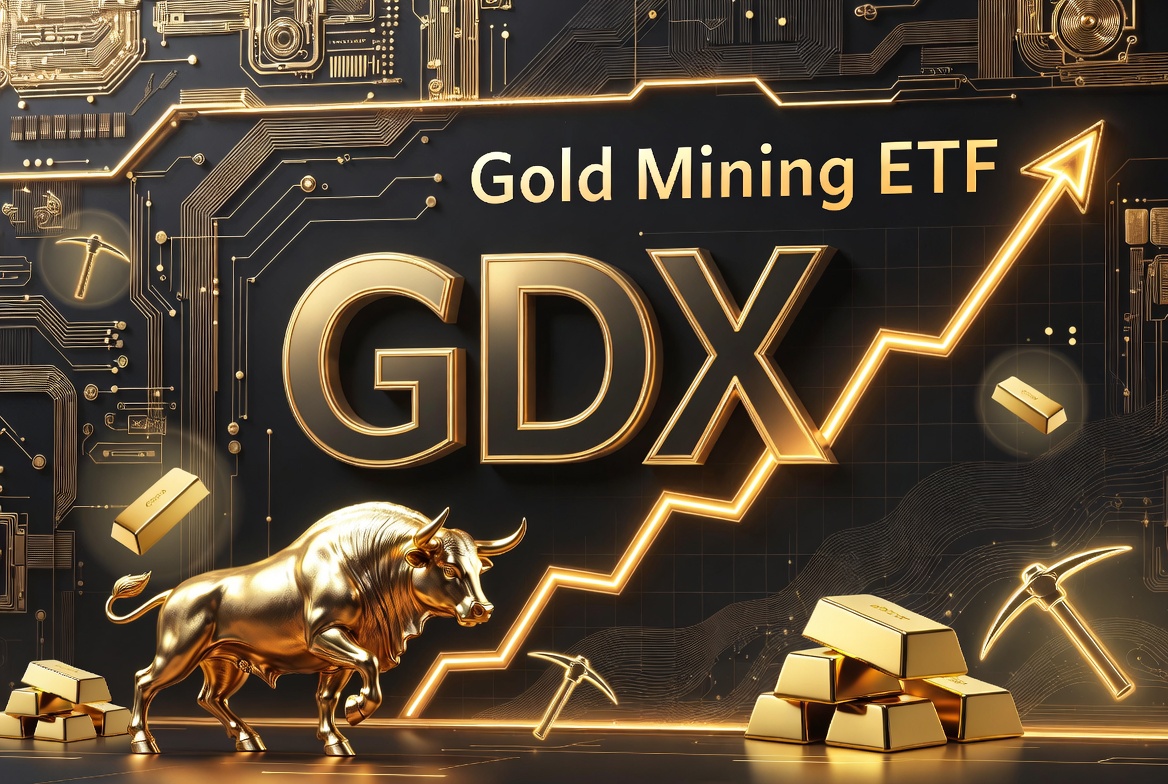
The core logic of a gold mining ETF lies in using mining companies as "profit amplifiers" for changes in the gold price. When gold prices rise, some miners' profits can increase by an even larger margin, causing GDX to often exhibit more pronounced fluctuations than gold itself.
GDX's market performance is influenced not only by gold prices, but also by stock market moves, energy costs, global interest rates, and risk aversion. As a result, GDX carries dual characteristics of both a gold asset and a stock asset.
What Is the Core Positioning of GDX?
GDX is designed to serve as a concentrated investment vehicle for global gold mining companies.
Structurally, GDX does not directly hold gold; instead, it holds shares in major gold miners. This makes GDX more akin to a gold industry stock index.
First, the fund screens gold mining companies based on index rules.
Next, the ETF allocates its holdings based on market capitalization and liquidity.
Then, changes in mining stock prices affect the ETF's net asset value (NAV).
Finally, GDX becomes a key industry ETF linking the gold market and the stock market.
This structure means GDX's volatility is typically higher than that of physical gold.
Why Does GDX Track Gold Mining Companies?
GDX tracks gold mining companies primarily because miner profitability is usually highly correlated with gold prices.
Gold miners' revenue comes mainly from gold sales, so rising gold prices generally improve their profit margins.
First, miners continuously extract and produce gold.
Then, the gold is refined and sold on the global market.
Next, sales revenue affects the company's cash flow and profitability.
Finally, the market adjusts miner valuations based on profit expectations.
Since GDX holds shares in many gold miners, the ETF typically fluctuates with gold price changes.
This mechanism means GDX is best described as a "collection of gold industry stocks."
GDX's holdings structure revolves primarily around large global gold miners.
Major gold producers usually have more stable mine reserves and production capacity, so they command a higher weight in the ETF.
First, the index provider screens eligible gold mining companies.
Then, the fund allocates holdings based on market cap, industry type, and liquidity.
Next, the ETF rebalances periodically to maintain tracking accuracy.
The table below shows GDX's typical holdings structure:
| Holdings Type |
Main Characteristics |
| Large Gold Miners |
Stable production |
| Global Mine Operators |
Geographic diversification |
| Mid-Sized Mining Companies |
Higher volatility |
| Gold Mine Developers |
Strong growth profile |
This structure means GDX functions essentially as a global gold mining industry index.
How Does the Revenue Model of Gold Mining Companies Work?
The revenue model of gold mining companies is fundamentally based on the spread between gold sales revenue and extraction costs.
Miners must continuously invest in equipment, labor, energy, and mine maintenance, so their profitability is sensitive to cost structures.
First, miners extract gold from mines.
Then, the gold is processed and refined before being sold.
Next, gold sales revenue is reduced by mining and operating costs.
Finally, the remainder constitutes corporate profit.
This mechanism means that when gold prices rise, miner profits can often be amplified.
For example, when gold prices increase, some miners' profit growth rates may exceed the percentage rise in gold.
How Do Gold Price Changes Affect GDX Volatility?
Gold price changes directly drive GDX volatility because miner profitability is heavily dependent on the gold market price.
First, rising gold prices boost miners' sales revenue.
Then, if energy and operating costs remain stable, profit margins usually expand.
Next, the market reassesses miners' future earnings potential.
Finally, rising mining stock prices push GDX's NAV higher.
However, when the gold market declines, miners' profit margins can contract just as quickly.
This structure means GDX tends to amplify gold market volatility.
Therefore, GDX is often viewed as an industry ETF with "gold leverage characteristics."
What Is the Difference Between GDX and a Gold ETF?
The biggest difference between GDX and a gold ETF lies in their underlying assets.
Gold ETFs typically directly hold gold, while GDX holds shares of gold mining companies.
First, gold ETFs focus purely on gold price movements.
Then, GDX is influenced not only by gold prices but also by stock market conditions and corporate operations.
Next, operational risks in mining—such as accidents, policy changes, and rising energy costs—also affect GDX volatility.
The table below summarizes the key differences:
| Comparison Dimension |
GDX |
Gold ETF |
| Underlying Asset |
Mining stocks |
Gold |
| Volatility |
Higher |
Relatively lower |
| Source of Returns |
Corporate profits |
Gold price changes |
| Stock Market Influence |
Significant |
Weak |
Thus, GDX is more of a gold industry stock investment vehicle.
What Are the Main Use Cases for GDX?
GDX is primarily used during gold trading cycles, risk-off periods, and inflation trades.
Some traders use GDX to gain exposure to gold market rallies. Since miner profits typically magnify gold price moves, GDX can be more volatile than gold itself.
Risk-off environments are also a key use case. During periods of elevated global economic risk, gold and gold mining ETFs tend to attract significant attention.
Institutional investors often use GDX for sector allocation, viewing gold miners as a key component of commodity-related assets.
Meanwhile, multi-asset trading platforms are increasingly offering CFD products tied to gold ETFs. Products like Gate CFD are expanding digital asset platforms' coverage of gold, ETFs, and global market assets.
However, it is worth noting that GDX is already a high-volatility industry ETF. When combined with leverage or CFD structures, overall market risk typically increases accordingly.
Summary
GDX is one of the most representative gold mining ETFs globally, reflecting the gold industry's performance by holding shares in gold miners.
Unlike direct gold holdings, GDX emphasizes miner profitability, production structure, and stock market volatility. As a result, GDX's market volatility is usually higher than that of gold itself.
Gold prices, the U.S. dollar trend, global interest rates, and risk sentiment all continuously affect GDX's market structure and capital flows.
FAQ
What is GDX?
GDX is a gold mining ETF that primarily holds shares in global gold mining companies to track the overall performance of the gold mining industry.
Why does GDX move with gold price fluctuations?
Gold miners' revenue comes mainly from gold sales, so changes in gold prices typically affect their profits and stock prices.
What is the difference between GDX and a gold ETF?
A gold ETF typically tracks the gold price directly, while GDX holds mining stocks, making it sensitive to corporate operations and stock market conditions.
Why is GDX's volatility usually greater than gold's?
Mining company profits are amplified by gold price changes, so GDX tends to show more pronounced swings than gold itself.
Is GDX a high-risk ETF?
Yes, GDX is a sector-specific ETF influenced by both the gold market and the stock market, so its volatility is typically higher than that of a broad index ETF.