Analyst Predicts XRP Could Surge to $15 as Futures Volume Hits Record High

Last Updated 2026-04-03 20:41:08
Reading Time: 1m
XRP set a new record on CME with $235 million in futures trading volume. Analysts believe that if XRP surpasses critical resistance levels, its price could target $15. This article delivers an in-depth analysis, combining real-time market data with technical insights.

XRP Market Overview: Strong Rebound in a Mixed Sentiment Environment

XRP, introduced by Ripple Labs, is a cryptocurrency designed chiefly for cross-border payments. With its rapid settlement times and low transaction costs, XRP has gained widespread adoption among traditional financial institutions for moving funds globally. Since the bull market that kicked off at the end of 2023, XRP has enjoyed multiple rallies. By mid-July 2025, heightened institutional interest has accelerated positive market sentiment even further.

Recently, XRP has traded in a range between $3.40 and $3.60. Trading volumes have climbed and investors are increasingly optimistic about its outlook.

CME Futures Volume Sets New Record—Are Institutions Ramping Up?

According to Finance Magnates, on July 11, 2025, XRP futures volume on the Chicago Mercantile Exchange (CME) soared to $235 million, marking an all-time high. This milestone signals that institutional investors from the traditional finance sector are taking a much more active role in the XRP derivatives market.

CME data show approximately 9,100 XRP futures contracts were traded that day, representing over 82 million units of XRP at spot equivalence. This significant trading activity demonstrates institutional confidence and could serve as a major catalyst for price momentum.

Analyst’s $15 Price Target Explained: What Needs to Happen?

Leading analyst Austin Hilton has stated that XRP is on the “eve of a second breakout.” According to Hilton, if XRP can decisively break through the critical $3.66 resistance and hold above $4.00, the next targets could be $5 or $10, and in the most bullish scenario, $15 in the coming weeks.

He underscores that this projection is founded on the following conditions:

  • The broader crypto market continues its upward trajectory;
  • The legal battle between Ripple and the U.S. SEC reaches a final resolution;
  • Institutions keep buying, while retail investor sentiment remains highly positive.

Hilton also warns that unless XRP surpasses its previous all-time high of $3.84, there remains a significant risk of a sharp pullback.

XRP Price Levels and Technical Analysis
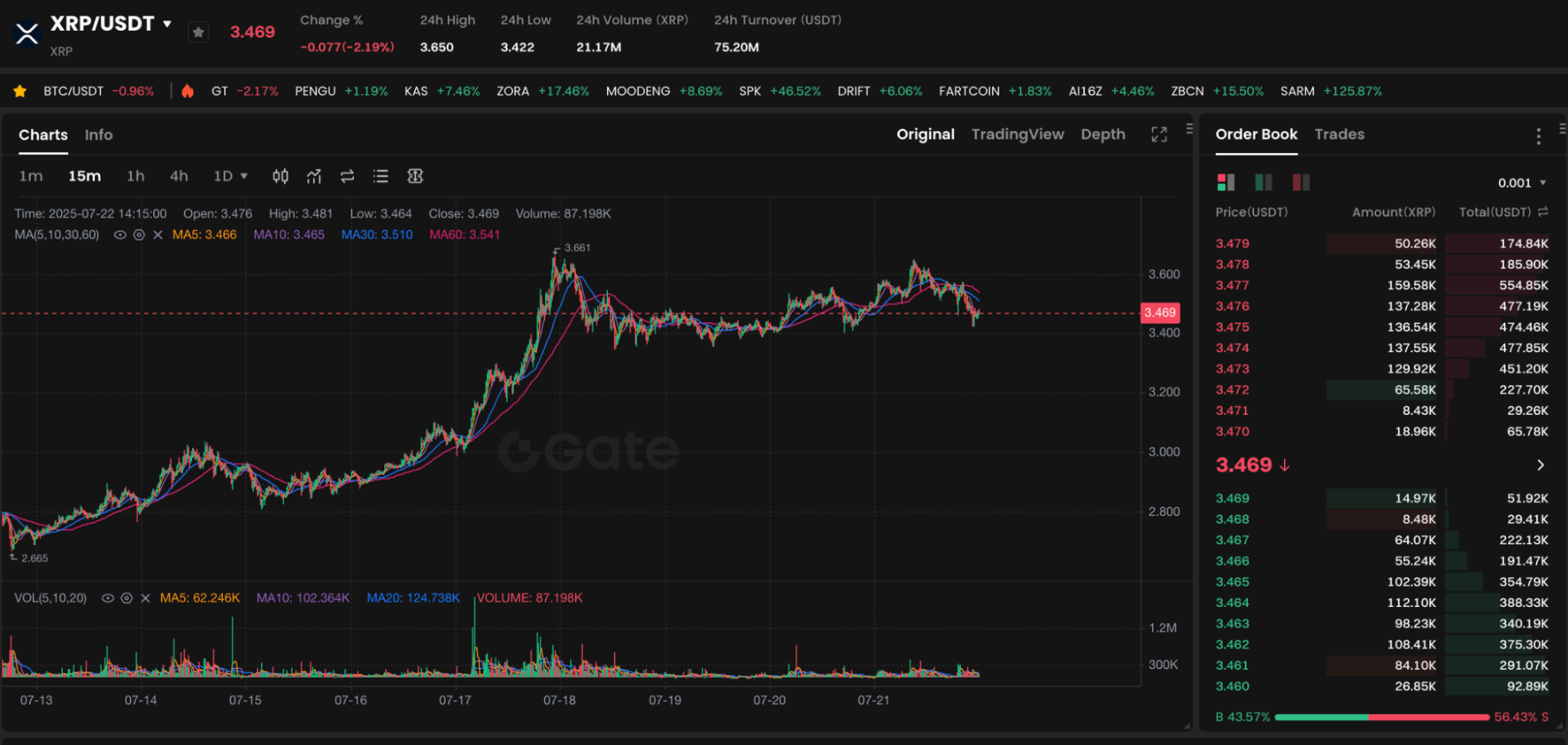

Chart: https://www.gate.com/trade/XRP_USDT

From a technical viewpoint, XRP has successfully broken out above the upper trendline of a symmetrical triangle pattern formed over the past two weeks. It rebounded after retesting support at $3.55. In the near term, the market is focused on several key levels:

  • Support levels: $3.40 (trendline support), $3.20 (previous range low);
  • Resistance levels: $3.66 (recent high), $3.84 (all-time high);
  • If XRP clears $3.84, subsequent upside targets include $5.00, $10.00, and potentially $15.00.

The daily RSI has cooled from overbought territory and now hovers near 65. This indicates room for further upward movement, though short-term corrections remain possible.

Risk Warning and Investment Guidance

For new investors bullish on XRP, consider the following:

  • Start with a light position and watch for a firm breakout above $3.66;
  • If the breakout is confirmed, add to your position incrementally and set clear take-profit levels;
  • If XRP drops below $3.20, view this as a short-term top and promptly execute stop-loss orders;

Consider the following risk factors:

  • The legal uncertainty surrounding Ripple’s litigation with the SEC;
  • Macro risks, such as potential Federal Reserve rate hikes or a sudden reversal in market sentiment, which could weigh on prices;
  • XRP needs to secure a sustained hold above $4.00 to draw in substantial institutional capital over the long term.
Author: Max
Disclaimer
* The information is not intended to be and does not constitute financial advice or any other recommendation of any sort offered or endorsed by Gate.
* This article may not be reproduced, transmitted or copied without referencing Gate. Contravention is an infringement of Copyright Act and may be subject to legal action.

Related Articles

AI-Native Settlement Layers: How United Stables Is Building the Next Financial Rail
Beginner

AI-Native Settlement Layers: How United Stables Is Building the Next Financial Rail

Stablecoins were originally designed as dollar substitutes within exchanges, primarily used for asset pricing and trade settlement. As on-chain financial ecosystems have matured, their role has expanded beyond simple payments to include collateral assets, cross-chain liquidity mediums, and unified settlement units. In particular, as AI systems and automated agents begin to participate directly in economic activity, demand has risen sharply for programmable value units capable of instant settlement. This shift is pushing stablecoins toward the role of foundational financial infrastructure.
2026-03-25 03:16:17
The ve(3,3) Flywheel Explained: How AERO Tokenomics Powers Aerodrome’s DeFi Economy
Beginner

The ve(3,3) Flywheel Explained: How AERO Tokenomics Powers Aerodrome’s DeFi Economy

In the competition for DeFi liquidity, high-inflation mining alone is no longer enough to build lasting advantages. Aerodrome applies the ve(3,3) economic model to redesign token emissions, voting mechanisms, and revenue distribution, creating a liquidity flywheel centered on governance and cash flow. This article examines AERO tokenomics, the veAERO locking mechanism, and protocol revenue models to explain how Aerodrome builds a sustainable DeFi economic system.
2026-03-25 06:41:58
How Does PAXG Work? In-Depth Overview of the Physical Gold Tokenization Mechanism
Beginner

How Does PAXG Work? In-Depth Overview of the Physical Gold Tokenization Mechanism

PAXG (Pax Gold) is a tokenized asset backed by physical gold, issued by the fintech company Paxos and traded on the Ethereum blockchain as an ERC-20 token. The core concept is to tokenize physical gold on-chain, with each PAXG token representing ownership of a certain amount of gold. This structure enables investors to hold and trade gold in the form of a digital asset.
2026-03-24 19:12:51
Aerodrome Tokenomics: How ve(3,3) Powers Base's Most Profitable DEX
Beginner

Aerodrome Tokenomics: How ve(3,3) Powers Base's Most Profitable DEX

AERO is the native token of Aerodrome Finance, a core decentralized exchange and liquidity protocol in the Base ecosystem. It is primarily used for liquidity incentives and ecosystem operations. veAERO is a governance NFT that users receive by locking AERO, representing both voting power and the right to share protocol revenue. Through a dual track structure of AERO as a utility token and veAERO as a governance credential, Aerodrome separates liquidity usage value from long term governance power, allowing participants to act as liquidity providers, governance decision makers, and revenue sharers within the same system.
2026-03-25 06:40:31
How is the price of PAXG determined? Pegging mechanism, trading depth, and influencing factors
Beginner

How is the price of PAXG determined? Pegging mechanism, trading depth, and influencing factors

PAXG (Pax Gold) is a tokenized asset backed by physical gold reserves, launched by fintech firm Paxos and issued as an ERC-20 token on the Ethereum blockchain. The core concept is to digitally represent real-world gold assets, allowing investors to hold and trade gold via the blockchain network. Because each PAXG token corresponds to a specific quantity of physical gold, its price is theoretically expected to closely track the global gold market.
2026-03-24 19:11:40
Hybrid Collateral Stablecoins: Inside United Stables' Stability and Yield Architecture
Beginner

Hybrid Collateral Stablecoins: Inside United Stables' Stability and Yield Architecture

In the early stages of the crypto market, traditional stablecoins mainly relied on single-reserve or single-collateral models. Their primary focus was price stability and payment convenience, which allowed them to become foundational tools for on-chain trading and capital flows. As the market has entered a more mature financial phase, however, this structure has begun to reveal limitations, including high concentration risk and the difficulty of balancing liquidity with yield. These constraints have driven the evolution toward multi-layer collateral and portfolio-based designs, such as the dual-layer hybrid collateral architecture proposed by United Stables, which seeks to redefine the underlying logic of stable assets.
2026-03-25 03:17:39





