El mercado de publicidad digital ha estado dominado durante años por grandes plataformas centralizadas, donde los anunciantes adquieren tráfico publicitario a través de estas plataformas, que dependen de los datos de comportamiento de los usuarios para una segmentación precisa. En este modelo, la plataforma publicitaria es el principal distribuidor de rentabilidad, mientras que los usuarios, aunque aportan su comportamiento de navegación y valor de atención, rara vez reciben recompensas directas. Con el creciente enfoque en la protección de la privacidad y la transparencia de datos, las limitaciones de los modelos tradicionales de publicidad son cada vez más evidentes.
La evolución de la tecnología Blockchain ha impulsado la innovación en los modelos publicitarios, y el ecosistema Web3 experimenta con mecanismos basados en tokens para rediseñar la lógica de distribución de rentabilidad. Basic Attention Token (BAT) es un ejemplo destacado, estableciendo un nuevo flujo de valor publicitario a través del navegador Brave y ofreciendo una estructura de incentivos para anunciantes, usuarios y creadores de contenido, diferente a las plataformas tradicionales.
BAT vs Google Ads: visión general y diferencias clave
El modelo publicitario de BAT gira en torno al ecosistema digital impulsado por el navegador Brave. Los anunciantes pagan la colocación de anuncios con BAT, los usuarios ganan recompensas BAT al ver anuncios y los creadores de contenido reciben rentabilidad mediante propinas de usuarios y reparto de ingresos publicitarios. En este sistema, BAT actúa como medio de liquidación del valor publicitario.
La diferencia esencial de este modelo es la redistribución de la rentabilidad publicitaria entre anunciantes, usuarios y creadores de contenido. La atención del usuario se valora como un activo cuantificable, haciendo que los usuarios sean participantes activos en la distribución de rentabilidad, no solo receptores de anuncios.
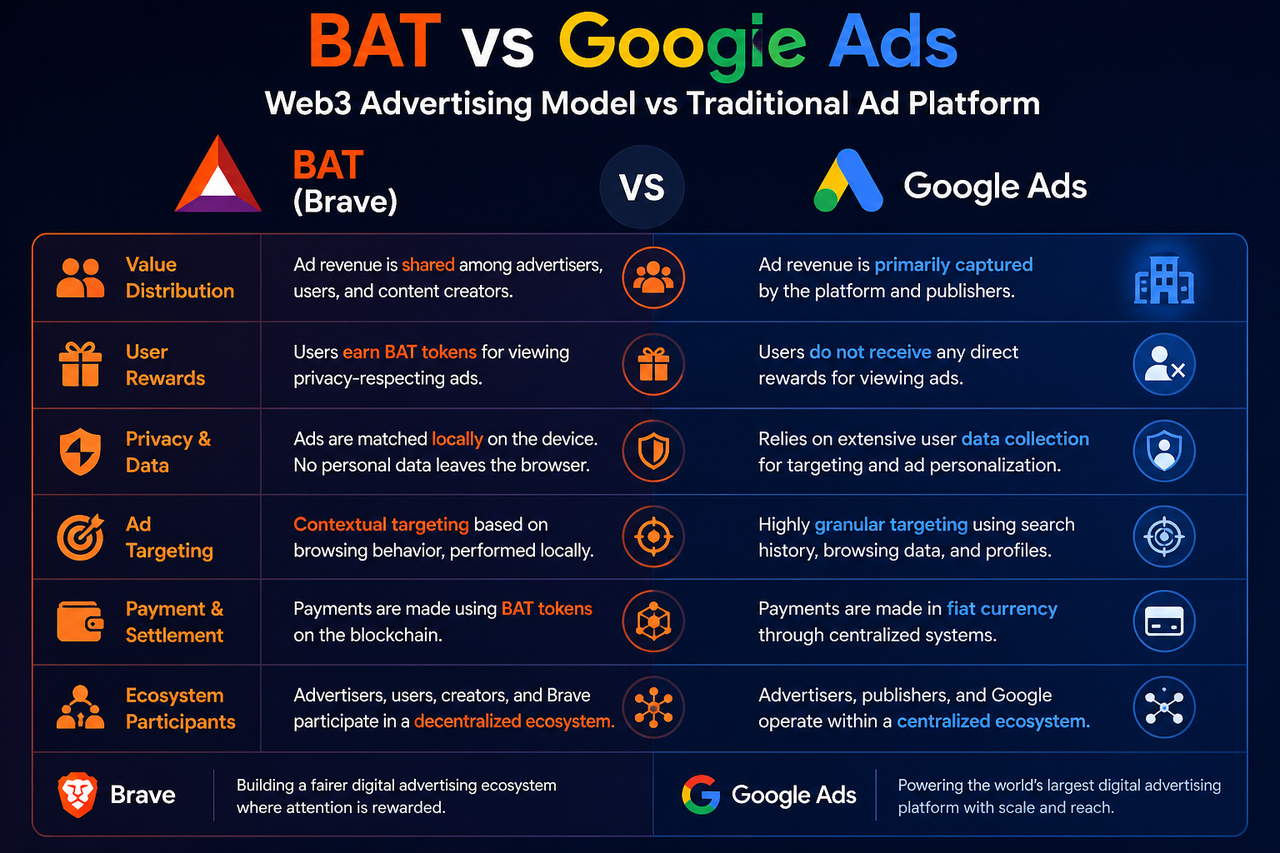
Google Ads es una plataforma publicitaria centralizada creada por Google. Los anunciantes pujan por la colocación de anuncios, y Google utiliza los datos de búsqueda y navegación de los usuarios para mostrar anuncios segmentados, cobrando tarifas por clics o impresiones.
En este modelo, la rentabilidad publicitaria se concentra principalmente entre la plataforma y los proveedores de tráfico, sin que los usuarios reciban recompensas directas por ver anuncios. Las principales ventajas de Google Ads son su enorme base de usuarios y su sistema de entrega de anuncios maduro y orientado a los datos.
| Dimensión de comparación |
BAT |
Google Ads |
| Distribución de rentabilidad |
Compartida entre usuarios, creadores y plataforma |
Dominada por la plataforma |
| Recompensas para usuarios |
Los usuarios pueden ganar BAT |
Sin recompensas directas para usuarios |
| Protección de la privacidad |
Coincidencia de anuncios local |
Recopilación centralizada de datos |
| Cobertura publicitaria |
Ecosistema Brave |
Red publicitaria de Google |
| Eficiencia publicitaria |
Mejora la eficiencia de distribución de valor |
Mejora la eficiencia de entrega de tráfico |
¿Cómo difieren BAT y Google Ads en los mecanismos de distribución de rentabilidad?
Una diferencia clave entre BAT y Google Ads es la lógica de distribución de rentabilidad. BAT utiliza un mecanismo de token para asignar la rentabilidad publicitaria entre anunciantes, usuarios y creadores de contenido, asegurando que el valor llegue a todos los participantes del ecosistema.
Por el contrario, el modelo de Google Ads canaliza los pagos de los anunciantes principalmente hacia la plataforma de Google y los editores, sin que los usuarios, como espectadores de anuncios, participen en la distribución de rentabilidad. En resumen, BAT promueve el reparto de valor, mientras que Google Ads concentra los ingresos en la plataforma.
¿Cómo difieren BAT y Google Ads en la protección de la privacidad del usuario?
Google Ads depende de los datos de comportamiento del usuario para segmentar anuncios, como el historial de búsqueda, la actividad de navegación y las etiquetas de intereses. Aunque esto mejora la precisión de los anuncios, también genera preocupaciones sobre privacidad y transparencia de datos.
BAT, a través del navegador Brave, utiliza coincidencia de anuncios local, lo que significa que los datos del usuario no se envían a servidores centrales. Las recomendaciones de anuncios se procesan localmente en el dispositivo del usuario, lo que reduce significativamente los riesgos de exposición de privacidad. Esto le da a BAT una ventaja clara en protección de la privacidad.
¿Cómo difieren BAT y Google Ads en eficiencia publicitaria?
La eficiencia publicitaria de Google Ads se basa en el análisis de datos a gran escala y la integración de recursos de la plataforma, destacando por su amplio alcance, entrega madura y abundante inventario de anuncios—ideal para anunciantes que buscan máxima exposición.
La eficiencia publicitaria de BAT se refleja en el flujo optimizado de valor. Al reducir intermediarios, los presupuestos publicitarios se distribuyen de forma más directa a usuarios reales y creadores de contenido, disminuyendo la pérdida de valor. Aunque la base de usuarios de Brave es menor que la de Google, su eficiencia en la utilización del valor ofrece ventajas únicas.
¿Para qué escenarios son más adecuados BAT y Google Ads?
Google Ads es más adecuado para empresas que buscan un alcance masivo y herramientas publicitarias robustas y maduras. Su amplia red y sistema de pujas consolidado ofrecen ventajas claras en campañas tradicionales.
BAT es ideal para escenarios donde la privacidad del usuario y la distribución transparente de rentabilidad son prioridad—especialmente para anunciantes interesados en modelos publicitarios Web3 y usuarios que desean recibir recompensas por ver anuncios.
Resumen
La diferencia principal entre BAT y Google Ads es la forma en que se distribuye el valor publicitario. Google Ads utiliza una plataforma centralizada para maximizar el alcance y la eficiencia de entrega de anuncios, mientras que BAT emplea un mecanismo de token basado en Blockchain para mejorar la transparencia en la distribución de rentabilidad, permitiendo que usuarios y creadores de contenido participen en el reparto de valor.
Estos modelos representan caminos opuestos entre las plataformas tradicionales de publicidad digital y el emergente ecosistema Web3. Google Ads simboliza la escala y madurez, mientras que BAT aboga por la protección de la privacidad y el reparto de valor. A medida que evoluciona el ecosistema publicitario Web3, estas diferencias pueden acelerar aún más los cambios en los modelos de publicidad digital.
Preguntas frecuentes
¿Cuál es la mayor diferencia entre BAT y Google Ads?
La mayor diferencia está en el mecanismo de distribución de rentabilidad. BAT asigna rentabilidad publicitaria a usuarios y creadores, mientras que la rentabilidad de Google Ads está principalmente controlada por la plataforma.
¿BAT ofrece mejor protección de la privacidad que Google Ads?
Sí. El navegador Brave, que impulsa BAT, utiliza coincidencia de anuncios local sin recopilar datos de usuario de manera centralizada, lo que le da una clara ventaja en protección de la privacidad.
¿Cuáles son las principales ventajas de Google Ads?
Las principales fortalezas de Google Ads son su alcance masivo, red publicitaria madura y herramientas de entrega integrales, lo que la hace ideal para campañas publicitarias a gran escala.
¿Cuáles son las principales ventajas de BAT?
Las fortalezas de BAT radican en la distribución transparente de rentabilidad, permitiendo que los usuarios reciban recompensas por ver anuncios y mejorando la protección de la privacidad.
¿BAT puede reemplazar a Google Ads?
Actualmente, BAT es más un complemento de los modelos publicitarios tradicionales. Dada la escala limitada del ecosistema Brave, BAT aún no tiene el alcance de mercado necesario para reemplazar a Google Ads.