Meta Platforms Stock (META) refers to Meta Platforms, Inc. Class A Common Stock, the U.S.-listed equity associated with the company behind Facebook, Instagram, WhatsApp, Messenger, Threads, and related digital services.
For crypto users, the main difference is the funding path. Instead of opening a separate securities account, depositing fiat currency, converting funds into U.S. dollars, and then placing an equity order, eligible users can use USDT inside Gate Stocks. This creates a crypto-native route to stock market exposure, but it does not remove stock market risk, product-rule risk, stablecoin risk, platform risk, or regional eligibility requirements.
Gate Stocks should be understood as a product structure with its own rules. Users should review account eligibility, available order types, fee display, settlement details, dividend handling, voting rights, supported corporate actions, transfer rules, and supported regions before placing an order. Buying Meta stock with USDT is an operational process, not an investment recommendation.
Before buying Meta stock with USDT, users need a Gate account, access to Gate Stocks, a sufficient USDT balance, and a clear understanding of the product rules that apply to stock trading through Gate. The account may need identity verification depending on the user’s region, product access status, and Gate’s current compliance requirements.
A user should prepare the following items before searching for Meta Platforms Stock (META):
| Requirement |
Why it matters |
User note |
| Gate account |
Required to access Gate products and account functions |
Use only the official Gate website or app |
| Identity verification |
May be required for deposits, withdrawals, and stock trading functions |
Requirements can vary by region and account status |
| USDT balance |
USDT is the settlement asset used for Gate Stocks |
Confirm the balance is available in the correct account section |
| Gate Stocks access |
Meta stock is accessed through the Gate Stocks interface |
Product availability should be verified as of June 2026 |
| Product-rule awareness |
Stock rights, fees, order execution, and corporate actions follow product rules |
Review the order page and latest Gate terms before trading |
This preparation step matters because Gate Stocks is not the same user journey as a traditional brokerage account. Users who need a broader foundation on USDT-based stock access can understand the process through buying U.S. stocks with USDT on Gate, especially the parts covering account preparation, USDT funding, and order review.
Gate’s stock product page states that users can access U.S. stocks and ETFs with USDT, with fractional access beginning from 0.01 shares and product availability covering many stocks and ETFs as of June 2026. Users should still confirm whether Meta Platforms Stock (META) is available in their own region and account interface before placing an order.
The comparison below helps users understand why Gate Stocks and a traditional broker should not be treated as identical access methods.
| Dimension |
Gate Stocks |
Traditional broker |
| Funding asset |
Uses USDT as the settlement asset |
Usually uses fiat currency such as USD |
| Account path |
Accessed through Gate account functions, subject to eligibility |
Requires a brokerage account and broker onboarding |
| Product access |
Provides stock exposure through Gate Stocks product rules |
Provides broker-held securities access under brokerage rules |
| Minimum access |
Fractional access may be available, subject to product rules |
Fractional access depends on the broker |
| Fee display |
Fees and total order cost should be checked on Gate order page |
Fees depend on broker schedule and order route |
| Voting rights |
May differ from direct broker-held shareholding |
May support shareholder voting depending on broker and security |
| Dividend handling |
Processed according to Gate Stocks product rules |
Processed according to broker and market rules |
| Transfer options |
Should be verified through Gate product terms |
Transfers depend on broker and custody arrangements |
| Regional availability |
Depends on Gate eligibility and product access rules |
Depends on broker licensing and user jurisdiction |
This comparison is not a ranking. It shows that USDT settlement, product rights, funding method, and account structure can differ across Gate Stocks and traditional brokerage access.
Step 1: How to Deposit USDT on Gate
To buy Meta stock with USDT, the user first needs a usable USDT balance on Gate. USDT may already be available in the user’s account, or it may need to be deposited from an external wallet or obtained through another supported Gate function.
When depositing USDT from another wallet, users should carefully check the deposit address, network, memo or tag requirement if shown, and minimum deposit rules. The withdrawal network on the sending wallet must match the deposit network selected on Gate. Sending USDT through the wrong network may result in failed or unrecoverable transfers.
A careful deposit process usually follows this flow:
-
Open the Gate account and go to the deposit section.
-
Select USDT as the asset.
-
Choose a supported network carefully.
-
Copy the deposit address from Gate.
-
Confirm that the sending wallet uses the same network.
-
Send a small amount first if the user is unfamiliar with the process.
-
Wait for the deposit to appear in the account.
-
Confirm whether the USDT needs to be transferred into the stock account before placing a Gate Stocks order.
Users should not assume that funds are immediately available for Meta stock orders after an on-chain deposit. Network confirmation, internal account routing, and product-account transfer rules may apply. Before placing an order, the user should verify that the USDT balance is visible in the account section used for Gate Stocks.
After the USDT balance is ready, the next step is to find Meta Platforms Stock (META) inside Gate Stocks. Users should open the stock trading section, search by the company name “Meta Platforms,” the stock name “Meta stock,” or the ticker “META.”
Ticker verification is important. “META” refers to Meta Platforms, Inc. Class A Common Stock, while similar names, fan tokens, crypto tickers, or unrelated assets may appear elsewhere in a digital asset interface. Users should confirm the asset name, ticker, stock category, and trading page details before entering an order.
Gate Stocks gives users access to stock and ETF products through a stock trading interface. The broader mechanics of Gate Stocks trading matter because stock products follow different rules from crypto spot trading, crypto futures, or token-only assets.
Users who are comparing Meta with other large U.S. technology stocks may also find the process similar to other Gate Stocks tutorials, such as buying Google stock with USDT on Gate, but each stock page, ticker, order screen, and product availability should be checked separately.
When checking Meta Platforms Stock (META), users should review:
| Item to check |
Why it matters |
Practical check |
| Stock name |
Avoids selecting the wrong asset |
Confirm Meta Platforms, Inc. Class A Common Stock |
| Ticker |
Identifies the listed security |
Confirm META |
| Settlement asset |
Shows how the order is funded |
Confirm USDT settlement in Gate Stocks |
| Market status |
Determines whether execution may occur |
Check whether the U.S. stock market is open |
| Quote and order details |
Helps users understand estimated cost |
Review price, quantity, fees, and total before confirming |
| Product availability |
Can differ by region or account status |
Verify access as of June 2026 |
This check protects users from avoidable operational errors. Gate Stocks may display stock market information, but users should still review the final order page because the displayed quote, estimated execution price, and final filled price may differ depending on market movement and liquidity.
Once Meta Platforms Stock (META) is selected, the user can enter the order page and choose the order details. The available order types may depend on Gate’s current product interface. If market and limit orders are available, the user should understand the difference before submitting an order.
A market order is designed to execute based on available market liquidity. It may fill quickly, but the final execution price can differ from the last displayed quote, especially during volatile market conditions or when liquidity changes. A limit order allows the user to set a maximum purchase price, but it may not execute if the market does not reach that price.
Before confirming a Meta stock order on Gate, users should review:
-
Selected asset: Meta Platforms Stock (META)
-
Order side: buy
-
Order type: market, limit, or another supported order type
-
Quantity or USDT amount
-
Estimated price
-
Estimated fee
-
Total estimated cost
-
Account balance after the order
-
Product terms and risk notices shown on the page
Order placement is not the same as final execution. An order may be submitted, partially filled, fully filled, rejected, or remain pending depending on market status, order type, available liquidity, and product rules. After a filled order, users should check the stock account or holdings page to confirm the executed quantity and average cost.
The difference between direct stock access and derivatives also matters. Users comparing stock exposure, broker-based ownership, and derivative-style products can use the distinction between Gate Stocks, traditional brokers, and stock CFDs to understand how funding assets, rights, execution, and risk structures may differ.
Gate’s stock product page states that Gate Stocks trading fees start from 0.023% (As of June 2026). Gate’s stock product page also mentions no platform fees, no commissions, and no hidden charges for Gate Stocks (As of June 2026). Users should verify the latest fee schedule on Gate before placing an order (As of June 2026).
Fee information may vary by account level, product rules, stock market conditions, order details, or future updates (As of June 2026). The fee shown on the order page is especially important because it reflects the current trading context before confirmation (As of June 2026). Users should not rely only on article text when making an order decision because the final fee display and total cost should be checked on the order page (As of June 2026).
Common cost areas include:
| Cost item |
What it means |
Verification note |
| Trading fee |
Fee charged for executing the stock order |
Check the order page and latest Gate fee rules (As of June 2026) |
| Spread |
Difference between buy and sell quotes or available market prices |
Review the displayed quote before confirming (As of June 2026) |
| Execution difference |
Final fill price may differ from the last viewed price |
More relevant for market orders and volatile periods |
| USDT funding cost |
Cost may arise before trading if users acquire or move USDT |
Check deposit, withdrawal, or conversion details separately |
| Corporate action handling |
Dividends or adjustments may follow product rules |
Verify latest Gate Stocks terms (As of June 2026) |
| Regional or account limits |
Access may vary by eligibility and compliance rules |
Confirm availability inside the user’s account (As of June 2026) |
The practical rule is simple: review the final confirmation screen (As of June 2026). The order page should be treated as the most relevant pre-trade reference for estimated price, quantity, fees, and total cost (As of June 2026). If a fee, quote, commission-related term, or product cost is unclear, users should pause and verify the latest official Gate rules before submitting an order (As of June 2026).
Buying Meta stock with USDT through Gate Stocks involves multiple risk layers. Some risks come from the U.S. stock market, some come from Meta as a company, and others come from the product structure, account setup, USDT settlement, and regional access rules.
Market risk is the most basic risk. Meta Platforms Stock (META) can rise or fall because of company earnings, advertising market conditions, artificial intelligence spending, regulatory scrutiny, macroeconomic conditions, interest rates, and broader U.S. equity market sentiment. Past performance does not guarantee future results.
Stock-specific risk also matters. Meta’s business depends on user engagement, digital advertising demand, platform competition, privacy regulation, content moderation pressure, infrastructure spending, and product execution across its apps and new initiatives. These factors can affect market expectations and stock valuation.
Liquidity and execution risk can appear when an order is placed during fast-moving markets or outside normal market conditions. A displayed quote does not guarantee the final execution price. Market orders may execute at a different price from the last visible quote, while limit orders may not execute.
Product-structure risk is also important. Gate Stocks is designed to provide access to stock trading through Gate’s product structure, and users should understand how this differs from a traditional brokerage account. Product rights, dividend handling, voting rights, transfer options, corporate actions, account statements, and regional rules should be checked through the latest Gate terms.
Users comparing economic benefits and shareholder status should understand how stock economic rights and shareholder rights may differ across Gate Stocks and traditional broker-held shares. Dividend handling and corporate actions may be supported according to product rules, but users should not assume that every shareholder right available through a traditional broker applies in the same way.
USDT-related risk should not be ignored. USDT is used as the settlement asset in Gate Stocks, but stablecoins can involve issuer, liquidity, redemption, market price, and regulatory risks. A user’s effective cost may also depend on how USDT was acquired, moved, or converted before the stock order.
Regional eligibility risk may affect whether a user can access Gate Stocks at all. Securities-related products are subject to compliance requirements, and availability may vary by jurisdiction, account type, and product status. Users should verify product availability from inside their own Gate account as of June 2026.
Summary
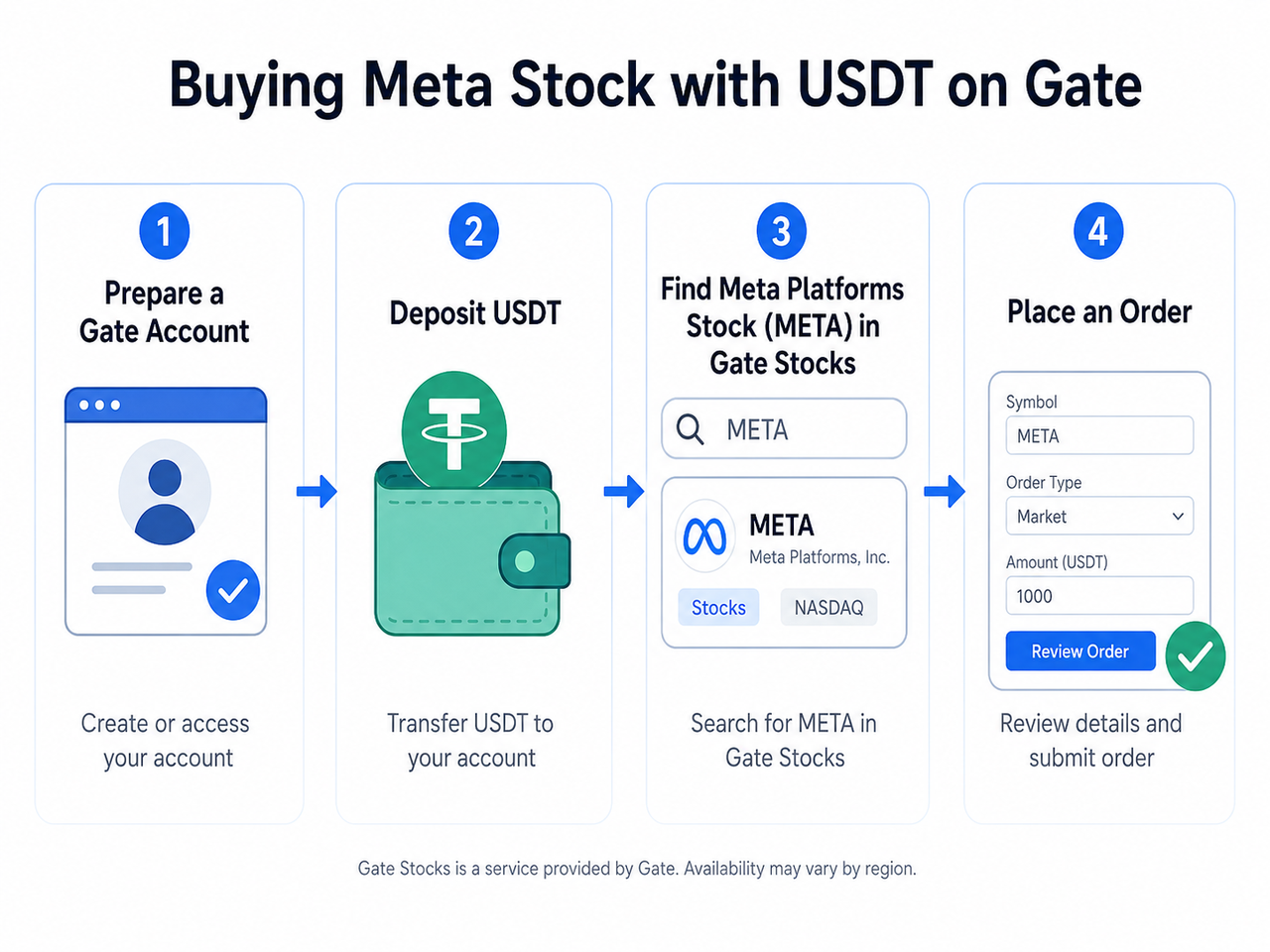
Buying Meta stock with USDT on Gate is an operational process that connects a user’s USDT balance with Meta Platforms Stock (META) through Gate Stocks. The basic workflow is to prepare an eligible Gate account, deposit or transfer USDT, enter Gate Stocks, search for META, review the order details, and confirm only after checking price, quantity, fees, and product terms.
The key user consideration is not only how to place the order. Users should also understand how Gate Stocks works, how USDT settlement differs from fiat brokerage funding, how stock exposure differs from direct broker-based shareholding, and how fees, execution, rights, and regional rules may apply.
Users who already understand Meta stock but are new to USDT-based stock access should focus on the mechanics first: account eligibility, correct ticker selection, order review, fee verification, and risk awareness. The process should remain educational and rule-based rather than driven by price expectations.
FAQs
Meta stock purchased through Gate Stocks gives users access to Meta Platforms Stock (META) through Gate’s product structure. It should not automatically be treated as identical to using a traditional broker because account structure, shareholder registration, voting rights, transfer options, and product rules may differ.
Gate’s stock product page states that fractional access begins from 0.01 shares as of June 2026. Users should verify the current minimum order size and account requirements on the Meta Platforms Stock (META) order page before placing an order.
Meta stock positions may be managed through Gate Stocks, but sell order execution depends on product rules, market hours, liquidity, order type, and account eligibility. Users should check whether the U.S. stock market is open and review the estimated price and fees before submitting a sell order.
Gate materials indicate that supported corporate actions, including cash dividends, stock dividends, stock splits, and reverse splits, may be handled according to product rules as of June 2026. Users should verify the latest Gate Stocks terms for Meta Platforms Stock (META), because dividend handling depends on eligibility, corporate action rules, and platform processing.
Does Gate charge custody or account maintenance fees for Meta stock?
Gate’s stock product page states that stock trading fees start from 0.023%, with no platform fees, no commissions, and no hidden charges as of June 2026. Users should still verify the latest fee schedule and the final order page before placing a Meta stock order.
Buying Meta stock with USDT does not reduce the market risk of Meta Platforms Stock (META). USDT settlement changes the funding method, but the position can still be affected by stock price volatility, product rules, execution conditions, stablecoin risk, and regional eligibility requirements.
Stock investing involves market risk, and prices may fluctuate significantly. Please make decisions carefully based on your own risk tolerance. This article does not constitute investment advice.







