Complete Guide to Ethereum Explorer and Analysis of the Latest Rewards Program

Beginner
Quick Reads
Last Updated 2026-03-29 04:18:29
Reading Time: 1m
Discover the core functionalities of the Ethereum blockchain explorer, explore effective ways to track Ethereum transactions, and learn strategies for reviewing smart contracts. Stay updated on Etherscan’s newest Points Program. This feature enables users to earn rewards with ease.

1. What Is an Ethereum Explorer?


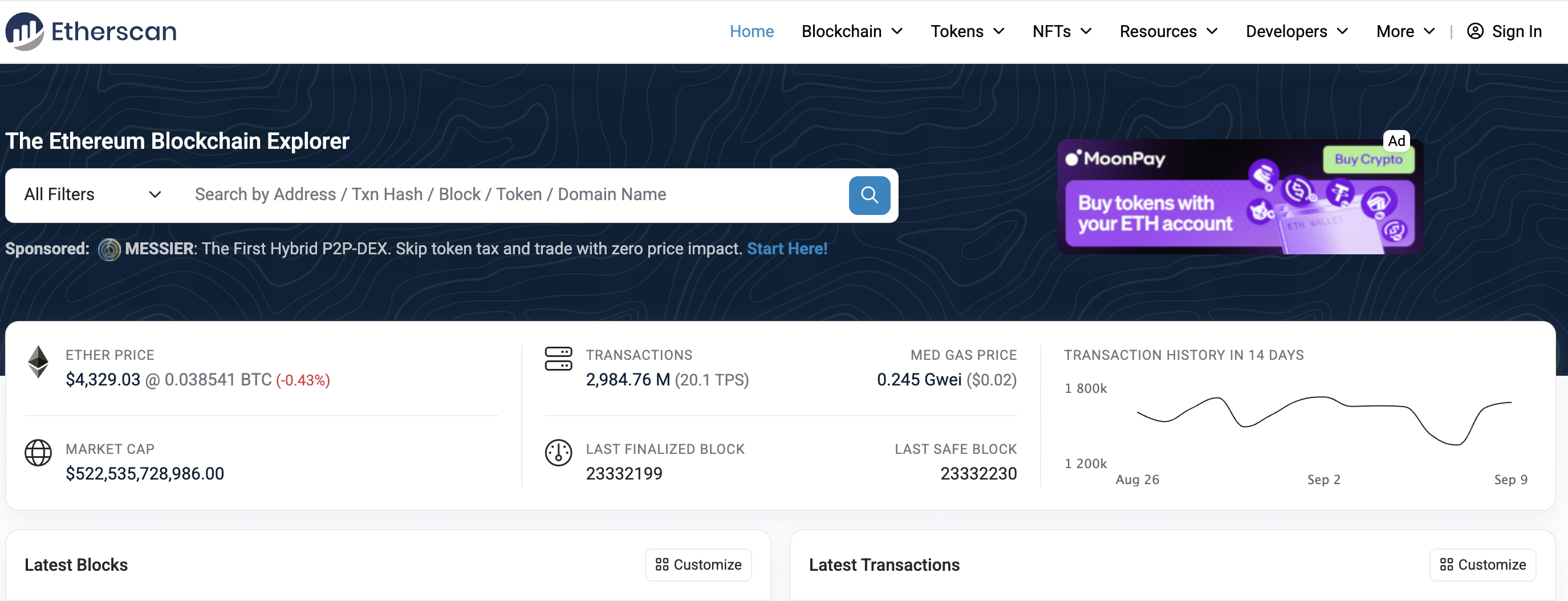
Image: https://etherscan.io/

An Ethereum explorer is an online tool that enables users to view transactions, wallet activity, and smart contract details on the Ethereum blockchain. With an Ethereum explorer, you can easily check transaction status, monitor wallet balances, verify smart contracts, and access transparent, secure blockchain data. Leading platforms in this category include Etherscan and Etherchain.

2. Core Features of an Ethereum Explorer

  • Transaction Lookup: Enter a transaction hash to see the sender, recipient, gas fee, and current transaction status.
  • Address Lookup: Input an Ethereum address to display the balance, transaction history, and token holdings.
  • Contract Lookup: Provide a contract address to review the contract’s source code, transaction records, and event logs.
  • Gas Fee Tracking: Monitor real-time gas fees across the network to choose the optimal time for submitting transactions.
  • Token Information: Look up ERC-20 or ERC-721 token transfers and holder addresses.

3. How to Query Transactions and Contract Details

  • Go to an Ethereum explorer website such as Etherscan.
  • Enter a transaction hash, wallet address, or contract address in the search field.
  • The explorer displays transaction status, timestamp, gas fee, and related token details.
  • For smart contracts, you can additionally view contract events and source code verification status.

4. Latest Points Program: Etherscan Points


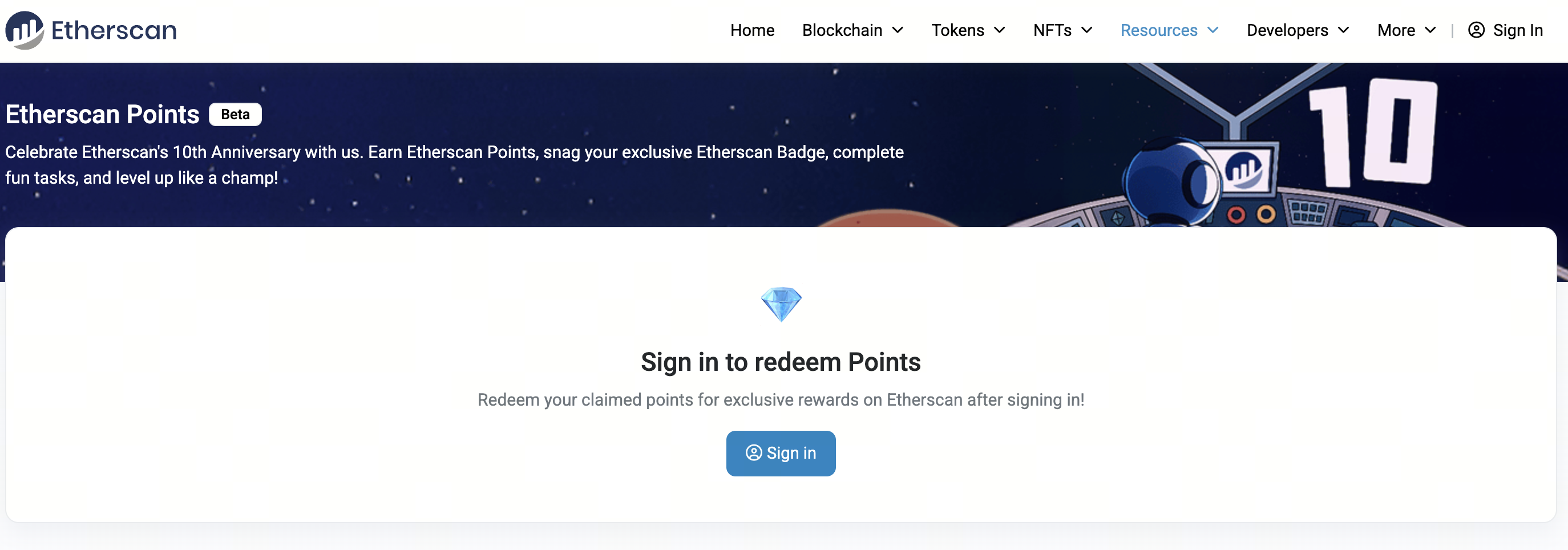
Image: https://etherscan.io/points

On August 15, 2025 (UTC), Etherscan officially launched the Etherscan Points program, allowing users to earn and redeem rewards by engaging in platform activities.

Ways to earn OG Points include:

  • Daily Check-in: Log in to Etherscan each day and complete check-in to receive point rewards.
  • Complete Quizzes: Take official quizzes and answer correctly to earn points.
  • Share Etherscan Moments: Share Etherscan content on social media for extra points.

Points can be redeemed for limited-edition 10th anniversary commemorative badges. To participate, users must have an active account created before August 12, 2025 (UTC). Etherscan notes that this program is not a token airdrop but a special 10th anniversary reward.

This points program boosts user engagement and also helps new users get acquainted with Ethereum explorer features and workflows.

Author: Max
Disclaimer
* The information is not intended to be and does not constitute financial advice or any other recommendation of any sort offered or endorsed by Gate.
* This article may not be reproduced, transmitted or copied without referencing Gate. Contravention is an infringement of Copyright Act and may be subject to legal action.

Related Articles

AI-Native Settlement Layers: How United Stables Is Building the Next Financial Rail
Beginner

AI-Native Settlement Layers: How United Stables Is Building the Next Financial Rail

Stablecoins were originally designed as dollar substitutes within exchanges, primarily used for asset pricing and trade settlement. As on-chain financial ecosystems have matured, their role has expanded beyond simple payments to include collateral assets, cross-chain liquidity mediums, and unified settlement units. In particular, as AI systems and automated agents begin to participate directly in economic activity, demand has risen sharply for programmable value units capable of instant settlement. This shift is pushing stablecoins toward the role of foundational financial infrastructure.
2026-03-25 03:16:17
The ve(3,3) Flywheel Explained: How AERO Tokenomics Powers Aerodrome’s DeFi Economy
Beginner

The ve(3,3) Flywheel Explained: How AERO Tokenomics Powers Aerodrome’s DeFi Economy

In the competition for DeFi liquidity, high-inflation mining alone is no longer enough to build lasting advantages. Aerodrome applies the ve(3,3) economic model to redesign token emissions, voting mechanisms, and revenue distribution, creating a liquidity flywheel centered on governance and cash flow. This article examines AERO tokenomics, the veAERO locking mechanism, and protocol revenue models to explain how Aerodrome builds a sustainable DeFi economic system.
2026-03-25 06:41:58
How Does PAXG Work? In-Depth Overview of the Physical Gold Tokenization Mechanism
Beginner

How Does PAXG Work? In-Depth Overview of the Physical Gold Tokenization Mechanism

PAXG (Pax Gold) is a tokenized asset backed by physical gold, issued by the fintech company Paxos and traded on the Ethereum blockchain as an ERC-20 token. The core concept is to tokenize physical gold on-chain, with each PAXG token representing ownership of a certain amount of gold. This structure enables investors to hold and trade gold in the form of a digital asset.
2026-03-24 19:12:51
Aerodrome Tokenomics: How ve(3,3) Powers Base's Most Profitable DEX
Beginner

Aerodrome Tokenomics: How ve(3,3) Powers Base's Most Profitable DEX

AERO is the native token of Aerodrome Finance, a core decentralized exchange and liquidity protocol in the Base ecosystem. It is primarily used for liquidity incentives and ecosystem operations. veAERO is a governance NFT that users receive by locking AERO, representing both voting power and the right to share protocol revenue. Through a dual track structure of AERO as a utility token and veAERO as a governance credential, Aerodrome separates liquidity usage value from long term governance power, allowing participants to act as liquidity providers, governance decision makers, and revenue sharers within the same system.
2026-03-25 06:40:31
How is the price of PAXG determined? Pegging mechanism, trading depth, and influencing factors
Beginner

How is the price of PAXG determined? Pegging mechanism, trading depth, and influencing factors

PAXG (Pax Gold) is a tokenized asset backed by physical gold reserves, launched by fintech firm Paxos and issued as an ERC-20 token on the Ethereum blockchain. The core concept is to digitally represent real-world gold assets, allowing investors to hold and trade gold via the blockchain network. Because each PAXG token corresponds to a specific quantity of physical gold, its price is theoretically expected to closely track the global gold market.
2026-03-24 19:11:40
Hybrid Collateral Stablecoins: Inside United Stables' Stability and Yield Architecture
Beginner

Hybrid Collateral Stablecoins: Inside United Stables' Stability and Yield Architecture

In the early stages of the crypto market, traditional stablecoins mainly relied on single-reserve or single-collateral models. Their primary focus was price stability and payment convenience, which allowed them to become foundational tools for on-chain trading and capital flows. As the market has entered a more mature financial phase, however, this structure has begun to reveal limitations, including high concentration risk and the difficulty of balancing liquidity with yield. These constraints have driven the evolution toward multi-layer collateral and portfolio-based designs, such as the dual-layer hybrid collateral architecture proposed by United Stables, which seeks to redefine the underlying logic of stable assets.
2026-03-25 03:17:39