Ethereum Drops Below $3,000 Again — Mixed On-Chain Signals Spark Market Divergence

Last Updated 2026-03-27 03:10:42
Reading Time: 1m
Ethereum’s price has once again dropped below $3,000, while on-chain data presents a complex picture: institutional buying, withdrawal outflows, and contradictory technical indicators. These mixed signals have led to significant disagreement in the market over ETH’s future prospects.

What’s Driving Ethereum Below $3,000 Again?
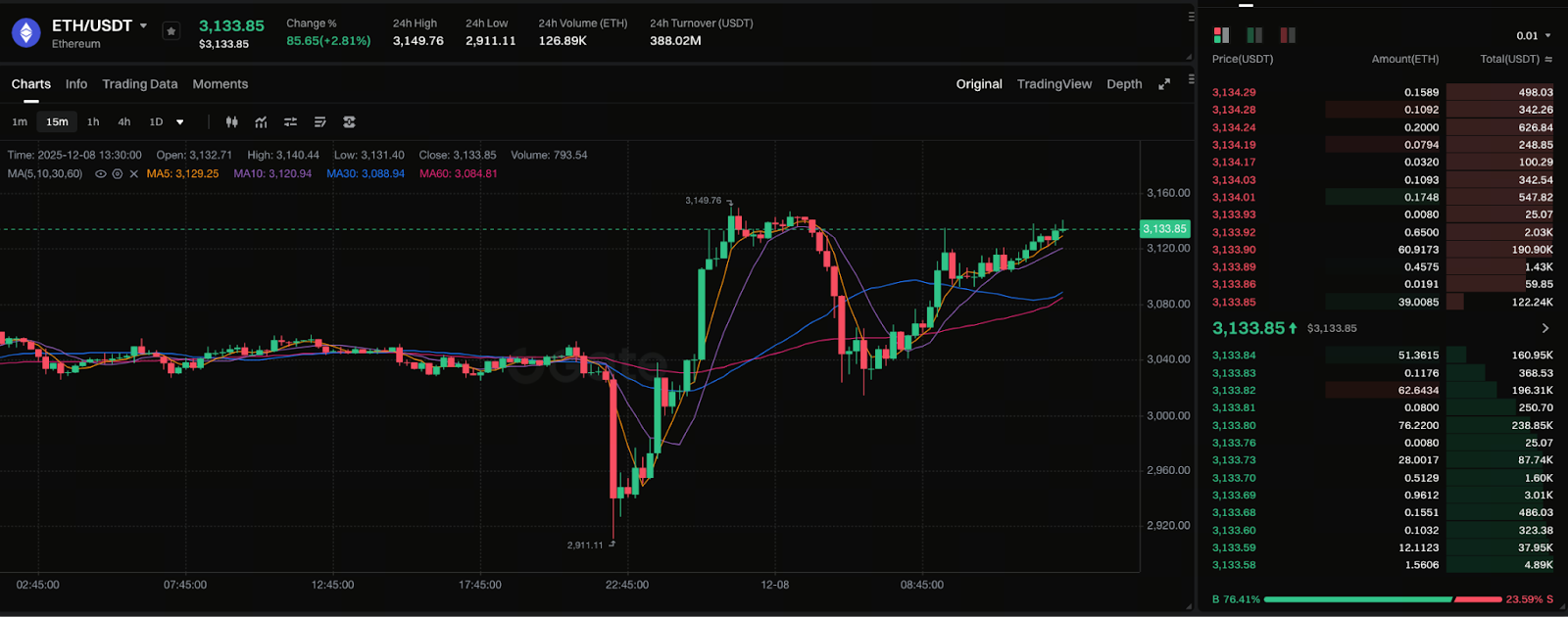

Chart: https://www.gate.com/trade/ETH_USDT

Ethereum’s latest slide below $3,000 isn’t due to a single catalyst—it’s the result of several overlapping factors fueling market volatility. The broader crypto market has seen increased turbulence lately. Bitcoin failed to lead a sustained market rally, and persistent uncertainty over global monetary policy has made investors more cautious.

Additionally, some traders have opted to take profits near the $3,000 mark, which has long been regarded as a major resistance zone. Without enough capital to break through, selling pressure mounts and triggers a pullback. Ethereum’s gains in recent weeks have been modest, with bulls lacking the momentum for a breakout. As buyers hesitate, short-term prices have corrected downward.

Why Are On-Chain Metrics Sending Mixed Signals?

On-chain data currently paints a complex and sometimes contradictory picture, with both bullish and bearish signals present:

Bullish Signal: Exchange Balances Keep Shrinking

ETH balances on centralized exchanges continue to decline, signaling that investors are moving assets to cold wallets. This is widely seen as a medium- to long-term bullish indicator, since lower circulating supply reduces short-term selling pressure.

This trend typically suggests:

  • Market participants are preparing to hold ETH for the long term
  • Current price levels are attractive to buyers
  • Selling activity on exchanges is decreasing

Bearish Signal: Whales Increase Short-Term Selling

Meanwhile, several large ETH whale addresses have recently executed notable sell-offs, typically during price rebounds or at key resistance levels. A drop in whale holdings or increased net outflows often coincides with short-term corrections.

Neutral / Contradictory Signal: On-Chain Activity Drops

Despite declining exchange balances, network transaction fees have plummeted and decentralized exchange (DEX) volumes have shrunk, reflecting a decrease in overall network activity. This may indicate:

  • Weaker speculation in the market
  • Lower trading demand
  • Capital temporarily sitting on the sidelines

This divergence in on-chain data leaves ETH without a clear short-term direction.

Diverging Market Sentiment: Who’s Buying and Who’s Selling?

Market sentiment is now clearly split into two camps:

Bullish (Buyers) Perspective:

  • Decreasing ETH on exchanges suggests reduced selling pressure
  • Institutional capital continues to trickle in
  • Ethereum’s ecosystem holds long-term value, with L2 growth and a rebound in DeFi activity

These investors see the current decline as a “healthy correction” and expect ETH to eventually climb back above $3,000.

Bearish (Sellers) Perspective:

  • Whales have been selling recently
  • Network activity is too weak to support a strong rebound
  • Macroeconomic headwinds are limiting risk appetite

Bears predict that if ETH can’t reclaim the $3,000–$3,200 range, prices could fall to $2,500 or even lower.

Key Technical Levels

Major Support:

  • $2,800: Short-term support; a break below could spark further panic selling
  • $2,500: Strong support, widely seen as the last line of defense after a decline

Major Resistance:

  • $3,000: Psychological barrier
  • $3,200: A breakout above this level could trigger a stronger upward trend

ETH is currently locked in a battle between bulls and bears. The direction of the next breakout may set the tone for the coming weeks.

Key Trends for Investors to Watch

Watch these signals closely in the near future:

  • Whether ETH balances on exchanges continue to fall
  • Whether DEX trading volumes rebound
  • Whether whales halt their selling
  • US economic data and monetary policy updates
  • Whether new institutional capital enters the market

In the short term, ETH may continue to trade below $3,000. The market needs a fresh catalyst to break the current deadlock.

Author: Max
Disclaimer
* The information is not intended to be and does not constitute financial advice or any other recommendation of any sort offered or endorsed by Gate.
* This article may not be reproduced, transmitted or copied without referencing Gate. Contravention is an infringement of Copyright Act and may be subject to legal action.

Related Articles

AI-Native Settlement Layers: How United Stables Is Building the Next Financial Rail
Beginner

AI-Native Settlement Layers: How United Stables Is Building the Next Financial Rail

Stablecoins were originally designed as dollar substitutes within exchanges, primarily used for asset pricing and trade settlement. As on-chain financial ecosystems have matured, their role has expanded beyond simple payments to include collateral assets, cross-chain liquidity mediums, and unified settlement units. In particular, as AI systems and automated agents begin to participate directly in economic activity, demand has risen sharply for programmable value units capable of instant settlement. This shift is pushing stablecoins toward the role of foundational financial infrastructure.
2026-03-25 03:16:17
The ve(3,3) Flywheel Explained: How AERO Tokenomics Powers Aerodrome’s DeFi Economy
Beginner

The ve(3,3) Flywheel Explained: How AERO Tokenomics Powers Aerodrome’s DeFi Economy

In the competition for DeFi liquidity, high-inflation mining alone is no longer enough to build lasting advantages. Aerodrome applies the ve(3,3) economic model to redesign token emissions, voting mechanisms, and revenue distribution, creating a liquidity flywheel centered on governance and cash flow. This article examines AERO tokenomics, the veAERO locking mechanism, and protocol revenue models to explain how Aerodrome builds a sustainable DeFi economic system.
2026-03-25 06:41:58
Aerodrome Tokenomics: How ve(3,3) Powers Base's Most Profitable DEX
Beginner

Aerodrome Tokenomics: How ve(3,3) Powers Base's Most Profitable DEX

AERO is the native token of Aerodrome Finance, a core decentralized exchange and liquidity protocol in the Base ecosystem. It is primarily used for liquidity incentives and ecosystem operations. veAERO is a governance NFT that users receive by locking AERO, representing both voting power and the right to share protocol revenue. Through a dual track structure of AERO as a utility token and veAERO as a governance credential, Aerodrome separates liquidity usage value from long term governance power, allowing participants to act as liquidity providers, governance decision makers, and revenue sharers within the same system.
2026-03-25 06:40:31
DePIN Identity Network and Real World Applications: How Humanity Protocol Brings on-chain Identity Into the Physical World
Beginner

DePIN Identity Network and Real World Applications: How Humanity Protocol Brings on-chain Identity Into the Physical World

Most Web3 identity systems remain confined to on-chain environments and struggle to achieve meaningful adoption in real world settings. Through a DePIN architecture and physical verification hardware, Humanity Protocol aims to bring decentralized identity into access control systems, hospitality, public services, and offline events, allowing on-chain identity to function not just as a digital credential, but as foundational infrastructure for real world access.
2026-03-25 07:40:53
How is the price of PAXG determined? Pegging mechanism, trading depth, and influencing factors
Beginner

How is the price of PAXG determined? Pegging mechanism, trading depth, and influencing factors

PAXG (Pax Gold) is a tokenized asset backed by physical gold reserves, launched by fintech firm Paxos and issued as an ERC-20 token on the Ethereum blockchain. The core concept is to digitally represent real-world gold assets, allowing investors to hold and trade gold via the blockchain network. Because each PAXG token corresponds to a specific quantity of physical gold, its price is theoretically expected to closely track the global gold market.
2026-03-24 19:11:40
Aster vs Hyperliquid: Which Perp DEX Will Prevail?
Beginner

Aster vs Hyperliquid: Which Perp DEX Will Prevail?

Aster and Hyperliquid are the two representative protocols of the "purpose-built L1 path" within the current decentralized perpetual exchange (Perp DEX) sector. As a pioneer in the field, Hyperliquid has built a deep liquidity moat through its highly mature order book architecture and strong community consensus. Conversely, Aster, as a rising challenger, seeks to leapfrog the competition in high-performance trading through more aggressive multi-chain aggregation logic, private transaction modules, and an underlying execution environment optimized for 2026 market demands.
2026-03-24 11:58:33





