Gate TradFi App & Web Officially Launch, Opening a New One-Stop Global Multi-Asset Trading Experience

Last Updated 2026-03-25 12:52:46
Reading Time: 1m
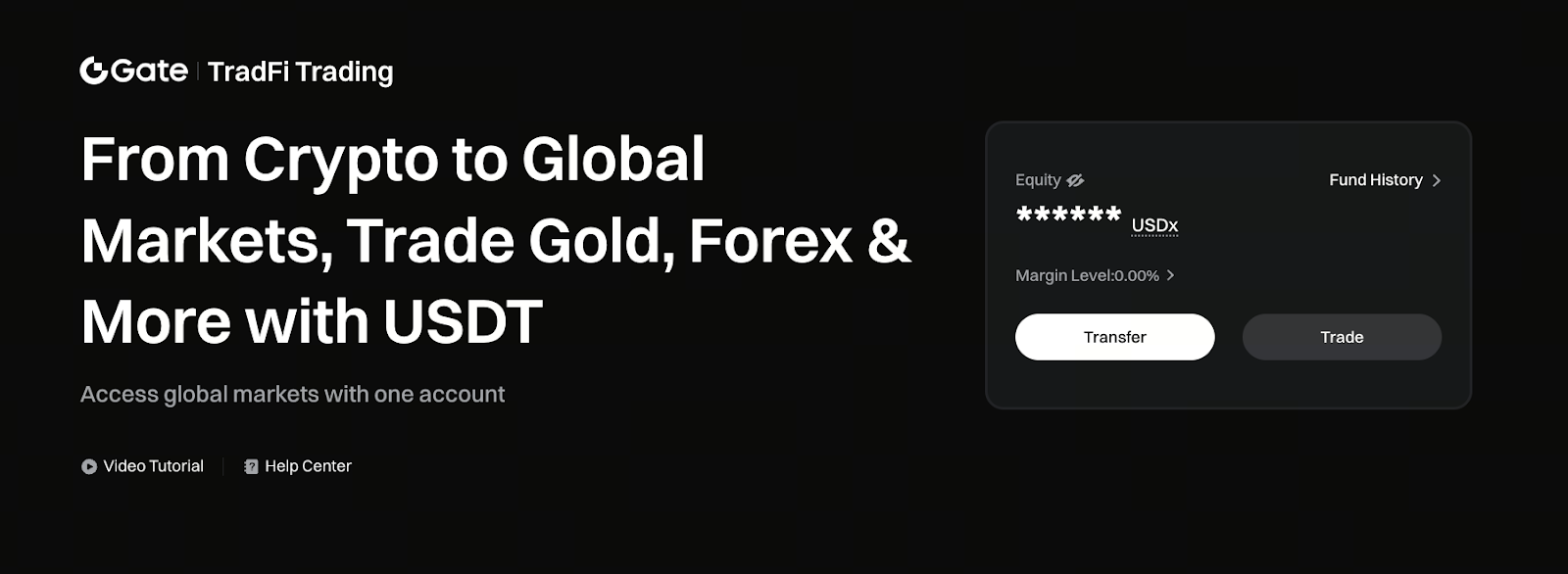
Gate TradFi now offers trading access on both its app and web platforms, enabling users to trade traditional financial assets—including gold, forex, indices, commodities, and stock CFDs. With a unified account on the Gate platform, users can seamlessly manage funds and execute multi-asset trades, significantly improving trading efficiency and the overall experience in global markets.


Image: https://www.gate.com/tradfi

Gate TradFi Now Fully Launched

Following a period of phased internal testing and optimization, Gate TradFi has officially ended its public beta and is now open to all users.

This launch not only brings a more stable and mature TradFi trading experience, but also marks Gate’s further expansion—beyond crypto assets—by offering direct access to global traditional financial markets.

Users can now trade a range of traditional financial assets directly on the Gate platform, without needing to register on other platforms or switch accounts.

What Is the Gate TradFi Multi-Asset Trading Portal?

Gate TradFi is a multi-asset trading module designed by Gate to let users access both crypto and traditional financial markets within a single platform.

With this module, users can use USDT as collateral to trade traditional financial instruments, including gold, forex, indices, commodities, and stock contracts for difference (CFDs).

This approach dramatically lowers the barriers to cross-platform trading, making asset allocation and risk hedging much more convenient.

How to Start Trading Quickly on App and Web

A key highlight of this upgrade is that TradFi trading now supports both App and Web access points.

On the App, after updating to the latest version, users can access the TradFi page directly from the navigation bar and begin trading once permissions are enabled and funds transferred.

On the Web, users simply log in to their Gate account and select TradFi from the navigation bar to enter the trading interface—no extra software installation required, enabling direct browser-based trading.

This unified entry design ensures a consistent trading experience across devices.

Which Traditional Financial Assets Does Gate TradFi Support?

Gate TradFi currently supports CFD trading for several types of traditional financial assets, including:

  • Metals, such as gold trading pairs
  • Major forex currency pairs
  • Leading global indices
  • Major commodities such as crude oil
  • Selected popular stock CFDs

The platform plans to expand to even more asset categories in the future, giving users a wider range of cross-market trading options.

Unified Account System and USDx Settlement Model

TradFi trading uses Gate’s internal unit, USDx, for account display and margin calculation. USDx is pegged 1:1 to USDT.

Users only need to transfer USDT to their TradFi account to start trading, with no asset conversion or extra custody fees required.

The unified account system lets users view asset balances, positions, and trading history all in one place, streamlining fund management.

Competitive Fees and Professional Trading System Support

Gate TradFi offers competitive fee structures across asset classes and supports high-leverage trading for forex, indices, and more.

On the technical side, TradFi runs on the robust MT5 trading system, supporting real-time market data, order execution, and strategy trading, with data synchronized between the App and professional trading systems.

For risk management, the platform monitors margin ratios and uses forced liquidation mechanisms to help manage risk exposure during periods of extreme market volatility.

TradFi Trading Risks and Regional Usage Notes

Please note that TradFi services may be restricted in certain jurisdictions, and users in some regions may not be able to access them at this time.

Trading traditional financial instruments involves price volatility and leverage risks. Users should fully review all relevant rules and risk disclosures before trading.

A New Gateway for Crypto and Traditional Finance Integration

The full launch of Gate TradFi allows users to trade both crypto and traditional financial assets within a unified account system.

With a single entry point and integrated asset management, users can allocate assets and make trading decisions more efficiently.

As more asset classes and trading tools are added, Gate TradFi is set to become a key bridge between crypto and traditional financial markets, bringing users broader access to global trading opportunities.

Author: Max
Disclaimer
* The information is not intended to be and does not constitute financial advice or any other recommendation of any sort offered or endorsed by Gate.
* This article may not be reproduced, transmitted or copied without referencing Gate. Contravention is an infringement of Copyright Act and may be subject to legal action.

Related Articles

AI-Native Settlement Layers: How United Stables Is Building the Next Financial Rail
Beginner

AI-Native Settlement Layers: How United Stables Is Building the Next Financial Rail

Stablecoins were originally designed as dollar substitutes within exchanges, primarily used for asset pricing and trade settlement. As on-chain financial ecosystems have matured, their role has expanded beyond simple payments to include collateral assets, cross-chain liquidity mediums, and unified settlement units. In particular, as AI systems and automated agents begin to participate directly in economic activity, demand has risen sharply for programmable value units capable of instant settlement. This shift is pushing stablecoins toward the role of foundational financial infrastructure.
2026-03-25 03:16:17
The ve(3,3) Flywheel Explained: How AERO Tokenomics Powers Aerodrome’s DeFi Economy
Beginner

The ve(3,3) Flywheel Explained: How AERO Tokenomics Powers Aerodrome’s DeFi Economy

In the competition for DeFi liquidity, high-inflation mining alone is no longer enough to build lasting advantages. Aerodrome applies the ve(3,3) economic model to redesign token emissions, voting mechanisms, and revenue distribution, creating a liquidity flywheel centered on governance and cash flow. This article examines AERO tokenomics, the veAERO locking mechanism, and protocol revenue models to explain how Aerodrome builds a sustainable DeFi economic system.
2026-03-25 06:41:58
Aerodrome Tokenomics: How ve(3,3) Powers Base's Most Profitable DEX
Beginner

Aerodrome Tokenomics: How ve(3,3) Powers Base's Most Profitable DEX

AERO is the native token of Aerodrome Finance, a core decentralized exchange and liquidity protocol in the Base ecosystem. It is primarily used for liquidity incentives and ecosystem operations. veAERO is a governance NFT that users receive by locking AERO, representing both voting power and the right to share protocol revenue. Through a dual track structure of AERO as a utility token and veAERO as a governance credential, Aerodrome separates liquidity usage value from long term governance power, allowing participants to act as liquidity providers, governance decision makers, and revenue sharers within the same system.
2026-03-25 06:40:31
DePIN Identity Network and Real World Applications: How Humanity Protocol Brings on-chain Identity Into the Physical World
Beginner

DePIN Identity Network and Real World Applications: How Humanity Protocol Brings on-chain Identity Into the Physical World

Most Web3 identity systems remain confined to on-chain environments and struggle to achieve meaningful adoption in real world settings. Through a DePIN architecture and physical verification hardware, Humanity Protocol aims to bring decentralized identity into access control systems, hospitality, public services, and offline events, allowing on-chain identity to function not just as a digital credential, but as foundational infrastructure for real world access.
2026-03-25 07:40:53
How is the price of PAXG determined? Pegging mechanism, trading depth, and influencing factors
Beginner

How is the price of PAXG determined? Pegging mechanism, trading depth, and influencing factors

PAXG (Pax Gold) is a tokenized asset backed by physical gold reserves, launched by fintech firm Paxos and issued as an ERC-20 token on the Ethereum blockchain. The core concept is to digitally represent real-world gold assets, allowing investors to hold and trade gold via the blockchain network. Because each PAXG token corresponds to a specific quantity of physical gold, its price is theoretically expected to closely track the global gold market.
2026-03-24 19:11:40
How Does GoldFinger Work? Gold Asset Tokenization, Proof of Reserve, and on-chain Circulation Explained
Beginner

How Does GoldFinger Work? Gold Asset Tokenization, Proof of Reserve, and on-chain Circulation Explained

GoldFinger operates through a process that includes asset custody, Proof of Reserve, token minting, and on-chain circulation. By placing physical gold within a compliant custody framework and mapping it on-chain through ART tokens, GoldFinger turns gold into a digital, programmable asset. At the same time, its Proof of Reserve mechanism ensures that on-chain tokens correspond to the underlying assets, supporting trading, collateralization, and redemption in DeFi scenarios.
2026-04-15 03:01:54