The fundamental differences among Glamsterdam, Dencun, and Fusaka stem from their unique problem domains: Dencun is designed for phased capacity improvements, Fusaka addresses mid-term collaborative transitions, and Glamsterdam focuses on restructuring block production collaboration and execution constraints. Treating these upgrades as interchangeable options can lead to misjudging both the value and complexity of implementation.
The Glamsterdam upgrade panorama situates Glamsterdam within the Lean Ethereum roadmap. Below, we compare the upgrades: What specific pain points does each address? Why is Glamsterdam regarded as a pivotal milestone in the roadmap?
What is Dencun? What problem does it solve?
Dencun serves as a capacity and availability milestone in Ethereum’s ongoing upgrade sequence, with its central aim being phased experience optimization. Key mechanisms include proto-danksharding (EIP-4844), targeting reduced L2 data availability costs and improved fee structures for scaling. For everyday users and the L2 ecosystem, Dencun’s impact is tangible—typically reflected in changes to L2 transaction costs and data submission efficiency.
Dencun does not address block production collaboration boundaries or preconditions for parallel execution. Its value lies in accumulating capacity experience for future upgrades and testing the ecosystem’s adaptability to protocol changes. Judging Glamsterdam by Dencun’s success metrics would misalign evaluation criteria.
What is Fusaka? What is its role in the upgrade path?
Fusaka acts as a collaborative optimization phase bridging previous and subsequent upgrades, focusing on how multiple components transition smoothly over the mid-term. It’s best understood as a “system linkage tuning” phase, rather than a stand-alone architectural direction. Fusaka’s value is in reducing gaps between upgrades, offering client, infrastructure, and application teams a more continuous adaptation window.
Fusaka and Glamsterdam are not competitors—they are sequential relay points. Fusaka reduces collaborative friction for upcoming structural changes, while Glamsterdam initiates deeper protocol boundary redesign. Recognizing Fusaka’s transitional role clarifies why Glamsterdam discussions are more about engineering mechanisms than simple fee metrics.
What is Glamsterdam? How does it differ from Dencun and Fusaka?
Glamsterdam tackles deeper structural issues: block production collaboration boundaries (ePBS (EIP-7732) mechanism) and pre-execution constraints (BAL (EIP-7928) and parallel execution). According to the Ethereum.org roadmap, Glamsterdam is a mainnet advancement milestone, but its mechanism discussions depend on testnet validation and client maturity data rather than a fixed timeline.
| Upgrade Phase |
Technical Focus |
Key Discussion Topics |
| Dencun |
Availability and scaling experience |
Capacity and cost changes |
| Fusaka |
Collaborative optimization and transition management |
Component linkage and seamless migration |
| Glamsterdam |
Block production and execution structure redesign |
Collaboration boundaries, conflict constraints, implementation consistency |
The table shows that Glamsterdam’s discussions are inherently more “mechanism-driven.” It asks not just “Will it be faster?” but also “Why will it be more stable, who’s responsible, and how is it validated?”
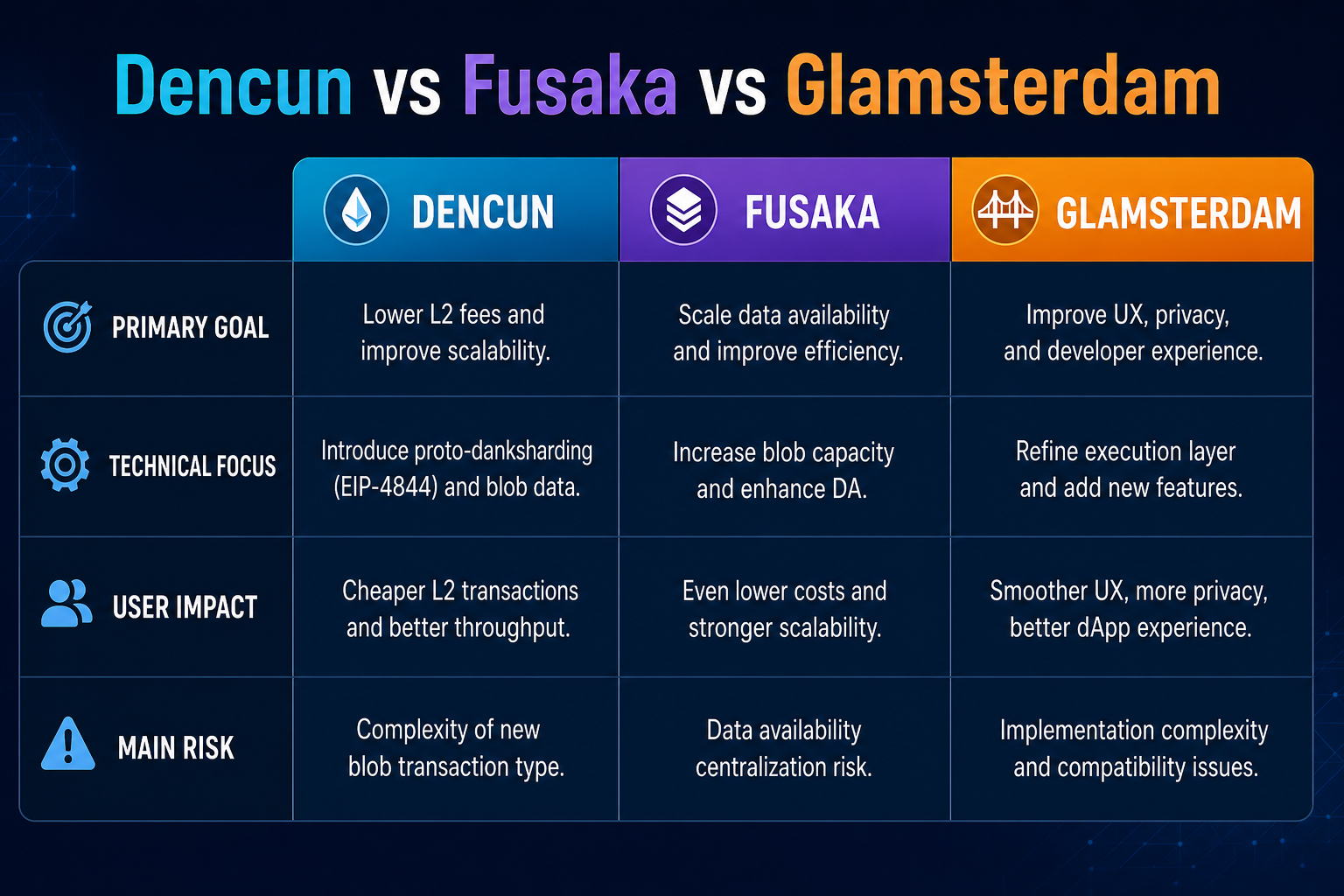 Figure 1. Comparison chart of objectives and mechanisms for Dencun, Fusaka, and Glamsterdam.
How do the three upgrades differ in user experience?
During Dencun, users most directly perceive changes in transaction costs and L2 availability. Fusaka’s impact is subtler, mainly reflected in system stability and transition smoothness. Glamsterdam’s improvements may show as greater predictability under heavy load, but the extent and pace depend on ecosystem adaptation.
User experience does not manifest identically with every upgrade. Applying a “fee reduction” model across all upgrades ignores the distinct objectives each brings. A more prudent user expectation is to focus on confirmation stability and peak-period interpretability, rather than a single fee promise.
How do the upgrades affect developers and infrastructure providers?
For Dencun, developers focus on cost and availability strategies. Fusaka shifts the focus to compatibility and migration coordination. With Glamsterdam, attention moves to validating execution assumptions, upgrading monitoring systems, and stratifying launch strategies.
Infrastructure providers must invest more in “mechanism comprehension” for Glamsterdam. Structural boundary changes impact alert design, fault diagnosis, and rollback strategies. The node upgrade preparation checklist offers a framework for layered deployment, metric monitoring, and rollback closure; Glamsterdam’s impact on DApps supplements application-side metric resets and release cadence, providing practical references for coordinated adaptation.
| Role |
Dencun Focus |
Glamsterdam Focus |
| Application Developer |
Cost and L2 strategies |
Execution assumptions and state access patterns |
| Node Operator |
Version synchronization and compatibility |
Layered monitoring and emergency rollback |
| Infrastructure Provider |
Capacity and latency |
Segment metrics and SLA resets |
This table helps teams allocate adaptation resources by role, preventing the direct application of Dencun experience to Glamsterdam preparation.
Why is Glamsterdam a key milestone for Lean Ethereum?
Lean Ethereum defines long-term direction, while Glamsterdam provides actionable engineering tools. It breaks down the long-term vision into verifiable tasks: Are collaboration boundaries clear, are state constraints pre-imposed, is execution behavior predictable? As long as these issues are validated, the roadmap is grounded.
Glamsterdam’s rise in independent attention comes from shifting the focus from abstract vision to executable engineering tasks. Teams can build test checklists, monitoring metrics, and review templates around ePBS and BAL, making upgrade discussions operationally evaluable.
What are the risks and uncertainties of the three upgrades?
Each upgrade carries risks in implementation timing, quality, and ecosystem synchronization, but their weights differ. Dencun risks capacity expectation mismatches, Fusaka risks collaborative link breakpoints, and Glamsterdam risks inconsistency in structural changes.
Risk comparison should focus on “type differences” rather than “quantity.” Each upgrade has its own failure modes, requiring distinct monitoring and response strategies. Adjustments to roadmap timing based on test feedback are normal engineering governance—not necessarily a change in mechanism direction.
Summary
Dencun, Fusaka, and Glamsterdam are sequential phases in the same roadmap, not competing versions. Understanding this path means returning each upgrade to its problem domain: capacity experience, collaborative transition, structural governance. Glamsterdam’s uniqueness lies in advancing Ethereum upgrade discussions to the boundary of mechanisms and engineering verifiability.
FAQ
What is the main difference between Glamsterdam and Dencun?
They focus on different aspects. Dencun is about phased availability and scaling experience, while Glamsterdam is about structural redesign of block production collaboration and execution constraints.
What role does Fusaka play among the three?
Fusaka acts as a mid-term transition phase, focusing on multi-component collaboration and seamless migration, creating stable conditions for future structural upgrades.
Why is Glamsterdam discussed separately?
Because it addresses specific mechanism issues and execution checklists, shifting the focus from abstract vision to actionable engineering tasks and concentrating search intent.
What type of information should development teams prioritize?
Monitor mechanism-level updates, client implementation progress, and testnet feedback, then align with your application’s own roadmap for compatibility checks and launch cadence adjustments.
Does Dencun’s success guarantee Glamsterdam’s smooth progress?
No. Dencun tests capacity paths and ecosystem adaptability, while Glamsterdam deals with structural changes at a different level. Risk types and preparation priorities differ.
Do regular users need to take special actions for Glamsterdam?
Generally, no additional on-chain migration is needed. The key is to check public upgrade announcements from wallets, exchanges, and Ethereum.org, and stay up to date with client release information.