Gold Prices Hit a New High: How Should Investors Respond to Record-Breaking Levels?
Latest Developments in Record Gold Prices
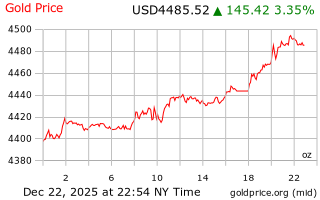
Image: https://goldprice.org/
By late December 2025, international gold prices have continued their upward trajectory. Spot gold has repeatedly set new record highs, breaking through several key price levels. According to the latest market data, spot gold briefly surpassed $4,400 per ounce, while futures contracts also reached new highs, trading within the $4,430–$4,480 per ounce range. This represents one of the strongest rallies since 2025 began.
This breakout is not only a record for the year but also a significant milestone in historical terms. Year-to-date, gold prices have surged more than 65%, marking one of the strongest performances since 1979.
Key Drivers of Gold Price Increases
Several factors have fueled the sharp rise in gold prices, including the following:
1. Shift in Monetary Policy Expectations
Markets increasingly expect the Federal Reserve to cut interest rates, shifting sentiment from tightening to easing. Lower rates reduce the opportunity cost of holding non-yielding assets like gold, which supports higher gold prices.
2. Rising Geopolitical Risks
Heightened international geopolitical tensions—including those involving the US and Venezuela, Russia, and ongoing conflicts in the Middle East—have increased investor demand for safe-haven assets. Gold, as the traditional safe haven, has directly benefited from this environment.
3. Central Bank Gold Reserve Accumulation
Central banks in multiple countries continue to add to their gold reserves as part of foreign exchange diversification strategies. This remains a major driver of gold’s long-term price appreciation.
4. Market Asset Allocation Demand
Ongoing inflation and global economic uncertainty have strengthened investor demand for asset diversification. As a result, precious metals like gold and silver are attracting significant capital inflows.
Gold Market Outlook and Expectations
From both technical and fundamental perspectives, gold prices have further upside potential after breaking historical highs. Multiple institutions forecast that if economic data remains weak or global monetary policy becomes more accommodative, gold prices could continue to rise.
However, some analysts warn that after reaching new highs, the market may enter a period of heightened volatility, with short-term risks of corrections and fluctuations. Investors should closely monitor the following key factors:
- Federal Reserve interest rate decisions and inflation trends
- Changes in geopolitical risk
- Investor risk aversion sentiment indices
- Market capital flows and ETF position changes
Gold Investment Strategies and Risk Reminders
1. Maintain Reasonable Position Sizing
Individual investors should avoid concentrating all capital in the gold market. Allocating about 5–10% of the overall portfolio to gold is recommended to diversify risk.
2. Monitor Costs and Trading Fees
Spot gold, futures, and ETF trading each involve different costs and fees. Investors should take these into full account before making decisions.
3. Practice Effective Risk Management
Short-term trading in a high-price environment requires caution. Setting stop-loss and take-profit levels can help prevent losses from sudden market swings.
4. Consider Dollar-Cost Averaging for Long-Term Investments
For those focused on long-term value, a regular, fixed-amount investment strategy in gold-related products can help smooth out costs and mitigate market volatility risk.
Conclusion
The surge in gold prices to record highs is the result of multiple converging factors. Historically, gold has demonstrated strong appeal in times of rising uncertainty and expectations of monetary easing. For investors, understanding the fundamental drivers and risks of the gold market is essential to seizing opportunities in precious metals.
Share
Content


Related Articles

2025 BTC Price Prediction: BTC Trend Forecast Based on Technical and Macroeconomic Data

Flare Crypto Explained: What Is Flare Network and Why It Matters in 2025

Pi Coin Transaction Guide: How to Transfer to Gate.com

How to Use a Crypto Whale Tracker: Top Tool Recommendation for 2025 to Follow Whale Moves

What is N2: An AI-Driven Layer 2 Solution