GUSD: Redefining Stablecoins Through On-Chain Yield and RWA Integration

Beginner
Quick Reads
Last Updated 2026-03-27 23:20:56
Reading Time: 1m
GUSD's introduction represents a major evolution in stablecoins, transforming them from passive stores of value into assets that generate yield. Unlike conventional stablecoins, GUSD generates yield from real-world assets (RWA). Its core investment portfolio consists of low-risk financial instruments, including U.S. short-term Treasuries and high-rated commercial paper. This approach ensures reliable and stable returns.

The Evolution of Stablecoins

Historically, stablecoins in the crypto market served primarily as safe havens or trading instruments. Users held them mainly for value preservation and transactional convenience. With the advent of DeFi and the rise of Real World Assets (RWA), GUSD ushers in a new era for stablecoins. It no longer serves solely as a passive store of value but evolves into an on-chain asset capable of generating ongoing yield.

GUSD’s concept is simple yet transformative: stability and growth in one. Holding GUSD is like owning an interest-bearing asset that accrues over time—turning stablecoins from static reserves into financial instruments with self-accumulating potential.

Source of Real Yield

Unlike traditional stablecoins backed exclusively by cash or bank reserves, GUSD generates yield via Real World Assets (RWA). Its underlying investment portfolio features U.S. short-term Treasury bonds, high-grade notes, and other low-risk financial products, providing genuine support for stable interest income.

This structure brings transparency and blockchain integration to traditional finance’s interest mechanisms. GUSD maintains its peg to the U.S. dollar while consistently generating authentic yield. For users seeking stability without sacrificing growth, GUSD offers a new dollar-denominated yield solution.

Flexible Entry and Exit Strategies

GUSD provides two entry channels tailored to different usage scenarios, balancing efficiency and liquidity:

  • Exchange Conversion: Users can swap USDT or other stablecoins for GUSD—fast, seamless fund transfer.
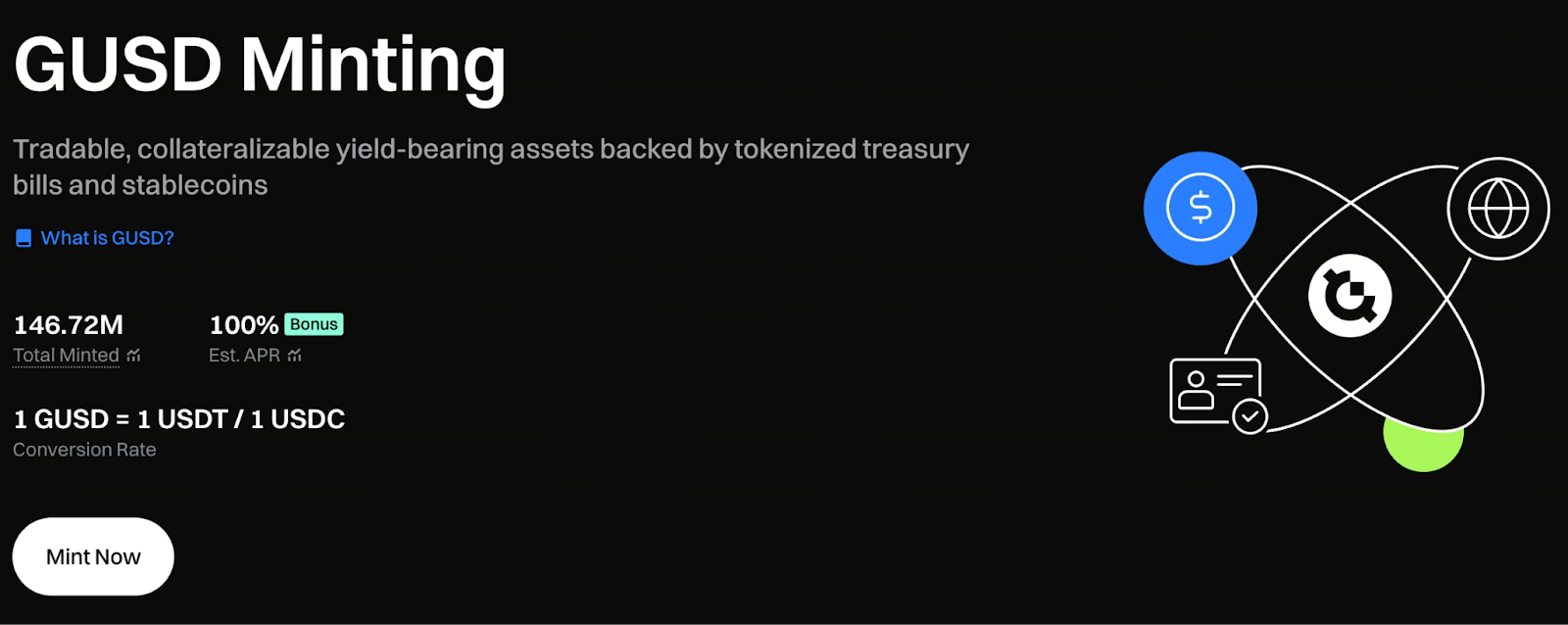
  • Mint GUSD at a 1:1 ratio using USDT or USDC via smart contract. This allows users to directly access the underlying RWA yield streams.

This dual approach enables both short-term traders and long-term investors to select their preferred method. It strikes a balance between stable returns and flexible capital management.

Users can mint GUSD to earn yield calculated on a daily basis, annualized: https://www.gate.com/staking/GUSD?gt_disable_intercept_jump=1

GUSD Yield Model

GUSD employs an accumulative interest, maturity-based redemption model, allowing asset value to grow steadily over time.

For example, minting GUSD with 100 USDT at a 20% annual yield lets users redeem approximately 120 USDC upon maturity.

This system streamlines compounding, enables natural accumulation of returns, and offers users clear expectations. For DeFi investors, GUSD combines the reliable yield of conventional bonds with the agility of on-chain assets.

Building Multi-Layered Use Cases

GUSD is more than a stablecoin—it’s a central component adaptable to a range of financial applications. Current use cases include:

  • Staking and Lockup Rewards: Long-term holders earn additional incentive yields.
  • Limited-Time Airdrops and Promotions: Driving community engagement and rewarding early adopters.
  • Multi-Functional Integrations: Compatible with lending, wealth management, margin trading, Launchpool, and other financial operations.

This versatile design makes GUSD a core, value-generating asset across the entire on-chain financial ecosystem.

GUSD’s Three Key Competitive Advantages

  1. Yield on long-term holding: The longer you hold, the greater the returns—ideal for stable portfolio allocation.
  2. High liquidity architecture: Supports both minting and exchange conversion, enabling flexible, convenient access.
  3. Robust ecosystem support: Functions across a broad spectrum of DeFi scenarios, maximizing capital efficiency.

With ongoing transparency in reserve audits and yield disclosures, GUSD is poised to become one of the world’s most trusted yield-generating stablecoins.

Risk Disclosure

This document is intended solely as general informational material and does not constitute investment advice or solicitation. Before participating in GUSD or any yield-generating stablecoin, users should fully understand product characteristics, sources of risk, and consult a qualified financial advisor. Usage restrictions may apply in certain regions; please comply with platform policies.

User Agreement: https://www.gate.com/legal/user-agreement

Conclusion

The launch of GUSD marks a pivotal shift for stablecoins—from mere value storage to active yield generation. By integrating RWA backing with transparent, on-chain interest accrual, GUSD bridges the gap between traditional finance and DeFi. As Web3 financial infrastructure matures, GUSD stands not just as a stablecoin but as a critical link to the era of yield-generating digital assets.

Author: Allen
Disclaimer
* The information is not intended to be and does not constitute financial advice or any other recommendation of any sort offered or endorsed by Gate.
* This article may not be reproduced, transmitted or copied without referencing Gate. Contravention is an infringement of Copyright Act and may be subject to legal action.

Related Articles

AI-Native Settlement Layers: How United Stables Is Building the Next Financial Rail
Beginner

AI-Native Settlement Layers: How United Stables Is Building the Next Financial Rail

Stablecoins were originally designed as dollar substitutes within exchanges, primarily used for asset pricing and trade settlement. As on-chain financial ecosystems have matured, their role has expanded beyond simple payments to include collateral assets, cross-chain liquidity mediums, and unified settlement units. In particular, as AI systems and automated agents begin to participate directly in economic activity, demand has risen sharply for programmable value units capable of instant settlement. This shift is pushing stablecoins toward the role of foundational financial infrastructure.
2026-03-25 03:16:17
The ve(3,3) Flywheel Explained: How AERO Tokenomics Powers Aerodrome’s DeFi Economy
Beginner

The ve(3,3) Flywheel Explained: How AERO Tokenomics Powers Aerodrome’s DeFi Economy

In the competition for DeFi liquidity, high-inflation mining alone is no longer enough to build lasting advantages. Aerodrome applies the ve(3,3) economic model to redesign token emissions, voting mechanisms, and revenue distribution, creating a liquidity flywheel centered on governance and cash flow. This article examines AERO tokenomics, the veAERO locking mechanism, and protocol revenue models to explain how Aerodrome builds a sustainable DeFi economic system.
2026-03-25 06:41:58
How Does PAXG Work? In-Depth Overview of the Physical Gold Tokenization Mechanism
Beginner

How Does PAXG Work? In-Depth Overview of the Physical Gold Tokenization Mechanism

PAXG (Pax Gold) is a tokenized asset backed by physical gold, issued by the fintech company Paxos and traded on the Ethereum blockchain as an ERC-20 token. The core concept is to tokenize physical gold on-chain, with each PAXG token representing ownership of a certain amount of gold. This structure enables investors to hold and trade gold in the form of a digital asset.
2026-03-24 19:12:51
Aerodrome Tokenomics: How ve(3,3) Powers Base's Most Profitable DEX
Beginner

Aerodrome Tokenomics: How ve(3,3) Powers Base's Most Profitable DEX

AERO is the native token of Aerodrome Finance, a core decentralized exchange and liquidity protocol in the Base ecosystem. It is primarily used for liquidity incentives and ecosystem operations. veAERO is a governance NFT that users receive by locking AERO, representing both voting power and the right to share protocol revenue. Through a dual track structure of AERO as a utility token and veAERO as a governance credential, Aerodrome separates liquidity usage value from long term governance power, allowing participants to act as liquidity providers, governance decision makers, and revenue sharers within the same system.
2026-03-25 06:40:31
How is the price of PAXG determined? Pegging mechanism, trading depth, and influencing factors
Beginner

How is the price of PAXG determined? Pegging mechanism, trading depth, and influencing factors

PAXG (Pax Gold) is a tokenized asset backed by physical gold reserves, launched by fintech firm Paxos and issued as an ERC-20 token on the Ethereum blockchain. The core concept is to digitally represent real-world gold assets, allowing investors to hold and trade gold via the blockchain network. Because each PAXG token corresponds to a specific quantity of physical gold, its price is theoretically expected to closely track the global gold market.
2026-03-24 19:11:40
Hybrid Collateral Stablecoins: Inside United Stables' Stability and Yield Architecture
Beginner

Hybrid Collateral Stablecoins: Inside United Stables' Stability and Yield Architecture

In the early stages of the crypto market, traditional stablecoins mainly relied on single-reserve or single-collateral models. Their primary focus was price stability and payment convenience, which allowed them to become foundational tools for on-chain trading and capital flows. As the market has entered a more mature financial phase, however, this structure has begun to reveal limitations, including high concentration risk and the difficulty of balancing liquidity with yield. These constraints have driven the evolution toward multi-layer collateral and portfolio-based designs, such as the dual-layer hybrid collateral architecture proposed by United Stables, which seeks to redefine the underlying logic of stable assets.
2026-03-25 03:17:39