Video processing is a key part of internet infrastructure. Whether for live streaming, short videos, or AI video generation, video files usually need to be transcoded, compressed, and processed into multiple resolutions before they can fit different devices and network conditions. Traditional video platforms typically rely on centralized cloud services to provide these capabilities. But as AI video and real-time generative media continue to develop, demand for GPU computing keeps rising, and video processing costs are increasing along with it.
Against this backdrop, decentralized video infrastructure has begun to draw more attention. Livepeer provides developers with video transcoding and real-time AI video processing through an open network of GPU nodes. Compared with traditional cloud platforms, Livepeer places greater emphasis on an open network structure and market-based resource coordination, while gradually expanding into AI avatars, real-time AI video, and generative media use cases.

What Is Livepeer’s Video Processing Network?
Livepeer is a decentralized video processing network built on Ethereum. It is mainly used for video transcoding, live streaming processing, and AI video computation.
In traditional video platforms, video processing is usually handled by centralized servers. In the Livepeer network, video tasks are distributed to different GPU nodes, which collectively complete video transcoding and AI video processing work.
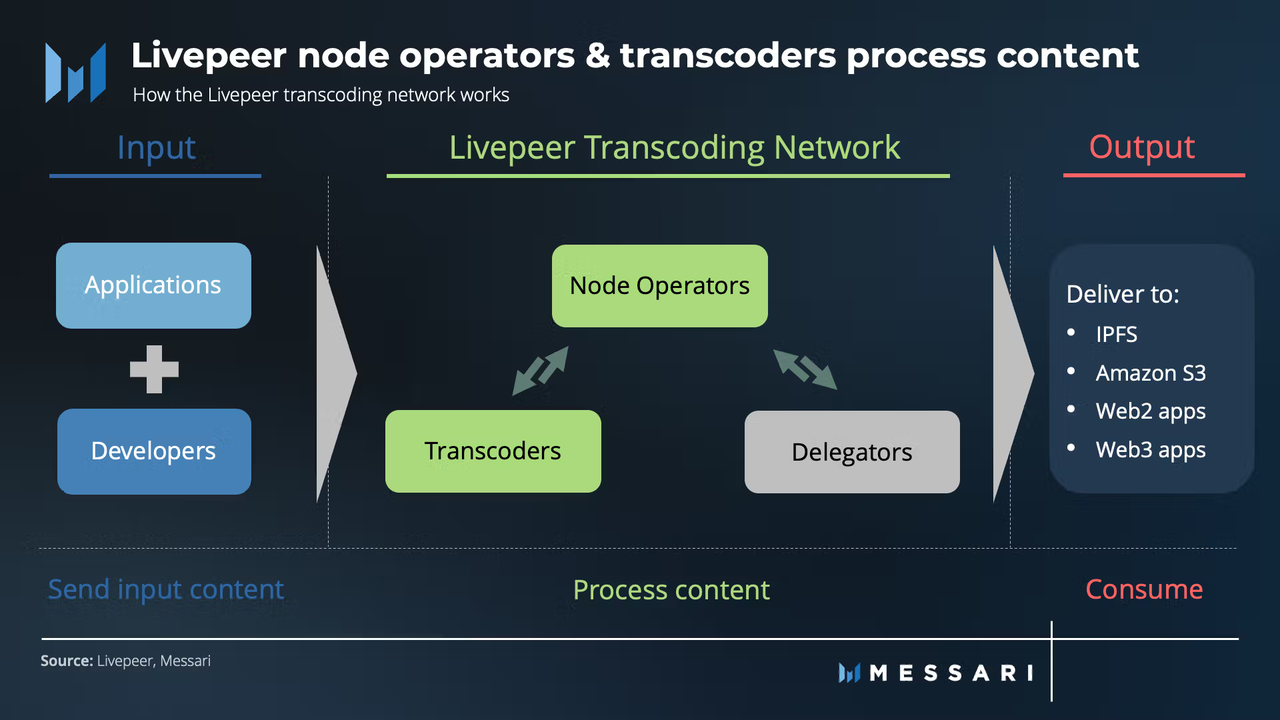
Image source: Messari
The network is mainly made up of the following roles:
-
Gateway: receives video requests and distributes tasks
-
Orchestrator: performs video transcoding and AI video processing
-
Delegator: supports node operations by delegating LPT
-
GPU node: provides the actual computing resources
LPT is the core coordination token in the network and is used for node staking and network incentives.
What Happens After a User Uploads a Video?
When a developer or application uploads a video, the video task is first sent to a Gateway. The Gateway is an important entry point that connects the application layer with the Livepeer network. It verifies the video request and sends the task to a suitable Orchestrator node based on network conditions.
Video tasks typically include:
The Gateway allocates tasks based on factors such as node performance, network load, and node reputation.
This mechanism allows Livepeer to dynamically coordinate GPU resources across the network.
How Does the Gateway Distribute Video Tasks?
The Gateway’s core role is to connect applications with the decentralized computing network.
After receiving a video request, the Gateway looks for available Orchestrators and sends the video processing task to them. To reduce network latency, the Gateway usually prioritizes nodes with stronger stability and better GPU performance.
Compared with the fixed server architecture used by traditional video platforms, Livepeer’s task distribution mechanism is closer to an open market model.
Different nodes compete for the opportunity to process tasks, so they need to maintain strong service quality and reliability.
Because Orchestrators must stake LPT, node reputation also affects their likelihood of receiving tasks.
An Orchestrator is the core computing node in the Livepeer network.
After a node receives a video task, it uses GPU resources to complete video transcoding. Video transcoding usually includes resolution adjustment, video codec conversion, video compression, and generation of multiple bitrate outputs.
For example, a live stream may need to generate video streams in different quality levels such as 480p, 720p, and 1080p at the same time, so it can support different devices and network environments.
As demand for AI video grows, Orchestrators have also begun to take on real-time AI video inference tasks, such as:
These tasks usually require support from high-performance GPUs.
How Does the GPU Network Support AI Video Processing?
Compared with traditional video transcoding, AI video places higher demands on GPU computing power.
Traditional video transcoding mainly depends on encoding and compression, while real-time AI video usually requires model inference, such as real-time facial driving, AI motion generation, video style transfer, and text-to-video generation.
These processes require continuous use of GPU resources, so real-time AI video has a higher requirement for low-latency computing.
Livepeer provides developers with scalable video computing resources through an open GPU node network.
Compared with centralized AI video platforms, Livepeer places more emphasis on open access and decentralized resource coordination.
How Does the Probabilistic Micropayment Mechanism Work?
Video processing often involves a large number of frequent small payments. If every payment were completed directly on-chain, gas costs could become high.
To reduce settlement costs, Livepeer uses a Probabilistic Micropayments mechanism.
In this model:
-
Users first create payment tickets
-
Nodes process video after receiving the tickets
-
Some tickets are randomly selected as winners
-
Winning tickets can be redeemed for the full payment amount
This mechanism can reduce the number of on-chain transactions while maintaining settlement efficiency across the network.
Probabilistic Micropayments are an important part of how the Livepeer network reduces on-chain payment costs.
Why Does LPT Staking Affect Task Allocation?
LPT is the core coordination token in the Livepeer network.
Orchestrators must stake LPT to participate in video task processing. In general, the more LPT a node stakes, the higher its chance of receiving tasks.
The main purposes of this mechanism include:
-
Improving node stability
-
Strengthening network security
-
Reducing the risk of malicious nodes
-
Encouraging long-term participation
Delegators can support node operations by delegating LPT and participate in reward distribution.
Because task allocation is related to node reputation, Orchestrators usually need to maintain high uptime and strong video processing quality.
The biggest difference between Livepeer and traditional video cloud platforms lies in the network structure.
Traditional video services are usually managed by a single platform that controls servers and GPU resources. Livepeer, by contrast, coordinates video processing capacity through an open node network.
| Comparison Dimension |
Livepeer |
Traditional Video Cloud Platforms |
| Network structure |
Decentralized |
Centralized |
| GPU source |
Open node network |
Cloud service provider |
| Video processing model |
Distributed task processing |
Centralized processing |
| Payment mechanism |
On-chain coordination |
Platform fees |
| AI video support |
Real-time GPU network |
Cloud GPU services |
As demand for AI video grows, GPU resources are becoming increasingly important, and decentralized video computing networks are gradually becoming a major direction for Web3 infrastructure.
Conclusion
Livepeer builds a decentralized video processing network through Gateways, Orchestrators, and GPU nodes. After a user uploads a video, the network automatically distributes the task, and GPU nodes complete video transcoding and AI video processing.
LPT plays a role in node staking, task coordination, and security incentives within the network, while the Probabilistic Micropayments mechanism helps reduce on-chain payment costs.
As AI video, AI avatars, and real-time media continue to develop, Livepeer’s positioning has gradually expanded from a traditional video transcoding platform into real-time AI video infrastructure, making it one of the representative projects in Web3 video computing networks.
FAQs
How Does Livepeer Handle Video Transcoding?
Livepeer sends video tasks to Orchestrator nodes, where GPU resources handle video encoding, compression, and multi-resolution output.
Why Does Livepeer Need GPU Nodes?
Video transcoding and AI video inference usually require substantial GPU computing power, and GPU nodes provide the actual computing resources for the network.
What Is the Probabilistic Micropayment Mechanism?
Probabilistic micropayments are a mechanism for reducing on-chain payment costs by using randomly selected winning tickets to reduce the number of on-chain transactions.
What Is the Role of LPT in the Network?
LPT is used for node staking, task allocation coordination, network security, and the Delegator delegation mechanism.
Is Livepeer Part of AI Infrastructure?
With the development of real-time AI video and generative media, Livepeer has gradually expanded into the field of AI video infrastructure.







