A crypto exchange demonstrates stronger financial health when it maintains enough liquid assets to meet customer withdrawals, discloses both reserves and liabilities, protects customer assets through clear custody controls and avoids excessive reliance on its own token. Proof of reserves improves transparency, but it cannot confirm solvency when debts, collateral arrangements and off-chain obligations remain unknown.
Recent events also show why crypto exchange due diligence should include operational continuity. On July 23, 2026, BitMEX announced that it would shut down operations effective September 23, 2026, following a strategic review. The exchange said users’ assets remained safe and under their control and instructed customers to close open positions and withdraw funds before the closure. The announcement did not establish insolvency, but it highlighted why users should monitor business sustainability, withdrawal procedures and counterparty risk alongside reserve disclosures.
TL;DR
-
Crypto exchange financial health depends on solvency, liquidity, reserve quality, custody, governance and sustainable operations.
-
Proof of reserves can verify selected assets at a stated time, but it may not disclose complete liabilities or pledged assets.
-
Liquid, widely traded reserves are generally more useful during withdrawal stress than locked, illiquid or exchange-issued tokens.
-
Withdrawal delays, opaque related-party transactions and inconsistent disclosures may indicate elevated counterparty risk.
-
A scorecard can organize research, but it is not an audit opinion, credit rating or safety guarantee.
Educational notice: This framework supports general research and risk awareness. It does not determine whether a particular exchange is safe, solvent or suitable for an individual user.
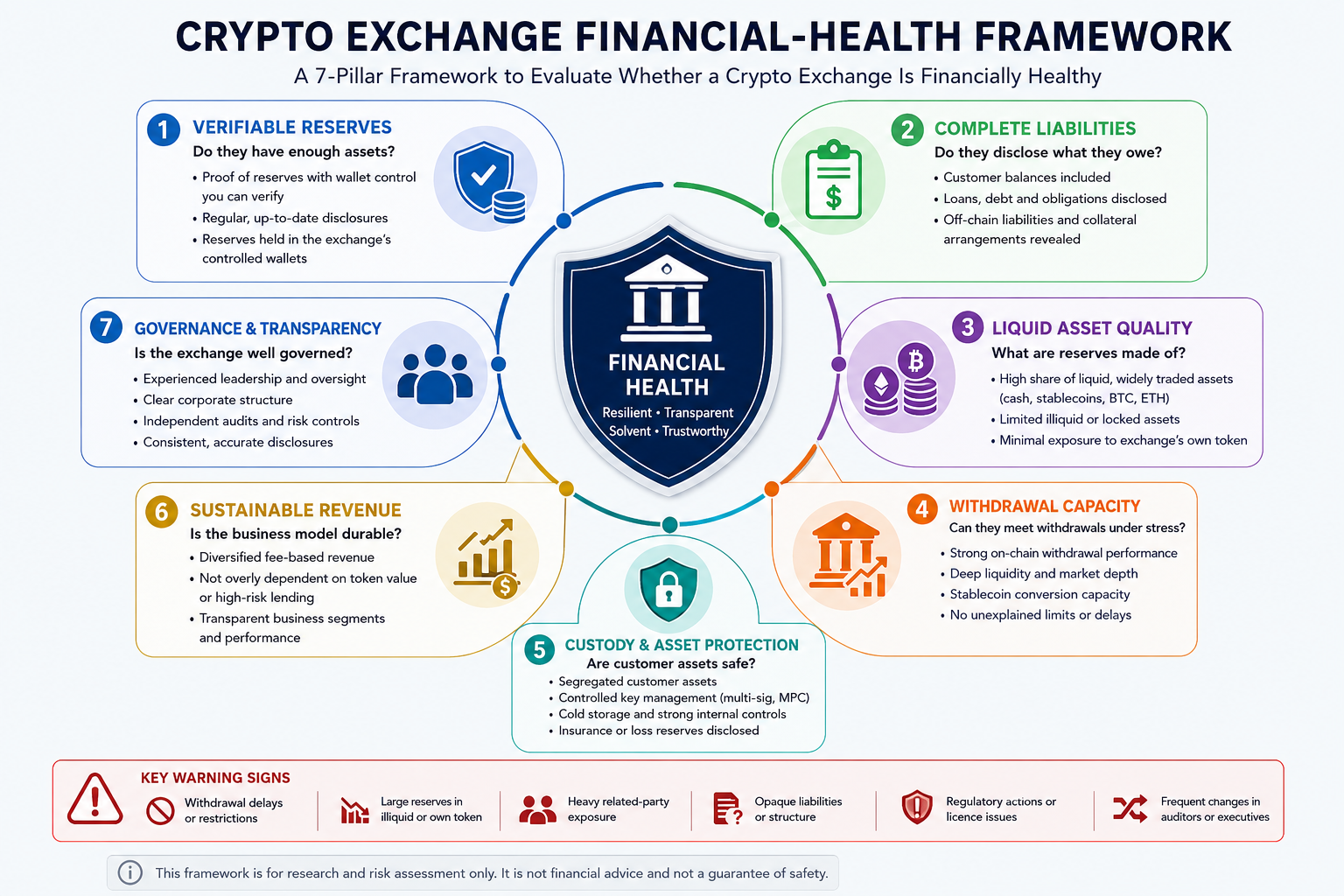
What Does Financial Health Mean for a Crypto Exchange?
Crypto exchange financial health describes whether a platform appears able to meet customer obligations, process withdrawals and continue operating without emergency financing or unstable collateral.
The assessment covers four related conditions:
| Condition |
What It Measures |
Main Question |
| Solvency |
Total assets compared with total liabilities |
Are all customer and corporate obligations covered? |
| Liquidity |
Immediately available assets compared with short-term withdrawals |
Can customers withdraw during market stress? |
| Reserve quality |
Liquidity, independence and availability of assets |
Can the reserves be used without heavy losses or delays? |
| Operational resilience |
Custody, governance, security and revenue stability |
Can the exchange withstand disruption or declining markets? |
Solvency and liquidity are not the same. An exchange may own assets worth more than its liabilities but lack enough immediately available funds to meet withdrawals. Another exchange may remain liquid temporarily by borrowing even though its total obligations exceed its assets.
Understanding how centralized exchanges operate helps explain why users depend on the platform to safeguard assets, maintain internal account records and execute withdrawals. That reliance creates counterparty risk whenever customers do not directly control the private keys.
Start With Proof of Reserves, but Do Not Stop There
Proof of reserves can show that an exchange controls identified assets, but it is not equivalent to a complete financial-statement audit.
A proof-of-reserves process may use public wallet addresses, cryptographic signatures and a Merkle tree representing customer balances. Individual users may then check whether their balances were included without viewing another customer’s account.
The PCAOB has warned that proof-of-reserves engagements vary in scope and should not be treated as evidence that a platform has enough assets to satisfy all customer liabilities. A report may omit debts, related-party obligations and whether assets have been borrowed or pledged as collateral.
Gate Learn’s overview of how proof of reserves works introduces the asset-verification process. The financial-health assessment must continue beyond that evidence.
| Proof of reserves can help show |
Proof of reserves may not show |
| Control of identified blockchain wallets |
Complete customer and corporate liabilities |
| Assets held on a reporting date |
Loans secured against those assets |
| Inclusion of a balance in a Merkle tree |
Off-chain debts and legal obligations |
| Composition of disclosed wallets |
Related-party transfers |
| Changes in public balances over time |
Liquidity during mass withdrawals |
| Greater transparency than no disclosure |
Full solvency or profitability |
A stronger disclosure identifies the reporting date, verification provider and methodology. It should also explain whether customer liabilities are included and whether disclosed assets are unencumbered.
Snapshot timing matters. Assets can enter a wallet before a reporting date and leave afterward. Regular disclosures supported by observable wallet histories therefore provide more information than a single report.
Compare the Exchange’s Assets With Its Liabilities
An exchange cannot be evaluated from asset balances alone because financial health depends on what those assets must repay.
The basic calculation is:
Reserve coverage ratio = Verifiable customer reserve assets ÷ Customer liabilities
Assume a hypothetical Exchange A discloses $5.2 billion of verifiable customer reserve assets and $5 billion of customer liabilities:
$5.2 billion ÷ $5 billion = 1.04
The result suggests $1.04 of disclosed reserve assets for each $1 of disclosed customer liabilities. It does not prove solvency. The conclusion would change if liabilities were incomplete, asset values were overstated or wallets were pledged to lenders.
Relevant liabilities may include:
-
customer account balances;
-
corporate borrowing;
-
lending-program obligations;
-
derivatives exposure;
-
collateral commitments;
-
legal claims or guarantees;
-
amounts owed to affiliates;
-
assets deployed through staking, lending or decentralized finance.
Reserve assets should also be distinguished from corporate treasury assets. A company may own valuable assets that are not legally or operationally available to repay customers.
An exchange that publishes wallet balances without comparable liability information provides evidence of assets, not evidence that all obligations are covered.
Check the Quality and Liquidity of Reserve Assets
Reserve quality determines how much practical withdrawal capacity the reported asset value provides.
Cash, widely used stablecoins and deeply traded crypto assets can generally be converted more readily than locked investments, thinly traded tokens, unsecured loans or assets issued by the exchange itself. Stablecoins still introduce issuer, reserve and redemption risks, while Bitcoin and Ether remain exposed to market volatility.
The liquid reserve ratio is:
Liquid reserve ratio = Highly liquid reserve assets ÷ Total disclosed reserves
Suppose Exchange A reports $5.2 billion of reserves, of which $3.6 billion is considered highly liquid:
$3.6 billion ÷ $5.2 billion = 69.2%
The remaining 30.8% is not automatically worthless. It may simply take longer to sell or require a discount during stressed conditions.
| Reserve type |
General liquidity profile |
Key question |
| Cash and cash equivalents |
High when confirmed and accessible |
Is the cash unencumbered? |
| Major stablecoins |
Often liquid, with issuer risk |
Can they be redeemed during stress? |
| Bitcoin and Ether |
Deep markets, but volatile |
What loss could rapid liquidation cause? |
| Smaller tokens |
Variable or limited |
Can a large position be sold near its stated value? |
| Locked or staked assets |
Not immediately available |
What is the release or unbonding period? |
| Loans and receivables |
Depends on borrower quality |
Can borrowers repay during stress? |
| Exchange-issued tokens |
Exposed to circular confidence risk |
Would demand survive a loss of trust? |
The own-token concentration formula is:
Own-token concentration = Exchange-issued tokens held as reserves ÷ Total reserve assets
High concentration creates circular risk. Falling confidence in an exchange may reduce the price and liquidity of its token precisely when the exchange needs to sell that token to meet withdrawals.
Evaluate Withdrawal Liquidity and Market Depth
Withdrawal performance is one of the most practical indicators of exchange liquidity because customer claims eventually need to be settled in transferable assets.
Users should examine whether withdrawals continue during volatility, network congestion and sudden increases in demand. Scheduled maintenance affecting one network is different from unexplained delays across unrelated assets.
Market depth also affects reserve value. A large token balance may appear valuable at the latest quoted price, but selling the position can move the market against the exchange. Thin order books, wide spreads and high slippage reduce realistic liquidation value.
Relevant indicators include:
-
sudden changes in withdrawal limits;
-
repeated delays without a clear technical explanation;
-
abnormal differences between exchange and wider market prices;
-
declining order-book depth;
-
difficulty converting balances into major assets;
-
incentives that discourage withdrawals;
-
emergency borrowing or capital raising.
Centralized exchanges commonly provide deeper liquidity and faster execution than many decentralized venues, but the trade-off is greater reliance on the platform’s custody and internal controls. The differences between centralized and decentralized exchanges illustrate why liquidity and custody must be evaluated together.
Public wallet transfers can support investigation, but they require context. A large transfer may reflect customer withdrawals, wallet consolidation or custody migration rather than financial distress.
A resilient exchange should generate repeatable operating revenue while maintaining clear separation between customer assets, corporate funds and affiliated businesses.
Revenue may come from spot and derivatives fees, custody, staking services, lending or technology services. Dependence on token appreciation, aggressive lending or unsustainably high yields creates greater sensitivity to falling markets.
Revenue concentration also matters. Heavy reliance on one region, product or affiliated market maker can turn a regulatory restriction, market decline or counterparty failure into a wider operational problem.
The BitMEX shutdown illustrates why business sustainability should be evaluated separately from immediate solvency. BitMEX said its September 23, 2026 closure followed a strategic review and stated that users’ assets remained safe and under their control. The case shows that an exchange may discontinue operations for strategic or commercial reasons even when the available announcement does not indicate that customer assets are missing. Users should therefore examine both financial capacity and the platform’s ability to maintain services over time.
Custody and governance questions include:
-
Are customer assets legally and operationally segregated?
-
Who controls hot-wallet and cold-wallet keys?
-
Do large transfers require multiple approvals?
-
Can customer assets be lent, pledged or rehypothecated?
-
Does the exchange have affiliated trading or lending firms?
-
Are related-party transactions disclosed?
-
Can executives override ordinary risk controls?
-
Which legal entity holds customer assets?
IOSCO’s recommendations for crypto-asset markets emphasize client-asset protection, custody controls and management of conflicts created by vertically integrated trading, listing and custody businesses.
Exchange structure therefore matters as much as the size of visible wallets. A licence held by one group company may not cover every service, jurisdiction or customer relationship.
Look for Operational and Market Warning Signs
No single warning sign proves insolvency, and an exchange closure does not automatically indicate financial failure. Operational events should be assessed according to their stated cause, withdrawal conditions, asset disclosures and supporting evidence.
BitMEX’s announced closure provides a useful distinction. The exchange attributed the decision to a strategic business review, said user assets remained safe and instructed customers to close positions and withdraw funds before September 23, 2026. Based on the reported information, the closure represents an operational and business-continuity event rather than confirmed evidence of insolvency.
Major red flags include:
-
proof of reserves without corresponding liabilities;
-
heavy reliance on an exchange-issued token;
-
unexplained withdrawal limits or delays;
-
unusually high lending or deposit yields;
-
opaque loans to founders or affiliated companies;
-
commingling of customer and corporate assets;
-
repeated changes in auditors;
-
executive departures during a liquidity event;
-
inconsistent reserve figures;
-
unexplained movements from disclosed wallets;
-
regulatory restrictions or licence suspensions;
-
terms allowing broad use of customer assets as collateral;
-
closure notices that provide insufficient time or unclear withdrawal procedures.
General crypto trading risks include exchange and operational failures that can prevent users from accessing assets. The presence of a warning sign should still be classified correctly before drawing a conclusion.
| Evidence type |
Example |
Appropriate interpretation |
| Directly observable |
Public wallet balance or withdrawal status |
Fact at a stated time |
| Exchange disclosure |
Reserve report or corporate statement |
Claim made by the platform |
| Independently reviewed |
Audit, filing or regulatory report |
Evidence within the stated scope |
| Inferred |
Wallet transfer interpreted as distress |
Hypothesis requiring corroboration |
| Unverified |
Unsupported social-media allegation |
Insufficient evidence |
This distinction prevents normal maintenance, wallet management or network congestion from being misrepresented as proof of financial failure.
Use a Crypto Exchange Financial-Health Checklist
A structured checklist is more reliable than judging an exchange by size, branding or one favorable report.
-
Confirm the legal entities and jurisdictions.
-
Review the latest proof-of-reserves disclosure.
-
Check whether customer liabilities are included.
-
Separate liquid reserves from illiquid or locked assets.
-
Calculate exposure to the exchange’s own token.
-
Review withdrawal performance during volatile periods.
-
Evaluate revenue sources and lending activities.
-
Investigate affiliates and related-party transactions.
-
Check regulatory, security and operational history.
-
Repeat the assessment after major events.
Exchange Financial-Health Scorecard
Score each category from 0 to 2 using verifiable evidence.
| Category |
0 points |
1 point |
2 points |
| Proof of reserves |
No meaningful disclosure |
Partial or irregular disclosure |
Regular, independently verifiable disclosure |
| Liability transparency |
No liability data |
Limited information |
Comprehensive, independently reviewed liabilities |
| Reserve quality |
Mainly illiquid or affiliated assets |
Mixed quality |
Mostly liquid, independent assets |
| Own-token exposure |
High dependence |
Moderate exposure |
Limited exposure |
| Withdrawal reliability |
Frequent restrictions or delays |
Occasional concerns |
Consistent processing during stress |
| Revenue sustainability |
Opaque or speculative |
Partly diversified |
Clear, diversified operating revenue |
| Custody controls |
Unclear or commingled |
Partial segregation |
Strong segregation and key controls |
| Related-party risk |
Significant and opaque |
Some disclosed exposure |
Limited, transparent exposure |
| Governance |
Concentrated and opaque |
Basic oversight |
Independent, transparent oversight |
| Regulatory standing |
Significant unresolved issues |
Mixed status |
Clear entities and compliance standing |
| Total score |
Research interpretation |
| 17–20 |
Strong visible indicators, with continued monitoring required |
| 13–16 |
Generally positive indicators, with several areas to verify |
| 8–12 |
Material transparency or risk gaps |
| 0–7 |
High uncertainty or multiple warning signs |
The score is not an official rating. Missing information should not receive a positive assumption, and liabilities, liquidity and custody deserve the greatest attention.
Worked Example
Assume hypothetical Exchange A receives 15 out of 20. It scores strongly on reserves, asset quality, own-token exposure and withdrawals but receives lower scores for liability disclosure, custody, governance and related parties.
The correct conclusion is not that Exchange A is safe. The score identifies where further verification is required.
Managing Personal Counterparty Exposure
No public framework can eliminate platform risk because users rarely have complete, real-time access to an exchange’s finances.
Risk controls may include limiting balances to near-term trading needs, enabling strong account security and reviewing custody terms regularly. Users who can protect private keys may consider self-custody for assets not required on an exchange, although self-custody replaces exchange risk with wallet, phishing and key-management risk.
Exchange selection should therefore consider financial health alongside security, liquidity, fees and operational suitability. These broader criteria also appear when assessing how to choose a crypto exchange.
Conclusion
Crypto exchange financial health cannot be reduced to one wallet balance, reserve ratio or licence. A credible assessment combines assets, liabilities, reserve quality, withdrawal liquidity, revenue, custody, governance and related-party exposure.
Proof of reserves is a useful starting point, but complete liabilities and asset encumbrance determine how much those reserves mean. Users should treat every disclosure as dated evidence, separate verified facts from inference and reassess custodial exposure whenever information becomes incomplete or inconsistent.
FAQ
What is the best way to check whether a crypto exchange is solvent?
Compare independently verified assets with complete liabilities, then examine asset quality, collateral obligations and related-party exposure. Proof of reserves alone cannot establish solvency.
Does proof of reserves prove that an exchange is financially safe?
No. Proof of reserves may verify selected assets at a particular time, but it may not disclose complete liabilities, pledged assets or future withdrawal capacity.
Why are liabilities important when assessing an exchange?
Liabilities reveal what the exchange owes to customers, lenders, counterparties and affiliates. A large reserve balance has limited meaning when the total claims against it are unknown.
Is an exchange’s own token a reliable reserve asset?
An exchange-issued token may have market value, but heavy dependence creates circular risk because falling trust in the exchange can also reduce the token’s value and liquidity.
What warning signs may indicate liquidity problems?
Unexplained withdrawal delays, wider spreads, falling market depth, emergency fundraising and incentives that discourage withdrawals may indicate pressure. None is conclusive without supporting evidence.