Traditional stock and commodity markets have long been limited by trading hours. Whether in U.S. equities, commodity futures, or foreign exchange markets, fixed opening and closing times still exist. This means that when major macro events, geopolitical risks, or shifts in market sentiment occur during off-hours, investors often cannot trade or hedge risk immediately.
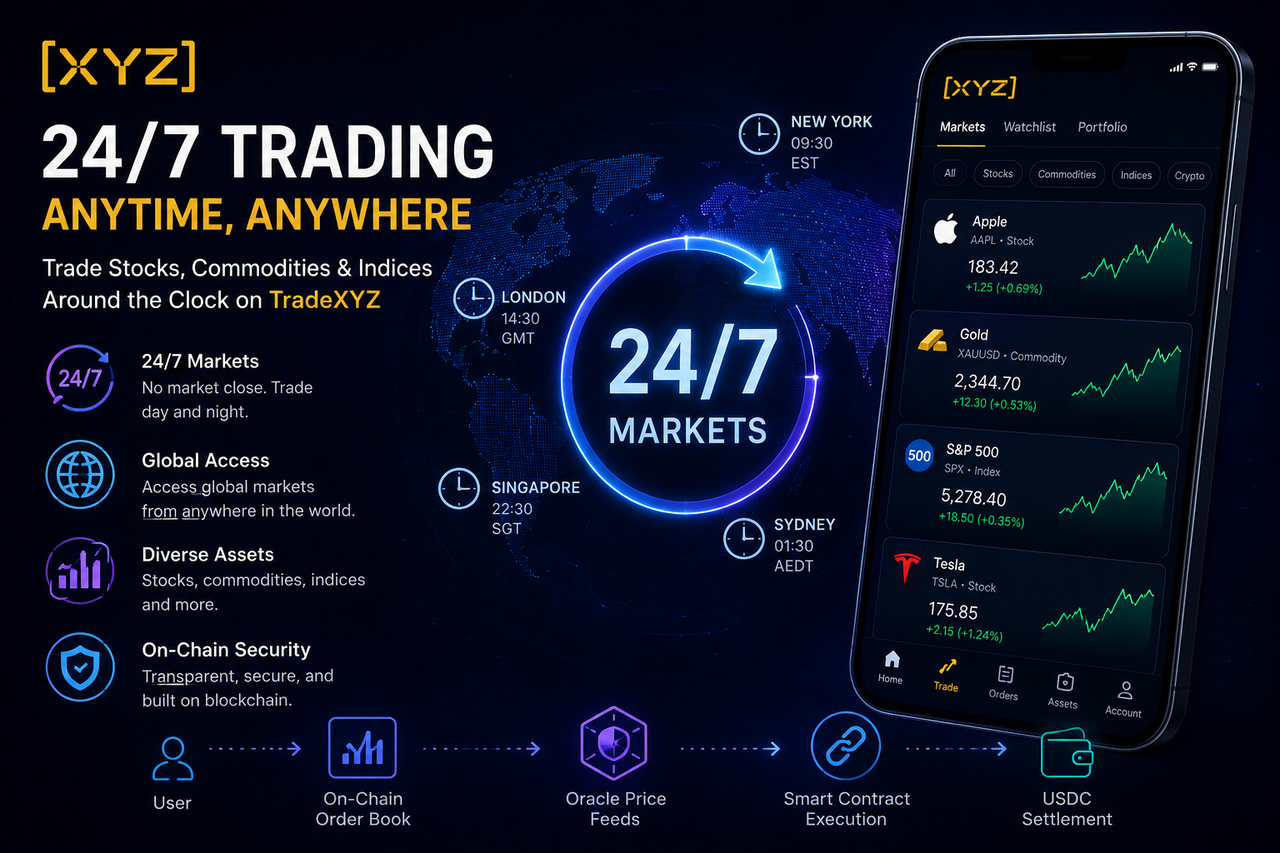
As on-chain derivatives markets develop rapidly, more platforms are trying to build “always-on global markets.” Through on-chain perpetual markets, oracle pricing, and order book infrastructure, TradeXYZ allows users to trade stocks, commodities, indices, and crypto assets in a market that runs 24 hours a day, 7 days a week.
Why Can’t Traditional Stock Markets Run 24/7?
Traditional stock markets depend on centralized exchanges, clearing systems, and bank settlement infrastructure, so they operate within fixed trading hours. For example, U.S. stocks usually trade only on business days. Commodity markets may have longer trading sessions, but they still have settlement periods and market breaks.
This structure helps concentrate liquidity and manage risk, but it also creates clear limitations. When major events happen over the weekend or while markets are closed, investors cannot adjust positions immediately. Market risk can only be repriced after the market opens.
On-chain perpetual markets are different. Because they run on on-chain infrastructure and do not rely on traditional securities exchanges, they can theoretically operate continuously.
How Does TradeXYZ Enable a 24/7 Market?
TradeXYZ’s core infrastructure is built on the on-chain perpetual contract model.
Unlike traditional stock trading, users on TradeXYZ do not trade real stocks. They trade perpetual markets built around asset prices. As a result, the platform does not need to depend on the opening hours of traditional securities markets.
Its market structure is mainly composed of an on-chain order book, perpetual contract mechanism, oracle system, and funding rate model. The order book continuously matches buy and sell orders. Oracles provide external price references, while funding rates help balance the gap between market prices and external reference prices.
In addition, the platform uses USDC as the unified margin and settlement asset, allowing different markets to operate within the same liquidity system.
Why Are Perpetual Contracts Suitable for 24/7 Trading?
One of the biggest differences between perpetual contracts and traditional futures is that perpetual contracts have no fixed expiration date.
Traditional futures require regular settlement and contract rollovers. Perpetual contracts, by contrast, use funding rates to keep market prices stable, allowing them to operate continuously over the long term. This structure naturally fits global, around-the-clock trading markets.
For stock and commodity markets, TradeXYZ is not actually copying traditional securities trading. Instead, it is building an on-chain derivatives market around price movements. Users can trade Tesla perpetuals on the weekend or participate in gold or index markets late at night.
This continuous market structure is gradually making on-chain perpetual markets an important venue for risk trading outside traditional financial markets.
How Does TradeXYZ Determine Stock and Commodity Prices?
Because stocks and commodities themselves do not run directly on-chain, the platform needs external data systems to establish price references.
TradeXYZ usually combines real-time prices from traditional markets, index data, OTC market quotes, and multiple oracle data sources to build a reference pricing system. Oracles continuously provide external prices to the on-chain system and serve as an important basis for mark prices, liquidation logic, and funding rate calculations.
However, because on-chain markets and traditional markets are not fully synchronized, prices may occasionally diverge. This is especially true on weekends or when traditional markets are closed, when price movements in on-chain perpetual markets are often more pronounced.
Where Does TradeXYZ’s Liquidity Come From?
TradeXYZ’s liquidity mainly comes from on-chain trading users, market makers, and the Hyperliquid ecosystem.
Because the platform uses an order book structure, it needs buyers and sellers to continuously provide resting orders and trading liquidity. Compared with a traditional AMM model, an order book can usually offer more transparent market depth and lower slippage.
However, the liquidity depth of some emerging markets may still be lower than that of mature crypto asset markets. For example, during extreme market conditions, some stock perpetual markets may see wider spreads, thinner order books, and greater slippage.
Therefore, liquidity management remains one of the key challenges for on-chain multi-asset perpetual markets.
What Are the Risks of On-Chain Stock and Commodity Trading?
Although 24/7 markets increase trading flexibility, they also create a new risk structure.
The first is volatility risk. Because on-chain markets can continue trading while traditional markets are closed, prices may move rapidly when major news breaks.
The second is oracle risk. If external price data is delayed or abnormal, it may lead to incorrect liquidations or market price deviations.
In addition, leverage further magnifies market risk. With high leverage, even a small price movement may trigger forced liquidation.
For commodity and stock perpetual markets, liquidity risk is also important. When market activity declines, users may face greater slippage and higher execution costs.
Conclusion
TradeXYZ enables 24/7 trading for stocks, commodities, and indices through on-chain perpetual contracts, oracle prices, funding rates, and an order book mechanism.
This model does not mean users directly trade real stocks. Instead, they use an on-chain derivatives market to trade long or short around asset prices and manage risk. Compared with traditional financial markets, on-chain perpetual markets can move beyond time and geographic limits, providing continuous market liquidity for users around the world.
FAQs
Do Users Actually Own Stocks on TradeXYZ?
No. Users trade perpetual contracts built around stock prices. These contracts do not represent real equity ownership.
How Are Stock Perpetual Prices Determined?
The platform usually combines oracle data, traditional market prices, and market supply and demand to build a reference pricing system.
Why Can Stock Perpetual Markets Still Trade on Weekends?
On-chain perpetual markets are not limited by traditional market trading hours, so they can operate around the clock.
Why Do Funding Rates Fluctuate?
When market prices diverge from reference prices, funding rates adjust dynamically to balance long and short markets.
What Are the Main Risks of On-Chain Stock Perpetual Markets?
The main risks include leverage risk, oracle risk, liquidity risk, price deviation risk, and market volatility risk.







