PoW public chains share a common security foundation based on hashrate competition for block production, but differ markedly in data structure, consensus mechanisms, and feature prioritization. Kaspa (KAS) is positioned as a high-throughput Layer 1, replacing the single-chain model with blockDAG. Litecoin, a fork of Bitcoin, emphasizes shorter block times and the Scrypt algorithm, while Monero builds privacy protections directly into its protocol layer. For effective comparison, start with how the ledger is structured, then examine mining algorithms, confirmation speed, and token issuance rules.
What Is Litecoin (LTC)?
Litecoin (LTC), launched in 2011, is a PoW public chain created by Charlie Lee as a fork of Bitcoin, designed as a payment network. Litecoin uses the UTXO model and a single-chain structure, with block intervals of approximately 2.5 minutes, a maximum supply of around 84 million LTC, and the Scrypt mining algorithm.
MWEB (MimbleWimble Extension Blocks) is introduced at the protocol layer as an optional privacy feature—privacy is not enabled by default. Unlike Kaspa’s blockDAG, Litecoin maintains a linear single chain, where only one valid block is typically kept at each height, and losing blocks become orphans. Key differences include a shorter block interval, the use of Scrypt, and the optional MWEB privacy module.
| Litecoin (LTC) Key Parameters |
Description |
| Data Structure |
Linear single chain |
| Consensus Protocol |
Nakamoto longest chain |
| Block Interval |
Approx. 2.5 minutes |
| Mining Algorithm |
Scrypt |
| Supply Cap |
Approx. 84 million LTC |
| Privacy Design |
Optional MWEB extension |
| Account Model |
UTXO |
This table summarizes Litecoin’s technical position: optimizing block speed and algorithm choice within a Bitcoin-style single-chain framework, with an optional privacy layer.
What Is Monero (XMR)?
Monero (XMR), launched in 2014, is a PoW public chain focused on privacy by default. Monero uses the CryptoNote protocol family, and implements Ring Signatures, Stealth Addresses, and RingCT to obfuscate transaction parties and amounts for every transaction.
Monero’s mining algorithm, RandomX, is optimized for CPU mining to limit ASIC dominance. The chain is single and linear, with block intervals of about 2 minutes and no hard supply cap, maintaining miner incentives through tail emission. Unlike Litecoin—where privacy is optional—Monero’s privacy is protocol default. Compared to Kaspa, Monero prioritizes untraceability at the transaction layer rather than parallel high-frequency block production.
| Monero (XMR) Key Parameters |
Description |
| Data Structure |
Linear single chain |
| Consensus Protocol |
Nakamoto longest chain |
| Block Interval |
Approx. 2 minutes |
| Mining Algorithm |
RandomX (CPU-friendly) |
| Supply Mechanism |
No hard cap, includes tail emission |
| Privacy Design |
Default ring signatures + stealth addresses + RingCT |
| Account Model |
CryptoNote-based |
Monero’s priorities are default privacy and ASIC-resistant mining, with a traditional single-chain ledger structure.
How Does Kaspa’s blockDAG Differ?
Kaspa’s core distinction from Litecoin and Monero is its ledger structure. Litecoin and Monero both use a single-chain model: new blocks reference a single parent, forming a linear chain, and blocks that lose the competition at the same height become orphans. Kaspa, by contrast, employs a blockDAG (block Directed Acyclic Graph), allowing new blocks to reference multiple predecessors and enabling miners to produce blocks in parallel within similar timeframes.
Kaspa’s GHOSTDAG consensus assigns a global order to parallel blocks, targeting about 10 blocks per second. Parallel blocks are included in the order and rewarded, not simply discarded. The mining algorithms are KHeavyHash for Kaspa, Scrypt for Litecoin, and RandomX for Monero. Kaspa focuses on high throughput and fair launch; Litecoin prioritizes payment efficiency and optional privacy; Monero emphasizes privacy by default and CPU mining. Kaspa transactions are transparent by default, a stark contrast to Monero.
blockDAG and GHOSTDAG details how parallel blocks are ordered in the ledger; Kaspa vs. Bitcoin: Core Differences offers a structural comparison from the single-chain perspective. Kaspa’s differentiation lies in the parallel confirmation paths enabled by blockDAG, not privacy or tail emission.
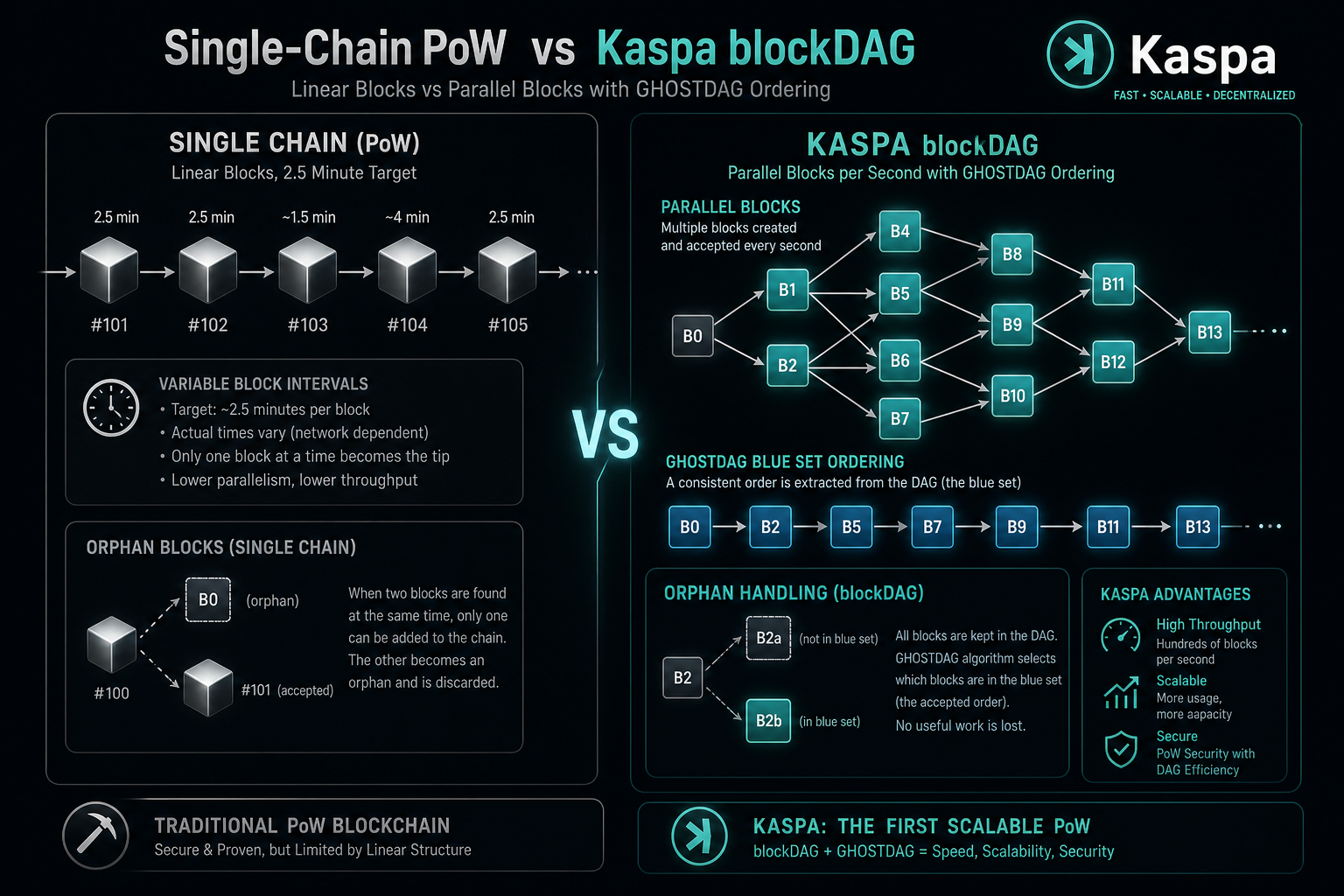
Figure 1. Architectural differences: Kaspa blockDAG parallel blocks versus Litecoin and Monero’s single-chain linear PoW structures.
PoW Public Chains: A Comparative Table
| Comparison Dimension |
Kaspa (KAS) |
Litecoin (LTC) |
Monero (XMR) |
| Data Structure |
blockDAG |
Single chain |
Single chain |
| Consensus Protocol |
GHOSTDAG |
Nakamoto longest chain |
Nakamoto longest chain |
| Target Block Rate |
~10 blocks/sec |
~2.5 min/block |
~2 min/block |
| Mining Algorithm |
KHeavyHash |
Scrypt |
RandomX |
| Orphan Block Handling |
Included in DAG order and rewarded |
Usually discarded |
Usually discarded |
| Privacy Design |
Default transparent (UTXO) |
Optional MWEB |
Default ring signatures + RingCT |
| Supply Mechanism |
Fair launch, ~28.7 billion cap |
Halving cycle, ~84 million cap |
No hard cap, with tail emission |
| Node Implementation |
RustyKaspa |
Litecoin Core |
Monero full node |
| Core Positioning |
High-throughput PoW Layer 1 |
Payment-focused single chain |
Privacy-by-default single chain |
This table compares three PoW public chains across nine dimensions. Kaspa breaks from the traditional single-chain paradigm in both data structure and block frequency; Litecoin optimizes speed and privacy options within a single-chain model; Monero enhances default privacy and CPU mining, also in a single-chain framework. All three rely on PoW for security, but their functional directions diverge.
KAS Tokenomics and Mining further explains KAS’s fair launch, KHeavyHash hashrate competition, and block reward reduction, which correspond to the “Supply Mechanism” and “Mining Algorithm” rows above.
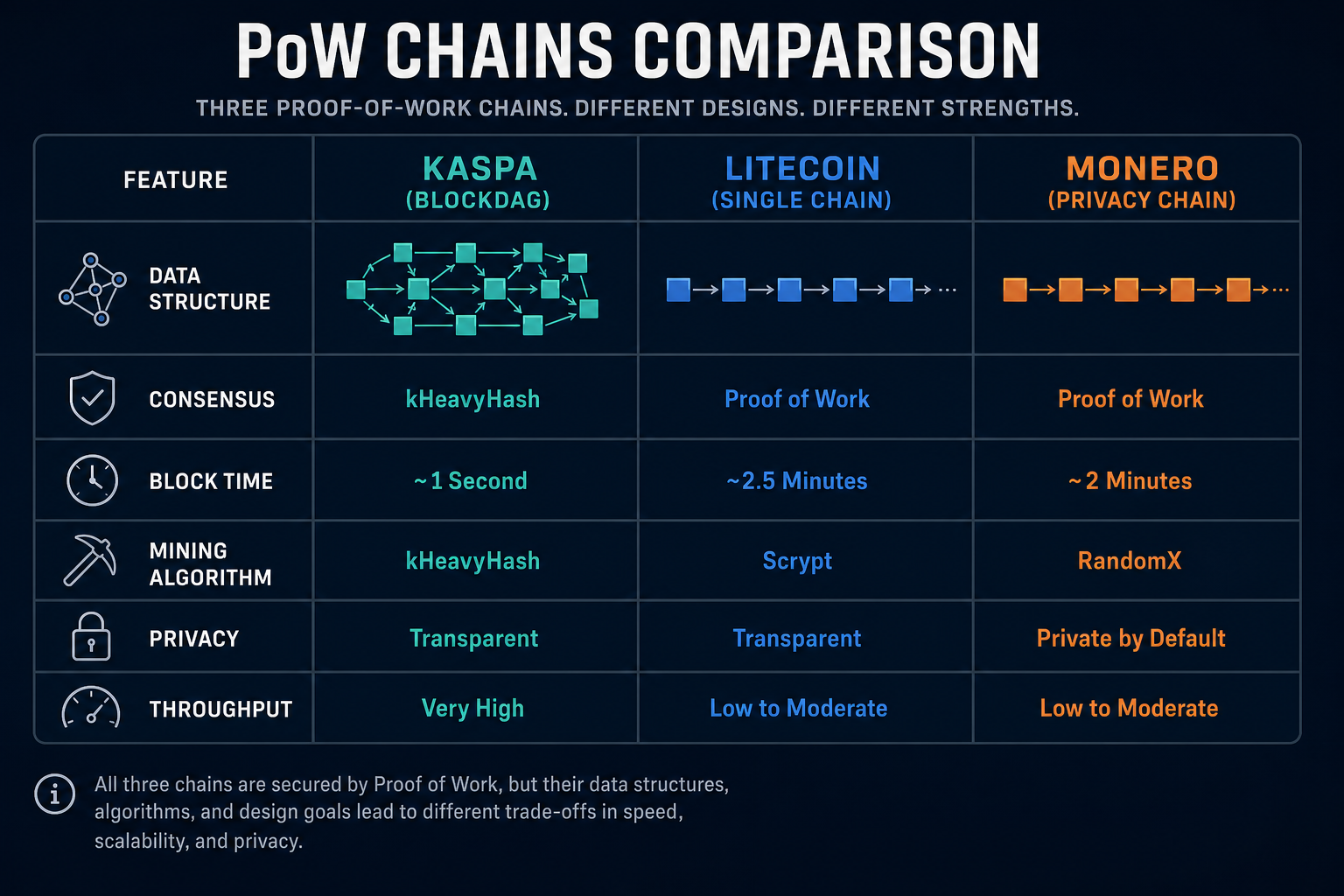
Figure 2. Kaspa, Litecoin, and Monero compared across data structure, consensus, mining, and privacy dimensions.
What Are the Limitations of Comparison?
When comparing PoW public chains, be aware of several structural limitations. Block frequency and confirmation speed are not directly interchangeable: Kaspa’s high block rate depends on network propagation and GHOSTDAG ordering depth, so cross-chain comparisons must consider specific confirmation rules, not just block intervals.
Privacy capabilities differ fundamentally: Monero’s privacy is default, Litecoin’s MWEB is optional, and Kaspa is transparent by default—each reflects a distinct design philosophy and cannot be simply ranked. Ecosystem maturity also varies: Litecoin and Monero have over a decade of operational history, while Kaspa’s mainnet is newer and its application layer is still evolving.
Mining algorithms and hashrate distribution are independent—Scrypt, RandomX, and KHeavyHash each require separate decentralization assessments. Supply mechanisms also differ: Kaspa has a defined cap, Litecoin follows a halving schedule, and Monero uses tail emission for ongoing incentives. Their tokenomics cannot be evaluated under a single framework. Focus on the mechanisms themselves, and avoid equating functional differences with superiority.
Summary
Kaspa (KAS), Litecoin (LTC), and Monero (XMR) are all PoW public chains built on the principle of hashrate competition for block production, but they differ significantly in ledger structure, consensus protocols, privacy design, and token issuance rules. Kaspa uses blockDAG and GHOSTDAG for parallel high-frequency block production; Litecoin optimizes block speed and privacy options within a single-chain framework; Monero is characterized by default privacy and RandomX CPU mining. When comparing, start by identifying data structure differences, then examine mining algorithms, confirmation paths, supply mechanisms, and ecosystem maturity—never rely on a single metric to generalize all PoW chains.
FAQ
What is Kaspa?
Kaspa (KAS) is a PoW-based Layer 1 public chain using a blockDAG data structure and GHOSTDAG consensus, targeting about 10 blocks per second. The native KAS token is used for trading fees and miner rewards. The network launched fairly, with no premine or hidden allocations, and the main full node implementation is RustyKaspa.
How does Kaspa differ from Bitcoin?
Bitcoin uses a single-chain structure with a block interval of about 10 minutes; blocks that lose the competition become orphans. Kaspa uses blockDAG for parallel block production, with GHOSTDAG ordering parallel blocks into the ledger, targeting about 10 blocks per second. The mining algorithm is KHeavyHash, not SHA-256. Both use the PoW UTXO model, but differ in data structure and security trade-offs.
How does Kaspa differ from Litecoin and Monero?
Kaspa uses blockDAG for parallel high-frequency block production, while Litecoin and Monero use single-chain structures. Litecoin focuses on shorter block intervals and optional MWEB privacy; Monero features default ring signature privacy and RandomX CPU mining. Kaspa does not offer protocol-level default privacy; each chain has a distinct functional focus.
Is Kaspa secure? Is PoW still trustworthy?
Kaspa’s security model relies on PoW hashrate competition and GHOSTDAG validation. Full nodes (RustyKaspa) independently verify every transaction and block. PoW’s security depends on decentralized hashrate and protocol implementation quality; parallel block production does not weaken PoW’s fundamentals, though network propagation and reorg risks must be considered. Litecoin and Monero also rely on PoW, and their hashrate distribution and protocol audits should be reviewed individually.
How do Litecoin and Monero differ in privacy design?
Litecoin transactions are transparent by default; privacy is optional via MWEB. Monero uses ring signatures, stealth addresses, and RingCT for privacy by default, making transaction tracing extremely difficult. Their privacy capabilities are not equivalent—distinguish between “optional” and “default” privacy when comparing.
What should be prioritized when comparing PoW public chains?
Start with the ledger data structure: single chain (Litecoin, Monero, Bitcoin) or blockDAG (Kaspa), as this determines block production and orphan handling. Then examine consensus protocol, mining algorithm, privacy design, supply mechanism, and ecosystem maturity—avoid judging solely by block interval or market cap.







