AI model training requires large amounts of parallel computing, so GPUs have become an important part of AI infrastructure. The architecture design and software environment of different chipmakers directly affect AI model training efficiency and how data centers are deployed.
NVIDIA and AMD differ clearly in GPU architecture, AI computing mechanisms, development ecosystems, data center strategies, and application scenarios. Differences in the CUDA software ecosystem, open computing environments, and industry deployment strategies also shape the companies’ competitive paths in the AI chip market.
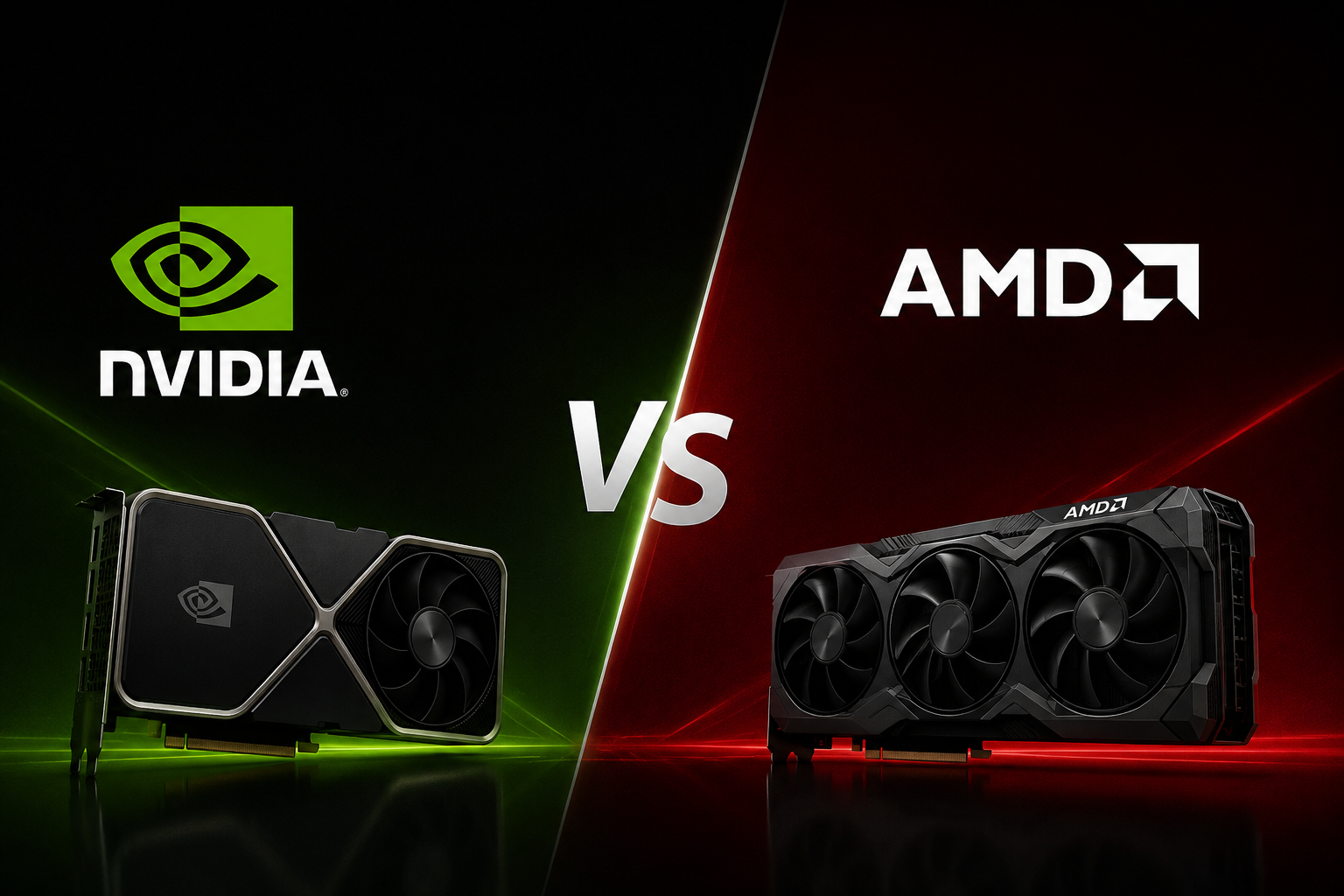
What Is NVDA
NVDA is NVIDIA’s stock ticker on the Nasdaq market. NVIDIA’s core businesses include GPUs, AI chips, data center computing, and high performance networking infrastructure.
NVIDIA GPUs are designed to improve parallel computing efficiency. Since AI model training requires large amounts of matrix and tensor computation, NVIDIA GPUs are widely used in large scale AI systems.
From an industry structure perspective, NVIDIA is no longer just a traditional graphics card company. Through CUDA, AI software tools, and data center platforms, NVIDIA has built a complete AI infrastructure ecosystem.
Official information shows that the data center business has become one of NVIDIA’s most important sources of revenue. AI companies and cloud platforms often use NVIDIA GPUs to deploy AI model training clusters.
What Is AMD
AMD is a semiconductor company with businesses across both CPUs and GPUs. Its products mainly cover servers, consumer processors, high performance GPUs, and data center computing markets.
AMD’s focus in the AI market mainly centers on its Instinct GPU series and ROCm software platform. AMD aims to compete with NVIDIA’s CUDA ecosystem through a more open ecosystem approach.
Unlike NVIDIA, AMD has a dual layout across both CPUs and GPUs. Some data centers build computing systems by combining AMD CPUs with AMD GPUs.
One of AMD’s business priorities is increasing its share of the high performance computing market. AI companies and cloud platforms have also begun trying AMD GPUs as AI training infrastructure.
Differences Between NVDA and AMD in GPU Architecture
NVIDIA GPU architecture places greater emphasis on AI parallel computing and Tensor Core acceleration. AMD GPU architecture focuses more on general high performance computing and open computing compatibility.
NVIDIA GPUs usually include many Tensor Cores for matrix operations in deep learning. During AI model training, Tensor Cores can significantly improve tensor computing efficiency.
AMD GPUs place more emphasis on a unified computing architecture. AMD uses Compute Units to process parallel computing tasks and improves compatibility through an open architecture.
The table below shows the differences between NVIDIA and AMD GPU architectures:
| Comparison Dimension |
NVIDIA |
AMD |
| AI Acceleration Focus |
Tensor Core |
Compute Units |
| Software Ecosystem |
CUDA |
ROCm |
| AI Training Optimization |
Stronger |
Continually expanding |
| Data Center Positioning |
AI infrastructure |
HPC and AI |
These architecture differences mean NVIDIA leans more toward AI specific optimization, while AMD emphasizes general high performance computing capabilities.
Large AI models usually require a more mature software coordination environment, so GPU architecture affects not only hardware performance, but also the AI development process.
Differences Between NVDA and AMD in AI Computing Mechanisms
NVIDIA’s AI computing mechanism is centered on the coordination between CUDA and GPU parallel computing. After AI developers submit a training task, CUDA calls GPU cores to execute matrix operations.
First, the deep learning framework generates the AI training task. Then, the CUDA Runtime converts the task into computing instructions that the GPU can recognize.
Next, NVIDIA GPUs use Tensor Cores to perform parallel tensor computation. Finally, the AI framework updates model parameters based on the GPU output.
AMD’s AI computing process relies more on the ROCm platform and an open computing environment. ROCm can also call GPU resources, but its AI software compatibility and ecosystem scale are relatively smaller.
Unlike NVIDIA, AMD emphasizes an open AI computing environment. Some developers use ROCm to deploy AI training systems in order to reduce reliance on CUDA.
When AI companies choose a GPU platform, they consider not only chip performance, but also software compatibility, the development environment, and training stability.
Differences Between NVDA and AMD in Development Ecosystems
NVIDIA’s development ecosystem is centered on CUDA, which has already formed a complete AI software system. Many deep learning frameworks and AI tools prioritize compatibility with the CUDA environment.
After deploying NVIDIA GPUs, AI developers can usually call a mature AI toolchain directly. PyTorch, TensorFlow, and some major AI platforms have supported CUDA for a long time.
AMD’s development ecosystem is built around ROCm. ROCm provides an open GPU computing environment and aims to improve AI software compatibility.
The table below shows the differences between the NVIDIA and AMD development ecosystems:
| Comparison Dimension |
NVIDIA CUDA |
AMD ROCm |
| AI Framework Support |
Broad |
Continually expanding |
| Developer Base |
Larger |
Relatively smaller |
| Software Maturity |
Higher |
Continually improving |
| GPU Coordination Capability |
Deep integration |
Open compatibility |
This ecosystem difference means NVIDIA has a strong advantage in AI software compatibility, while AMD emphasizes open computing environments and ecosystem expansion.
From a business perspective, AI companies tend to choose platforms with stable software environments, so the development ecosystem has become an important part of AI chip competition.
Differences Between NVDA and AMD in Data Center Strategies
NVIDIA’s data center strategy focuses on building complete AI infrastructure. NVIDIA provides not only GPUs, but also networking equipment, AI servers, and software platforms.
Major cloud computing platforms commonly use NVIDIA GPUs to build AI clusters. During AI model training, GPUs, networks, and data processing systems need to work together closely.
AMD’s data center strategy places more emphasis on CPU and GPU collaboration. AMD EPYC server processors and Instinct GPUs jointly support high performance computing tasks.
Structurally, NVIDIA leans more toward a platform based AI data center strategy, while AMD focuses more on competition in high performance computing and the server market.
As demand for AI infrastructure has increased, both companies have strengthened their data center market strategies, but their business priorities remain clearly different.
Differences Between NVDA and AMD in Application Scenarios
NVIDIA GPUs are more widely used in large scale AI model training, autonomous driving, and cloud computing. Many AI companies use NVIDIA GPUs to train language models and generative AI systems.
AMD GPUs appear more often in high performance computing, servers, and some AI training scenarios. AMD also has strong influence in the gaming GPU and server CPU markets.
NVIDIA’s key application areas usually include:
-
AI model training
-
Data centers
-
Autonomous driving
-
Cloud computing
AMD’s application focus leans more toward coordinated CPU and GPU computing environments.
This difference in scenarios means NVIDIA is closer to an AI infrastructure supplier, while AMD is closer to a diversified semiconductor company.
Conclusion
NVDA and AMD are both important players in the AI chip and GPU markets, but the two companies differ clearly in GPU architecture, software ecosystems, and data center strategies.
NVIDIA’s core advantages lie in the CUDA ecosystem, Tensor Cores, and AI software coordination. AMD, by contrast, places more emphasis on an open computing environment and a combined CPU and GPU layout.
As demand for AI model training grows, competition in the GPU and AI chip markets continues to expand. Software compatibility, data center coordination, and development ecosystems have become important areas of competition between NVIDIA and AMD.
FAQs
What Is the Biggest Difference Between NVDA and AMD?
NVDA refers to NVIDIA, whose core strengths lie in the CUDA AI ecosystem and GPU parallel computing capabilities. AMD focuses more on open computing environments and a coordinated CPU and GPU layout.
Why Is NVIDIA Stronger in the AI Market?
NVIDIA has built a mature CUDA ecosystem. Many AI frameworks and deep learning tools prioritize compatibility with CUDA, giving NVIDIA an advantage in AI software compatibility.
Can AMD Train AI Models?
AMD GPUs can also train AI models. AMD mainly uses the ROCm platform to access GPU resources and support some AI frameworks and high performance computing environments.
What Is the Difference Between CUDA and ROCm?
CUDA is NVIDIA’s GPU parallel computing platform, while ROCm is AMD’s open GPU computing environment. Both are used for AI and high performance computing, but their ecosystem scale differs.
How Are NVDA and AMD Different in the Data Center Market?
NVIDIA places greater emphasis on a platform based AI data center strategy, including GPU, networking, and AI software coordination. AMD focuses more on a combined computing layout built around server CPUs and GPUs.