Spark Token Price Prediction: Will Capital Efficiency Drive SPK Growth in 2025?

Beginner
Quick Reads
Last Updated 2026-04-03 15:20:48
Reading Time: 1m
Spark’s ecosystem is powered by a highly sophisticated mechanism engineered to seamlessly integrate decentralized finance (DeFi) with real-world assets (RWA).

Capital Efficiency and the Long Game of On-Chain Governance

In today’s fast-paced crypto market, Spark Token (SPK) has chosen to steer clear of hype-driven meme coin trends, focusing instead on a long-term vision for on-chain capital management. At the core of its ecosystem is a sophisticated mechanism designed to integrate decentralized finance (DeFi) with real-world assets (RWA). As of this writing, the Spark ecosystem has deployed assets exceeding $3.9 billion, demonstrating a commitment to prudent risk management while driving capital efficiency.

What Is SPK?

SPK isn’t just another utility token—it’s the governance backbone of the Spark ecosystem, with several key functions:

  • Governance Voting: Holders can influence the protocol’s development by voting
  • Security Collateral: Serves as staking collateral to safeguard protocol operations
  • Revenue Sharing: Users are rewarded for staking and contributing to the protocol

This gives SPK a clear distinction from generic tokens, firmly anchoring its value with structural support.

Three Core Products Power the Spark Ecosystem

Spark isn’t a single-purpose platform. Its ecosystem is built on three fundamental pillars for capital deployment:

  • Savings: Stablecoin holders can earn reliable yields
  • Borrow: A lending and borrowing platform focused on USDS, deeply integrated with top liquidity solutions like Sky
  • Liquidity Layer: Directly injects liquidity into other DeFi protocols

This integrated approach enhances user efficiency. It also provides the ecosystem with resilience during bear markets.

SPK Price Outlook for 2025

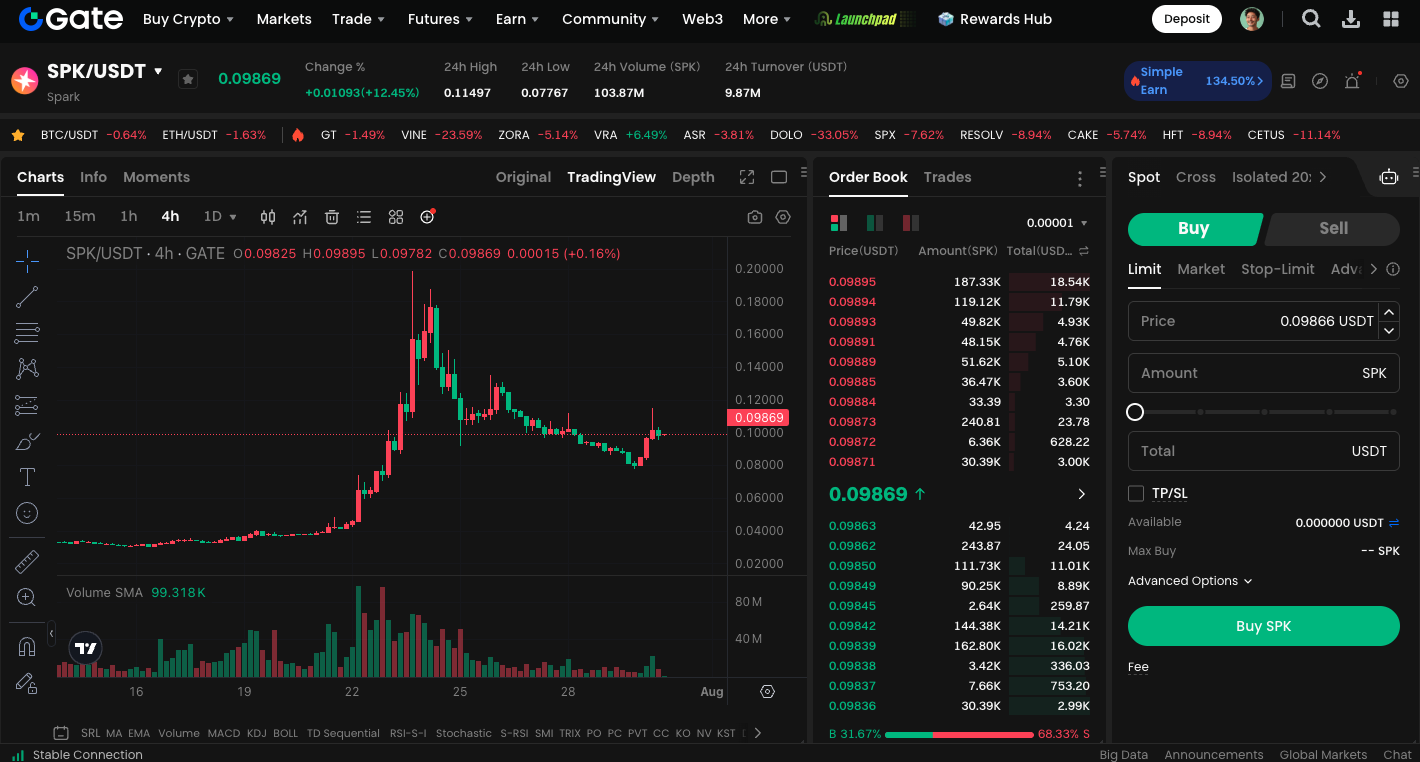
CoinCodex’s latest predictive model projects Spark Token’s 2025 trading range at $0.0735 to $0.1086, with an average annual price of $0.0822. This translates to a possible price fluctuation of approximately -11% to +11% from the current price of around $0.0978 at the time of writing.

While this forecast is slightly under the present price, these figures represent the market’s conservative median view. They do not preclude significant upside potential. If investor confidence in capital-efficient protocols increases, SPK could surpass these projections.

Is SPK a Smart Bet for Portfolio Diversification?

Unlike short-term speculative projects, Spark acts as a structured DeFi asset allocation tool. Long-term investors seeking broader diversification and risk balance may find SPK a worthy defensive addition to their portfolios. Its innovative governance framework and substantial capital deployment offer solid fundamentals, sharply contrasting with tokens lacking tangible use cases.

Start spot trading SPK now: https://www.gate.com/trade/SPK_USDT

Conclusion

As the crypto market trends toward greater institutional adoption and real-world utility, projects like Spark—which place capital efficiency and on-chain governance at their core—are well positioned to emerge as leaders. While short-term price consolidation may occur, the broader convergence of finance and blockchain gives SPK the potential to become a flagship capital allocation tool in the next growth cycle.

Author: Allen
Disclaimer
* The information is not intended to be and does not constitute financial advice or any other recommendation of any sort offered or endorsed by Gate.
* This article may not be reproduced, transmitted or copied without referencing Gate. Contravention is an infringement of Copyright Act and may be subject to legal action.

Related Articles

AI-Native Settlement Layers: How United Stables Is Building the Next Financial Rail
Beginner

AI-Native Settlement Layers: How United Stables Is Building the Next Financial Rail

Stablecoins were originally designed as dollar substitutes within exchanges, primarily used for asset pricing and trade settlement. As on-chain financial ecosystems have matured, their role has expanded beyond simple payments to include collateral assets, cross-chain liquidity mediums, and unified settlement units. In particular, as AI systems and automated agents begin to participate directly in economic activity, demand has risen sharply for programmable value units capable of instant settlement. This shift is pushing stablecoins toward the role of foundational financial infrastructure.
2026-03-25 03:16:17
The ve(3,3) Flywheel Explained: How AERO Tokenomics Powers Aerodrome’s DeFi Economy
Beginner

The ve(3,3) Flywheel Explained: How AERO Tokenomics Powers Aerodrome’s DeFi Economy

In the competition for DeFi liquidity, high-inflation mining alone is no longer enough to build lasting advantages. Aerodrome applies the ve(3,3) economic model to redesign token emissions, voting mechanisms, and revenue distribution, creating a liquidity flywheel centered on governance and cash flow. This article examines AERO tokenomics, the veAERO locking mechanism, and protocol revenue models to explain how Aerodrome builds a sustainable DeFi economic system.
2026-03-25 06:41:58
Aerodrome Tokenomics: How ve(3,3) Powers Base's Most Profitable DEX
Beginner

Aerodrome Tokenomics: How ve(3,3) Powers Base's Most Profitable DEX

AERO is the native token of Aerodrome Finance, a core decentralized exchange and liquidity protocol in the Base ecosystem. It is primarily used for liquidity incentives and ecosystem operations. veAERO is a governance NFT that users receive by locking AERO, representing both voting power and the right to share protocol revenue. Through a dual track structure of AERO as a utility token and veAERO as a governance credential, Aerodrome separates liquidity usage value from long term governance power, allowing participants to act as liquidity providers, governance decision makers, and revenue sharers within the same system.
2026-03-25 06:40:31
DePIN Identity Network and Real World Applications: How Humanity Protocol Brings on-chain Identity Into the Physical World
Beginner

DePIN Identity Network and Real World Applications: How Humanity Protocol Brings on-chain Identity Into the Physical World

Most Web3 identity systems remain confined to on-chain environments and struggle to achieve meaningful adoption in real world settings. Through a DePIN architecture and physical verification hardware, Humanity Protocol aims to bring decentralized identity into access control systems, hospitality, public services, and offline events, allowing on-chain identity to function not just as a digital credential, but as foundational infrastructure for real world access.
2026-03-25 07:40:53
How is the price of PAXG determined? Pegging mechanism, trading depth, and influencing factors
Beginner

How is the price of PAXG determined? Pegging mechanism, trading depth, and influencing factors

PAXG (Pax Gold) is a tokenized asset backed by physical gold reserves, launched by fintech firm Paxos and issued as an ERC-20 token on the Ethereum blockchain. The core concept is to digitally represent real-world gold assets, allowing investors to hold and trade gold via the blockchain network. Because each PAXG token corresponds to a specific quantity of physical gold, its price is theoretically expected to closely track the global gold market.
2026-03-24 19:11:40
Aster vs Hyperliquid: Which Perp DEX Will Prevail?
Beginner

Aster vs Hyperliquid: Which Perp DEX Will Prevail?

Aster and Hyperliquid are the two representative protocols of the "purpose-built L1 path" within the current decentralized perpetual exchange (Perp DEX) sector. As a pioneer in the field, Hyperliquid has built a deep liquidity moat through its highly mature order book architecture and strong community consensus. Conversely, Aster, as a rising challenger, seeks to leapfrog the competition in high-performance trading through more aggressive multi-chain aggregation logic, private transaction modules, and an underlying execution environment optimized for 2026 market demands.
2026-03-24 11:58:33