Preface
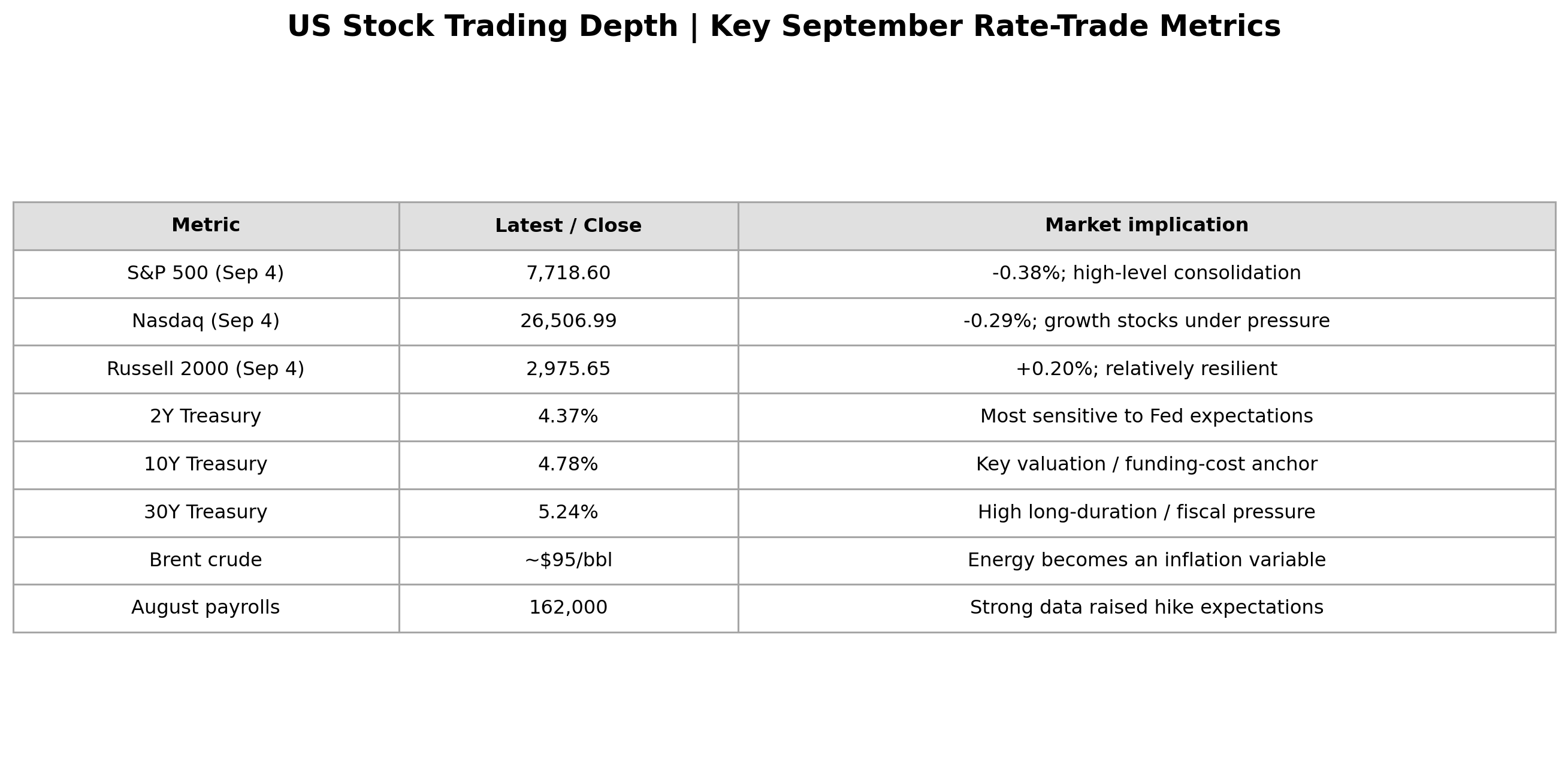
During the first week of September, U.S. equities were confronted by an unfavorable macroeconomic environment: the economy didn’t show a marked slowdown, and employment exceeded expectations. At the same time, Middle East tensions pushed oil prices higher, reigniting inflation fears. With the Federal Reserve’s September meeting fast approaching, the outlook for interest rates is increasingly uncertain. On September 4, the U.S. reported an August nonfarm payroll increase of 162,000—well above prior, lower market forecasts. This surprise led to a jump in bets on a September rate hike. Reuters reported on September 7 that the market had priced in about a 57% probability of such a move, while the upcoming CPI report will serve as a key indicator.
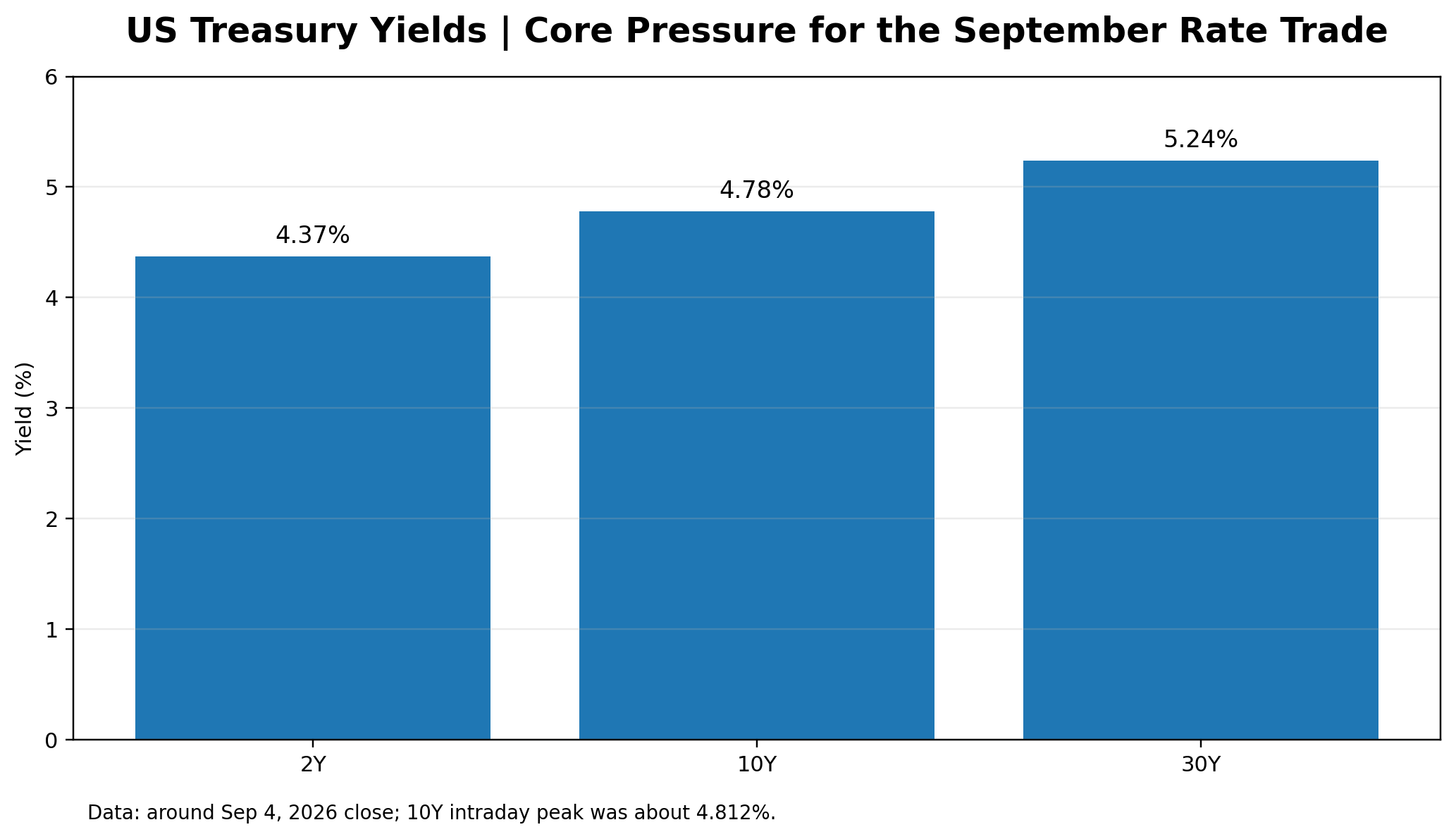
What does this mean for U.S. equities? The main change isn’t “stocks must fall,” but rather that the market’s short-term pricing logic may switch from prioritizing earnings back to focusing on interest rates. Previously, robust corporate earnings offset high valuations. However, if the 10-year Treasury yield returns to 4.8% and oil prices approach $100, discounting pressures on future cash flows for growth stocks will significantly intensify. Traders must again ask: If the economy avoids recession but rates remain high, which stocks can continue to outperform?
Key Points
-
Strong employment has diminished concerns about recession, but at the same time, elevated interest rate risk.
-
Higher oil prices dampen rate-cut trades through both inflation expectations and rising corporate costs.
-
When the 10-year Treasury yield approaches 4.8%, richly valued growth stocks become especially responsive to rate changes.
-
The market may shift from “buying AI across the board” toward “earnings certainty, capital return, and pricing power.”
-
Going forward, the primary focus should be on sector-level earnings and valuation differentiation rather than index direction.
Why Strong Employment May Become a Challenge for the Stock Market
Normally, strong employment is a positive for equities—it indicates steady consumer income, sustained corporate demand, and an economy unlikely to slip into recession. Yet stock markets trade based on the discounted value of future cash flows. When robust employment leads investors to believe the Fed must maintain tighter policy, interest rates become the flip side of strong employment.
This is the paradox currently facing markets: the more resilient the economy, the better corporate profits—but also, the less reason the Federal Reserve has to cut rates quickly. For banks, industrials, and select cyclical stocks, this may be positive, as nominal growth and financing needs persist. For high-valuation growth stocks, however, it implies downward pressure on valuation ceilings.
The Critical Variable Is “Real Interest Rates”—Not Just Rate Hikes or Cuts
Markets often oversimplify trading decisions: “rate cuts mean tech stocks rise, rate hikes mean they fall.” The reality is much more nuanced. Growth stock valuations depend on how future cash flows are discounted versus the risk-free rate and risk premium. If economic growth is strong and corporate profits are revised higher, stocks can climb even amid high rates. On the flip side, if rates fall but profits are cut sharply, equities may not benefit.
As such, CPI and the Fed meeting are this cycle’s most essential observation points. If oil price increases don’t clearly feed through to core inflation, and strong employment is matched by manageable wage growth, markets may embrace a “high rates, strong earnings” scenario. If energy prices drive persistent inflation expectations, long-term yields could stay elevated, restricting further valuation expansion.
Why Oil Prices Are the Second Key Theme for U.S. Equities in September
As of September 7, Brent crude was close to $97 per barrel and U.S. crude about $92. Higher oil prices first benefit energy stocks, but they impact far more than just that sector. Airlines, transport, chemicals, manufacturing, and consumer goods all face rising costs—and if firms can’t pass these on to consumers, profit margins get squeezed.
Even more crucially, oil prices shape inflation expectations. If markets see high prices as a short-term supply shock, bonds may remain calm. But persistent high prices raise the odds of renewed central bank tightening. U.S. equity trading then sees classic divergence: energy and certain value sectors gain from nominal price rises, while long-duration growth stocks face increased valuation pressures.
Why Rising Rates Do Not Automatically End the AI Stock Rally
AI’s greatest advantage in trading remains profit growth. Over the past year, the market has consistently raised expectations for AI infrastructure, cloud computing, and semiconductors. As long as companies continue to deliver robust earnings, higher rates alone aren’t enough to end the AI rally. Recent outperformance by Nvidia, memory, and select semiconductors shows the market is still trading the AI capital expenditure cycle.
However, the AI theme is now experiencing internal divergence. The question is shifting from “Who’s related to AI?” to “Who can convert AI investment into revenue and free cash flow?” Microsoft’s recent report of $29.4 billion in Azure quarterly sales, and its move to reorganize financial disclosures to be more AI-centric, demonstrates that AI is moving from narrative to operational metrics at large tech firms.
If rates remain high, the AI stocks best able to withstand volatility will likely be those with high revenue growth, strong cash flows, and clear capital expenditure returns. AI pure-plays lacking profit delivery will see pronounced swings.
Sector Rotation May Accelerate
If September brings not a recession trade, but a mix of high nominal growth, high rates, and high oil prices, traditional sectors may outperform more than in recent months. Financials will benefit from steeper yield curves and increased capital market activity; industrials from infrastructure, energy, and AI data center spending; energy from direct oil price gains; and healthcare and select defensive sectors from serving as stabilizers in volatile markets.
Schwab’s latest sector outlook notes that industrials are buoyed by power capacity, AI infrastructure, construction, and defense capital expenditure; financials by improved yield curves and rising net interest income; healthcare by technological advances and operational efficiency. This shift from a single AI driver to broader earnings themes may significantly expand sector rotation opportunities.
Trading Risk: “The Index Doesn’t Fall, But Making Money Gets Tougher”
September is most likely to see apparent index stability alongside ongoing internal divergence. New York Stock Exchange market observations show the S&P 500 in the 7,600–7,800 range, with equal-weight indices lagging, weaker breadth, technology and energy outperforming, and pressure in software names.
This raises the bar for traders since index gains no longer guarantee broad stock advances. The practical strategy may move from “buying beta” toward “finding earnings certainty alpha.” Especially as the 10-year yield approaches 4.8%, expensive stocks with poor profit delivery are likely candidates for repricing.
Weekly Trading Framework: Monitor CPI, Then Yields, Then Earnings
Step one: Evaluate whether CPI confirms oil-driven inflation pressures. If inflation comes in low, markets may price rate cuts again. If it overshoots, long-term yields may climb. Step two: Track the 10-year Treasury yield. If yields rise and equities hold firm, earnings are supporting valuations. If yields rise and breadth deteriorates, valuation pressures are growing.
Step three: Focus on sector earnings. Whether banks, industrials, energy, semiconductors, and major software names see earnings revisions upward will determine how quickly funds rotate out of AI leaders into other sectors. For traders, it’s not just about rate hikes or cuts—it’s how macro changes drive capital flows toward earnings certainty.
Conclusion: September Is Not Just an “End-of-Rate-Cut Trade”—It’s a Fresh Test of Valuation Resilience
A market misconception today is seeing strong employment as wholly negative. In reality, it reduces recession risk but raises rate risk. Oil price increases similarly drive energy higher but can restrain other sectors via inflation expectations. September’s real trade is rebalancing these competing forces.
If earnings stay strong, U.S. equities could hold their highs even in a high-rate climate—but how profits are made will change: from expanding valuations to profit realization, from a single AI theme to sector rotation, and from buying broadly to selecting quality companies. What matters most now isn’t whether the index sets new highs, but where rising rates and increasing macro complexity channel capital.
Why “Relative Returns” Are More Effective Than Betting Only on Index Direction
When rates, oil, and earnings are all moving, overall index direction can be influenced disproportionately by a handful of mega-caps, making simple index bets less reliable. A relative return framework is better suited—compare financials versus tech, energy versus consumer, industrials versus software, and companies with earnings upgrades versus downgrades to spot areas where capital repricing is most evident.
History shows higher rates don’t guarantee value stocks will always outperform growth stocks. The critical factor is earnings flexibility. Industrials with strong capex demand, banks with improving net interest income, and energy firms benefiting from commodity prices can use profit growth to offset valuation pressure. However, if high rates only suppress demand, cyclical sectors may face renewed stress.
As such, what’s most valuable for trading isn’t a simple list of “rate hike winners” or “rate cut winners,” but three types of companies: 1) those with consistently upward earnings revisions; 2) those with strong pricing power able to pass on costs; and 3) those with robust balance sheets that keep investing and growing market share in a high-rate environment.
FAQ
With September rate hike expectations rising, does that mean U.S. stocks will definitely fall?
Not necessarily. It depends on whether earnings are strong enough to offset the higher discount rate. A strong economy and robust earnings can help some stocks absorb higher rates. The vulnerable companies are those with lofty valuations but insufficient profit realization.
Which sectors benefit most from rising oil prices?
Energy gains directly; some resource and energy services firms benefit indirectly. Cost-sensitive sectors like transport, chemicals, manufacturing, and discretionary consumer industries may be pressured.
Is it still a good strategy to chase AI stocks now?
It’s wiser to be selective than to chase the whole market. Focus on revenue growth, free cash flow, capital expenditure returns, and valuation alignment—not just the AI label.