US stock spot trading and US stock futures offer two different ways to access US equity market movements on Gate. Spot trading provides direct exposure by letting users buy and sell supported US stocks or ETFs with USDT, while futures are contract based products that support margin, leverage, and long or short positions. The better choice depends on a user’s experience, trading goals, and risk tolerance. Spot trading may suit users seeking simpler US equity exposure, while futures are more suitable for experienced traders who understand derivatives and fast moving risk.
What are US stock spot and futures on Gate?
US stock spot trading and US stock futures both give users exposure to the US equity market, but they work in very different ways.
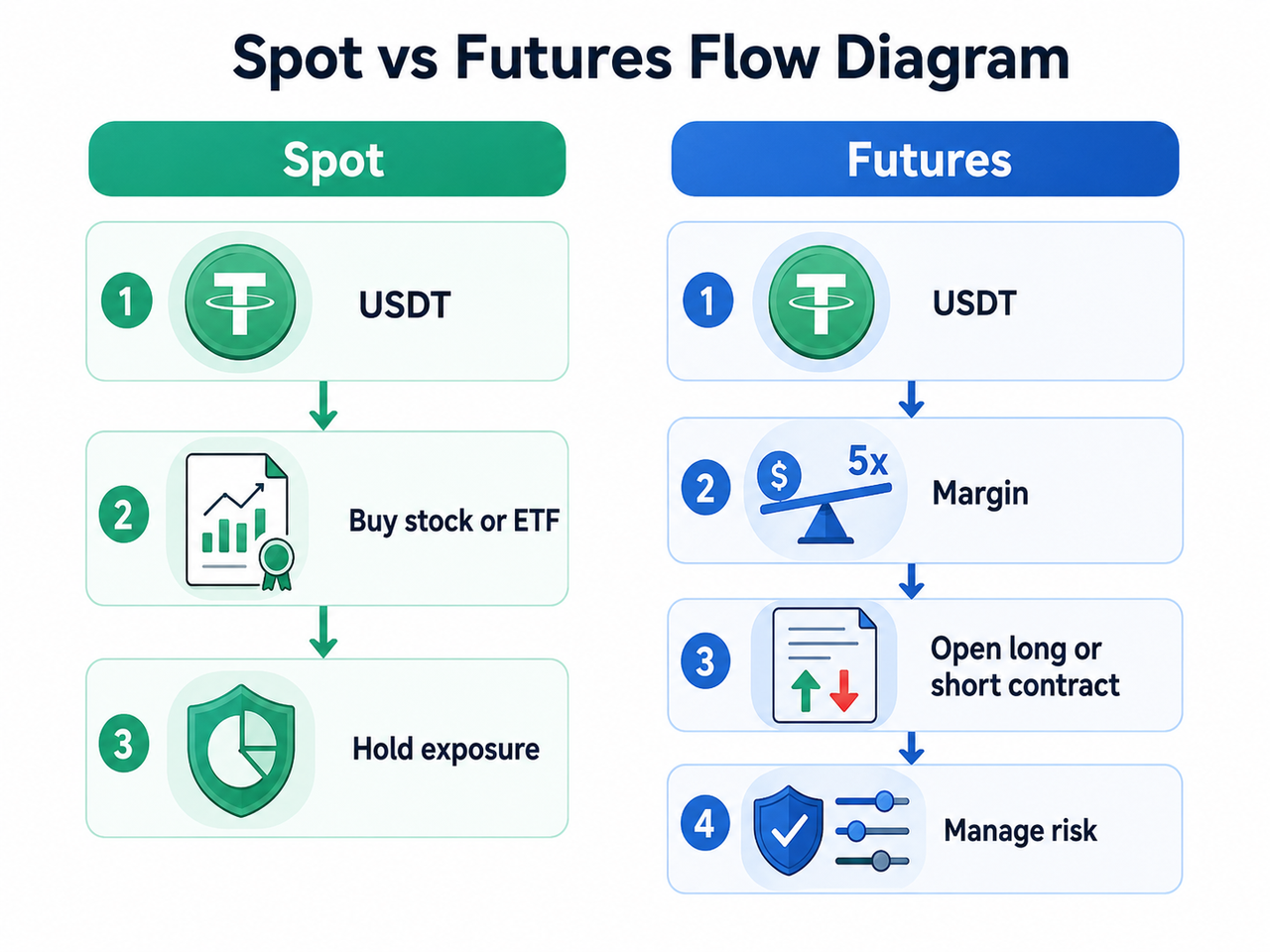
US stock spot trading on Gate refers to buying and selling US stocks and ETFs through a digital asset account, with USDT used as the trading and settlement medium. Users gain direct exposure to the underlying stock or ETF price, and their position value changes as the market price moves. Gate describes its stock trading service as a way to access US stocks and ETFs with USDT, without requiring a separate overseas brokerage account.
US stock futures, by contrast, are derivative contracts. Instead of directly buying the stock, users trade a contract whose value is linked to the price movement of the underlying stock. Futures allow both long and short strategies, and they usually involve margin, leverage, funding costs, and liquidation risk. For users moving between crypto markets and traditional finance, this difference is important because spot products and derivatives serve very different trading goals.
How does Gate US stock spot trading work?
Gate US stock spot trading is designed to let users access US stocks and ETFs through the same type of account environment they already use for digital assets. After meeting the relevant eligibility and compliance requirements, users can transfer USDT into the stock trading account and place buy or sell orders for supported securities.
When a buy order is completed, the user holds exposure to the selected stock or ETF. When a sell order is completed, the position is reduced or closed, and the account balance is updated accordingly. This model makes US stock trading more familiar for users who already manage crypto assets in USDT.
Because Gate stock trading connects digital asset accounts with securities market access, it also reflects the broader development of real world assets, where traditional assets are increasingly accessed through digital platforms.
How do Gate US stock futures contracts work?
Gate US stock futures are contract based products. A trader does not buy the stock itself. Instead, the trader opens a long or short position on a contract linked to a stock’s price movement.
A long position benefits when the contract price rises. A short position benefits when the contract price falls. Because futures use margin, the trader only needs to provide part of the position value as collateral, but this also magnifies both profits and losses.
Some Gate stock perpetual contract listings support long and short positions with selectable leverage, while the specific contract availability, trading parameters, and risk controls may vary by symbol. Users should always check the latest contract rules, margin requirements, and product availability before trading.
US Stock Spot vs Futures: key differences
| Comparison point |
US stock spot on Gate |
US stock futures on Gate |
| Product type |
Direct stock or ETF exposure |
Derivative contract exposure |
| Main purpose |
Buying and holding, portfolio exposure, simpler market participation |
Directional trading, hedging, leveraged strategies |
| Long and short access |
Mainly buy first, sell later |
Supports long and short positions |
| Margin and leverage |
Generally no futures style leverage |
Uses margin and may support leverage |
| Liquidation risk |
No futures liquidation mechanism, but asset value can fall |
Liquidation can occur if margin becomes insufficient |
| Cost structure |
Trading fees and possible market spread |
Trading fees, funding costs, margin costs, and spread |
| Suitable time horizon |
Medium to long term, or straightforward exposure |
Short term to medium term active trading |
| Risk level |
Lower than leveraged futures, but still exposed to market risk |
Higher due to leverage, liquidation, and contract mechanics |
The core difference is ownership style. Spot trading focuses on direct exposure to stocks or ETFs, while futures trading focuses on contract based exposure. Understanding the difference between US stock trading with USDT and derivative trading helps users avoid treating the two products as interchangeable.
Which users are suitable for US stock spot trading?
US stock spot trading may be more suitable for users who want simple exposure to US equities without using leverage. It fits users who prefer to buy, hold, and manage positions based on company fundamentals, ETF allocation, sector themes, or broader market trends.
It may also suit crypto users who already hold USDT and want to diversify into US stocks or ETFs within a more unified platform experience. Since the position does not rely on futures margin, users do not face forced liquidation in the same way they would with leveraged contracts.
| User type |
Why spot trading may fit |
| Beginner stock market users |
The structure is easier to understand than futures |
| Long term investors |
Spot positions can be held without managing funding rates |
| ETF focused users |
ETFs can provide broader market or sector exposure |
| Lower risk traders |
No leverage based liquidation mechanism |
| USDT based users |
Trading can be managed through a digital asset account |
That said, spot trading is not risk free. Stock and ETF prices can still fall sharply due to earnings results, interest rate changes, macroeconomic shifts, liquidity conditions, or sector specific events.
Which users are suitable for Gate US stock futures?
Gate US stock futures may be more suitable for experienced traders who understand derivatives, margin, leverage, and liquidation. These users often focus on short term price movements, volatility, event driven trading, or hedging existing exposure.
Futures can be useful when a trader wants to express a market view in either direction. For example, a trader who expects a stock linked contract to rise may open a long position, while a trader expecting a decline may open a short position. This flexibility is one of the main reasons futures attract active traders.
However, futures require stricter risk management. Users need to monitor margin ratio, position size, leverage level, entry price, stop loss settings, funding costs, and market liquidity. A correct market view can still result in losses if leverage is too high or if short term volatility triggers liquidation.
What are the risks of US stock spot and futures trading?
Both US stock spot trading and US stock futures carry market risk, but the risk structure is different.
For spot trading, the main risk is price decline. A stock or ETF may lose value because of weak earnings, poor industry conditions, broader market stress, regulatory changes, or reduced liquidity. Users may also face execution risk during volatile periods, especially when market prices move quickly.
For futures trading, the risks are broader. In addition to price volatility, users face leverage risk, liquidation risk, margin risk, funding cost risk, and contract liquidity risk. Since leverage amplifies exposure, even a relatively small price movement can create a large account impact.
Users should also consider product availability and regional restrictions. Financial products connected to stocks, ETFs, derivatives, or digital assets may not be available in every jurisdiction. Before trading, users should review the latest platform rules, local requirements, and their own risk tolerance.
Summary
US stock spot and US stock futures on Gate are designed for different needs. Spot trading is more direct. It gives users exposure to US stocks and ETFs through USDT based trading and is generally easier to understand. Futures trading is more flexible, but also more complex. It allows long and short strategies and may support leverage, but it requires careful margin and liquidation management.
For users seeking straightforward participation in US equities, spot trading may be the more suitable starting point. For experienced traders who understand derivatives and can manage fast moving risk, US stock futures may offer more tactical flexibility.
Neither product guarantees profit. Users should understand how each product works before trading and avoid using leverage unless they can manage the potential downside.
FAQs
What is the main difference between US stock spot and futures on Gate?
US stock spot trading gives users direct exposure to US stocks or ETFs, while US stock futures are derivative contracts linked to stock price movements. Spot trading is usually simpler, while futures involve margin, leverage, and liquidation risk.
Can user short US stocks through spot trading on Gate?
Spot trading is mainly designed around buying and selling stock or ETF exposure. Futures contracts are generally the product type used when traders want to take short positions.
Are US stock futures riskier than spot trading?
Yes, futures are generally riskier because they use margin and may involve leverage. This can magnify gains, but it can also magnify losses and lead to liquidation.
Who should consider US stock spot trading?
US stock spot trading may suit users who want simpler exposure to US stocks or ETFs, prefer not to use leverage, and want to manage stock related positions through a USDT based account structure.
Who should consider Gate US stock futures?
Gate US stock futures may suit experienced traders who understand contract trading, margin management, leverage, funding costs, and short term volatility.
Do US stock spot positions have liquidation risk?
Spot positions do not have the same futures liquidation mechanism. However, the market value of the stock or ETF can still fall, so users can still lose money.
What should users check before trading US stock futures?
Users should check the supported contract, leverage range, margin requirements, funding rules, liquidity, trading fees, liquidation mechanism, and regional availability before opening a position.