Blockchain consensus requires every validator to repeat the same computations, making on-chain processing expensive and limited. This creates a long-standing computational bottleneck, as smart contracts cannot efficiently handle large volumes of historical transaction data.
Brevis is engineered around the principle of “proving work, not repeating it.” By enabling off-chain computations to be verified on-chain within milliseconds, Brevis delivers a scalable, trustworthy computational foundation for DeFi, data-driven applications, and AI.
What Is Brevis? Why Is It Called the “Infinite Computation Layer” for Web3?
Brevis is a verifiable computation platform that shifts complex workloads off-chain, ensuring result integrity with zero-knowledge proofs. On-chain validators no longer need to re-execute computations—just verify a concise proof that the computation was executed correctly, dramatically reducing overhead.

The “Infinite Computation Layer” concept addresses the core limitation of blockchains like Ethereum: transaction-level computational caps make complex analytics, model inference, and cross-chain aggregation infeasible on-chain. Off-chain computation with on-chain verification breaks the dependency on block gas limits.
| Core Component |
Role |
Main Function |
| Pico zkVM |
Open-source modular zkVM |
Write logic in Rust and generate proofs |
| ZK Data Coprocessor |
Off-chain data computation engine |
Access historical/cross-chain data and generate proofs |
| coChain |
Crypto-economic security layer |
Trust via staking and slashing |
| Pico Prism |
Real-time block proof |
Real-time proof for Ethereum |
| Vera |
Content authenticity proof |
ZK proofs for media authenticity |
| ProverNet |
Decentralized proof market |
Match proof demand and supply |
The table outlines Brevis’s technical stack: Pico zkVM and the ZK Data Coprocessor handle computation, coChain secures trust, and Pico Prism, Vera, and ProverNet deliver real-time proofs, content provenance, and proof market liquidity.
How Does the Brevis ZK Coprocessor Work?
Smart contracts are nearly “blind to history”—directly reading and processing large volumes of on-chain data is prohibitively expensive. To enable contracts to act on users’ historical blockchain behavior, a mechanism is needed that avoids replaying all data on-chain.
The ZK Data Coprocessor does exactly this: it accesses historical or cross-chain data and computes off-chain, returning both the result and a cryptographic proof that the data exists and the computation is correct. Smart contracts only need a millisecond-scale on-chain verification to trust the result.
The verifiable computation data flow follows four steps: the application submits a request, the coprocessor computes off-chain using real on-chain data, generates a ZK proof, and the smart contract verifies and accepts the result.
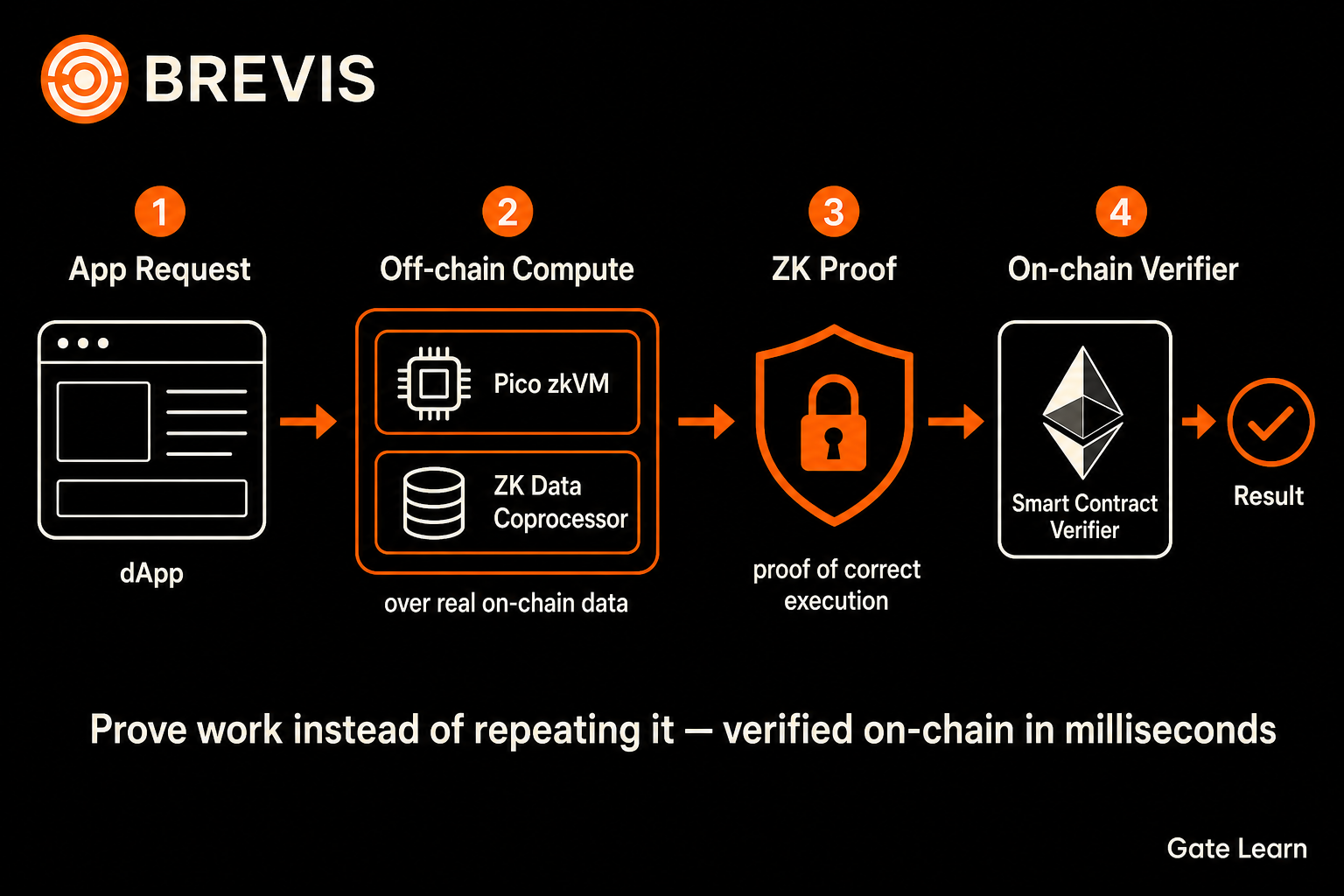
Figure 1. Brevis verifiable compute data flow: application request → off-chain computation (Pico zkVM and ZK Data Coprocessor using on-chain data) → ZK proof generation → on-chain verifier validation and result delivery.
What Role Does Pico zkVM Play in the Brevis Architecture?
Pico zkVM is Brevis’s open-source modular zero-knowledge virtual machine, empowering developers to write any computation logic in Rust and generate proofs. As a general-purpose execution layer for verifiable computation, Pico zkVM unifies program development and proof generation in a single toolchain.
Its “glue-and-coprocessor” architecture features a RISC-V core executing Rust programs as the “glue,” while common operations—like Keccak-256 hashing, signature verification, and machine learning inference—are routed to specialized precompiled circuits for acceleration. Brevis reports this approach accelerates proof generation by approximately 10x to 80x.
How Do coChain and the Crypto-Economic Security Model Ensure Trust?
Brevis offers two security models: pure-ZK and OP/coChain. The distinction lies in the trust anchor—pure-ZK relies solely on cryptographic proofs, while OP/coChain adds an economic game-theory layer. Business logic written once with the Brevis SDK can be deployed on either model.
coChain is a PoS blockchain with on-Ethereum staking and slashing. Validators generate results from archive node data, reach PoS consensus, and push proposals with aggregated signatures to the request chain, entering a challenge window.
If a challenger successfully disputes an incorrect result with a ZK proof during this window, the validator’s stake is slashed on Ethereum. If unchallenged, the result is immediately usable by dApps without proof costs. coChain plans to integrate EigenLayer for dynamic security adjustment.
| Dimension |
pure-ZK |
OP/coChain |
| Trust Source |
Cryptographic proof |
Staking & slashing + optional challenge |
| Result Latency |
Wait for proof |
Usable after challenge window |
| Compute Cost |
Proof generated each time |
No proof cost if unchallenged |
| Security Level |
Guaranteed by ZK |
Dynamically adjustable via EigenLayer |
The table compares both models: pure-ZK offers maximum determinism for mission-critical scenarios, while coChain provides flexibility in cost and throughput. Both can be mixed and matched as needed.
What Is the Utility of the BREV Token in the Brevis Ecosystem?
BREV is the native utility and governance token of the Brevis network, powering the economic cycle around proof supply. Its roles include payment, staking, and governance, directly linked to the Prover incentive and slashing mechanisms described in BREV token and coChain.
| Function |
Description |
| Proving fee payment |
Users pay proving fees in BREV |
| Prover staking |
Provers lock BREV to receive tasks; slashed if default |
| Protocol governance |
BREV holders participate in protocol governance |
These three functions form a closed loop: users pay for proofs, Provers stake to receive assignments, and the community adjusts parameters via governance, tying proof quality and network security together.
How Is Brevis Different from Oracles and Other ZK Coprocessors?
Brevis and oracles address different layers: oracles transport off-chain data on-chain, while Brevis focuses on computation and proof of correctness over on-chain and historical data. Understanding the distinction between “data transport” and “verifiable computation” is key to Brevis vs. oracles.
Oracles rely on trusted nodes or data providers, while Brevis leverages zero-knowledge proofs for direct on-chain verification. Compared to other ZK coprocessors, Brevis’s edge lies in its general-purpose Pico zkVM, ZK Data Coprocessor, and dual pure-ZK/coChain models.
What Are the Real-World Adoption Scenarios for Brevis?
Brevis’s “Real Adoption” highlights practical, business-driven verifiable computation. As disclosed in Brevis’s official blog (2025), the network has produced over 340 million proofs across more than 50 protocols on 8+ blockchains, with incentive and reward programs totaling over $300 million.
Data-driven incentives are a prime use case: protocols can distribute rewards based on users’ on-chain history (e.g., trading volume, holding duration), with ZK proofs ensuring authenticity. ProverNet, a decentralized proof market live on mainnet, requires Provers to stake BREV and enforces slashing for default.
Pico Prism delivers real-time block proofs for Ethereum; Brevis reports 99.8% real-time coverage on 16 GPUs, meeting the Ethereum Foundation’s $100,000 hardware target. The Foundation’s On-Prem Proving Initiative (Ethproof) named Brevis one of its four selected teams in March 2026. Vera leverages ZK proofs to verify media origin and authenticity, addressing content provenance in the deepfake era.
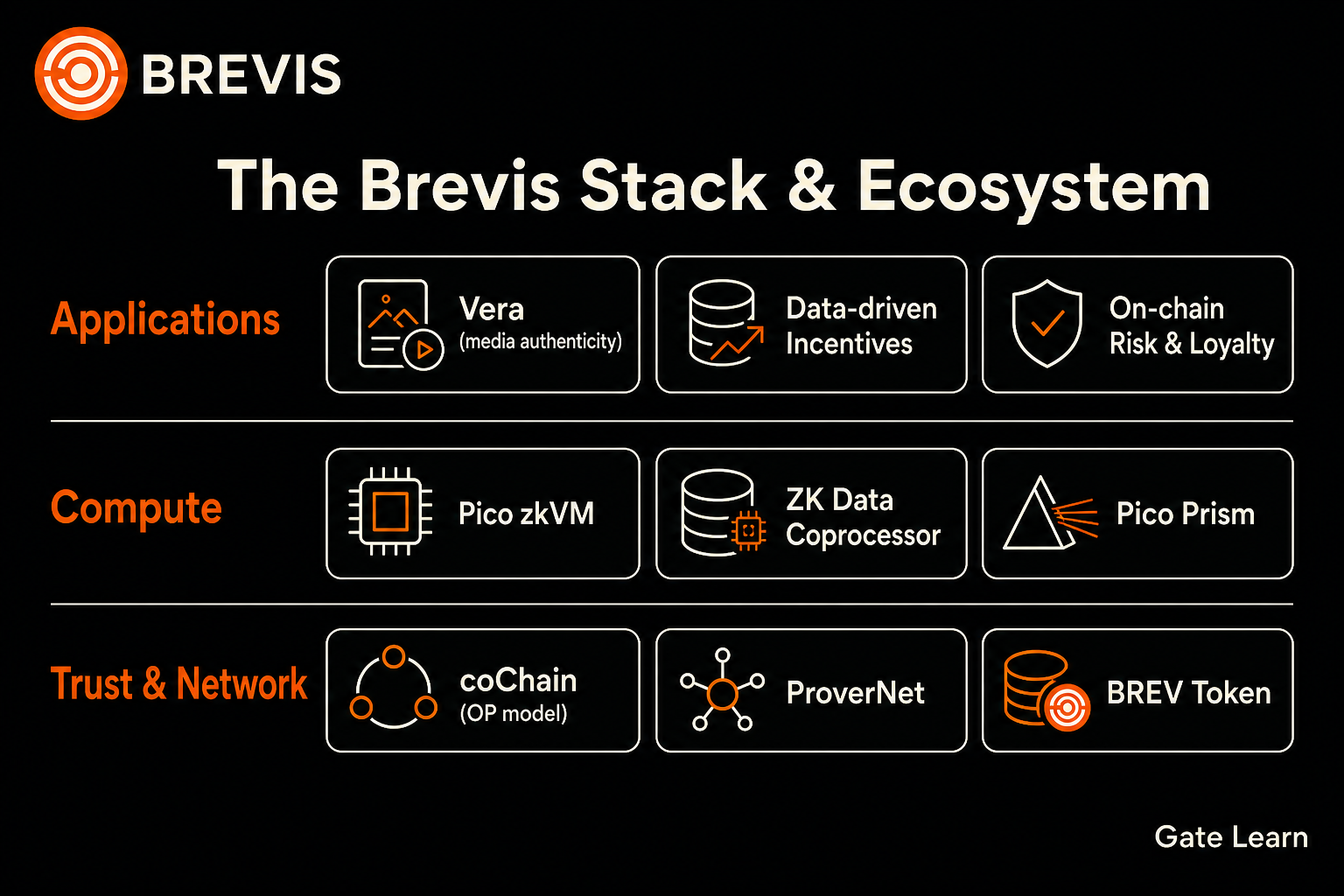
Figure 2. Brevis technology stack and ecosystem overview: roles of Pico zkVM, ZK Data Coprocessor, Pico Prism, Vera, ProverNet, coChain, and BREV token.
What Are the Advantages, Risks, and Limitations of Using Brevis?
Brevis’s strengths are scalability and trust: off-chain execution with on-chain verification eliminates gas limit constraints, ZK proofs enable trustless validation, and the SDK’s write-once, multi-model deployment streamlines engineering.
Limitations stem from ZK computation itself—proof generation requires specialized hardware and significant hashrate, and general-purpose proofs remain costlier than native execution. Complex logic incurs higher costs and latency.
Risks include coChain’s reliance on active challengers and sufficient staking, potential implementation flaws in smart contract and SDK integrations, and ProverNet’s dependence on Prover participation. These are structural constraints of the mechanism and do not constitute investment advice.
Summary
Brevis is a verifiable computation platform for Web3, shifting costly computation off-chain with the principle of “proving work, not repeating it.” On-chain, a succinct proof is verified within milliseconds. The stack features Pico zkVM and the ZK Data Coprocessor for computation, pure-ZK and coChain models for trust, and the BREV token for payments, staking, and governance—plus real-world applications like Pico Prism, Vera, and ProverNet.
FAQ
What Is Brevis (BREV)?
Brevis is a verifiable computation platform powered by zero-knowledge proofs, known as Web3’s infinite computation layer. It executes complex computations off-chain and enables on-chain verification of concise proofs, eliminating redundant validator computation.
How Do the ZK Data Coprocessor and Oracles Differ?
Oracles primarily move off-chain data on-chain, still requiring trust in the data source. The ZK Data Coprocessor performs computation off-chain using actual on-chain or historical data, attaching a cryptographic proof so results can be directly verified on-chain.
Why Does Pico zkVM Accelerate Proof Generation?
Pico zkVM’s “glue-and-coprocessor” architecture uses a RISC-V core to execute Rust programs, routing common operations to specialized precompiled circuits for acceleration. This boosts proof speed by about 10x to 80x, according to Brevis.
How Should One Choose Between pure-ZK and coChain Models?
pure-ZK relies exclusively on cryptographic proofs for maximum determinism, requiring proof generation every time. coChain uses Ethereum-based staking, slashing, and a challenge window—if unchallenged, results skip proof costs. Both models can be written once and deployed as needed via the Brevis SDK.
What Are the Uses of the BREV Token?
BREV is the native utility and governance token of the Brevis network, with three core uses: paying proving fees, serving as staking collateral for Provers (locked for task eligibility, slashed for default), and participating in protocol governance.







