Users searching for the utility of the INJ token are usually seeking to understand its relationship with the Injective on-chain financial ecosystem. Rather than focusing solely on price movements, examining the token’s functions offers a clearer view of how a project structures governance, security, trading revenue, and long-term ecosystem incentives.
This inquiry generally covers several dimensions, including total token supply, initial allocation, governance rights, staking incentives, trading fee distribution, burn mechanisms, and ecosystem application expansion.
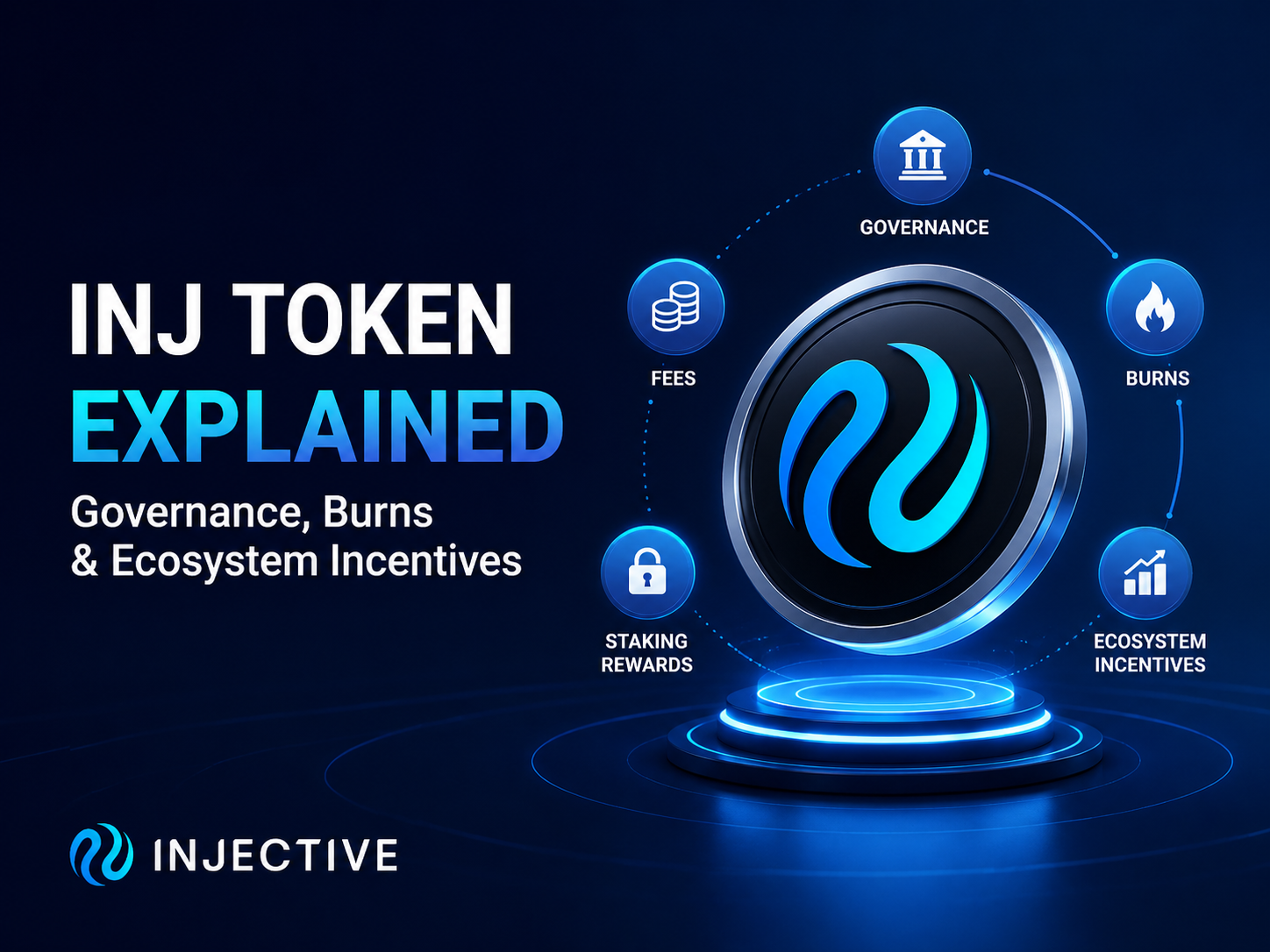
What Is the INJ Token
INJ serves as the core functional asset necessary for the operation of the Injective network. Beyond its use for trading fees and staking, INJ also powers governance, value capture, and ecosystem incentives.
According to official tokenomics documentation, the INJ token generation event (TGE) was completed in October 2020, with an initial supply of 100,000,000 INJ. The allocation covers seed round, private sale, Binance Launchpad, team, advisors, ecosystem development, and community growth.
| Allocation Category |
Percentage |
| Seed Round |
6% |
| Private Sale |
16.67% |
| Binance Launchpad |
9% |
| Team |
20% |
| Advisors |
2% |
| Ecosystem Development |
36.33% |
| Community Growth |
10% |
The allocation structure emphasizes ecosystem development and team building, with the largest share dedicated to ecosystem growth. This shows that the INJ token model is designed not only for early sales but also reserves significant resources for future developers, applications, community initiatives, and network expansion.
How Does INJ Enable On-Chain Governance
INJ governance centers on empowering token holders to participate in decision-making for Injective network parameters and protocol direction. As Injective’s governance token, INJ allows holders to influence network upgrades, parameter adjustments, and ecosystem rules through on-chain voting.
The governance process typically involves proposals and voting. First, the community or relevant participants submit governance proposals. Next, INJ holders or stakers vote. The system then determines if the proposal passes based on voting results. Finally, approved proposals are enacted, affecting on-chain parameters or protocol execution.
This setup means INJ is not just a payment asset—it also represents network governance rights. Official tokenomics documents confirm that INJ is used for community governance, covering on-chain parameter management and integrating with Injective’s PoS network structure.
The significance of this governance model is that it shifts protocol control from a single team to the broader on-chain community. For a financial public chain like Injective, trading fee parameters, market mechanisms, contract uploads, and economic model changes can all impact the ecosystem, making governance rights a key component of INJ’s value.
How Does the INJ Burn Mechanism Work
The INJ burn mechanism is designed to convert a portion of ecosystem revenue into token burns, reducing circulating supply. Injective’s Burn Auction mechanism auctions a basket of assets and burns the INJ paid by the winning bidder.
This process acts as an on-chain revenue recycling system. First, ecosystem applications or users contribute assets to the auction pool. The auction module then aggregates these assets into a basket. Participants use INJ to bid, and the highest bidder receives the asset basket while the INJ they pay is burned.
Official tokenomics documents state that the Burn Auction is powered by Injective’s exchange and auction modules. The auction module collects assets, organizes bidding, confirms winners, and burns the INJ paid.
This mechanism links ecosystem activity to INJ supply changes. As of May 2024, official sources report that over 5,920,000 INJ have been removed from total supply through Burn Auctions.
How Is INJ Used for Validator and Staking Incentives
The INJ staking mechanism is central to securing the Injective network. Injective uses a Tendermint-based PoS consensus model, where validators and delegators participate in network operations by staking INJ.
In the staking process, validators run nodes and validate blocks. Regular holders can delegate INJ to validators. The system then distributes rewards based on validator performance, and delegators receive proportional rewards after commission is deducted.
INJ staking offers both incentives and constraints. Validators earn rewards for block production and transaction validation, but malicious behavior or failure to perform duties can result in penalties to staked assets. Official sources state that validator rewards consist of newly minted INJ and a portion of trading fees.
This mechanism directly ties INJ to network security. Higher staking levels increase the cost of network attacks, while stable validator performance strengthens the foundation for on-chain financial applications.
What Role Does INJ Play in the Trading Fee System
INJ acts as the link between user trades, application revenue, and the protocol’s economic model. According to official tokenomics, all trading fees on Injective are paid in INJ, and protocol revenue generated by applications using the exchange module is also accumulated in INJ.
INJ is the primary settlement asset within the Injective ecosystem. Users pay fees, gas, purchase services, or participate in financial applications using INJ as the core medium for payments and value transfers.
Fee revenue does not remain at a single payment stage. A portion enters the auction mechanism, while the remainder is retained by applications to support ongoing operations. Official sources indicate that, in the exchange module’s revenue distribution, 60% goes to the auction module and 40% is retained by applications using the module.
This structure balances token burning with application incentives. The burn mechanism tightens INJ supply management, while application-retained revenue gives developers the economic foundation to continue building trading products.
How Does INJ Support Injective Ecosystem Expansion
INJ supports ecosystem expansion by providing developers, applications, and users with a unified economic coordination tool. It serves as a governance, fee, and incentive asset.
Injective’s ecosystem applications are centered on on-chain finance, including decentralized trading, derivatives, prediction markets, cross-chain assets, and automated financial services. INJ functions as a payment, collateral, incentive, and value capture asset within these applications.
Developers can build applications using Injective’s financial modules. Users generate on-chain activity through trading and interactions. Application revenue then enters the fee and auction systems, with a portion fed back into the INJ token model via the burn mechanism.
This structure means that as ecosystem activity increases, the connection between INJ and network usage grows stronger. INJ is not just an isolated token—it is the bridge among Injective’s financial application layer, validator network, and governance system.
What Potential Challenges Does the INJ Token Model Face
The INJ token model faces potential challenges from ecosystem adoption, staking participation, liquidity depth, and changes in economic parameters. Even with a burn mechanism reducing supply, the token’s value ultimately depends on real network demand and ecosystem activity.
The burn mechanism relies on ongoing revenue. If on-chain trading volume, application revenue, or user participation drops, the assets entering the auction system will decrease. Similarly, the staking mechanism depends on validator quality and delegator engagement; insufficient participation can undermine PoS network stability.
INJ’s economic model has also evolved through upgrades, such as INJ 3.0, which featured supply rate changes and stronger deflationary design. Official documents note that INJ 3.0 adjusted mint module parameters and increased the deflation rate.
This demonstrates that the INJ token model is both governable and adjustable, but users must pay attention to the balance between governance changes, ecosystem revenue, and application growth.
Summary
The INJ token is the core asset of the Injective ecosystem, serving multiple roles across governance, staking, fee payments, burning, and ecosystem incentives.
Operationally, users generate on-chain fees by using Injective applications. Part of the revenue enters the auction system, where participants bid with INJ and those tokens are burned. Validators and delegators secure the network through staking. The initial allocation of 100,000,000 INJ established the foundation for ecosystem development, team building, community growth, and early participation.
Understanding INJ requires more than just knowing its total supply—it is essential to see how it connects network security, protocol revenue, application incentives, and on-chain governance.
FAQ
What is the total supply of INJ?
The INJ token generation event occurred in October 2020, with an initial supply of 100,000,000 INJ. This supply is subsequently affected by staking rewards, burn mechanisms, and governance parameters.
What are the main uses of INJ?
INJ is primarily used for on-chain governance, network staking, fee payments, ecosystem incentives, and the burn mechanism. It is the core connecting asset among Injective’s financial applications, validator network, and protocol economic system.
How does the INJ burn mechanism work?
Injective’s Burn Auction aggregates ecosystem revenue into an asset basket. Participants bid with INJ, and after the auction, the winner receives the asset basket while their INJ payment is burned.
What is the purpose of INJ staking?
INJ staking is used to secure the Injective network. Validators run nodes and validate transactions, while delegators can delegate INJ to validators and receive proportional rewards.
What is the relationship between INJ and the Injective ecosystem?
INJ is the native asset of the Injective ecosystem, spanning governance, trading, staking, and application incentives. Fees and revenue generated by ecosystem applications directly impact INJ’s economic model.







