As Telegram Mini Apps and the TON ecosystem continue to grow, more developers are looking to bring mature EVM applications into Telegram-based use cases. However, TON and Ethereum differ in smart contracts, development languages, and execution environments, which makes cross-ecosystem integration more complex.
Structurally, TAC is built around the TON Adapter, EVM execution layer, Hybrid dApps, and a cross-chain messaging system. Its goal is to connect Telegram users with the broader Ethereum application ecosystem.
What Is TAC (TAC)
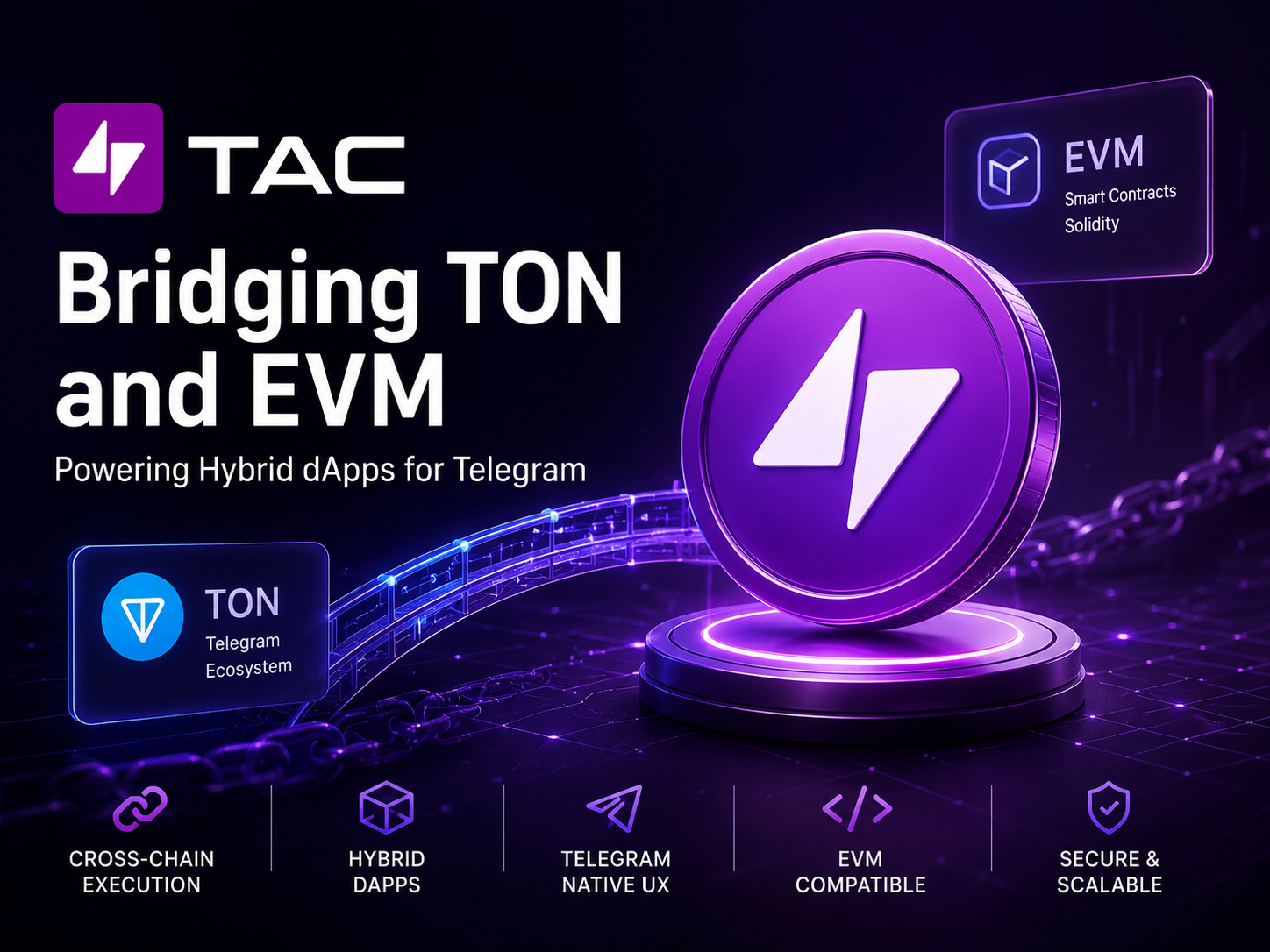
TAC can be understood as an EVM execution network that connects TON and Ethereum. Its core function is to bring EVM applications into the TON ecosystem without changing the Telegram user experience. Officially, TAC is described as the EVM execution layer for Telegram, with an emphasis on compatibility with Solidity and the EVM toolchain.
In terms of how it works, when a user initiates an action through a Telegram Mini App or TON wallet, the system sends the request to the TAC network through the TON Adapter. The TAC EVM layer then executes the Solidity contract and returns the result to the TON user. The entire process depends on cross-chain message verification and execution.
The importance of this structure is that developers can reach Telegram users without rewriting their applications, while users do not need to learn a new wallet or cross-chain process.
TAC’s Core Architecture and Operating Mechanism
TAC’s core architecture consists of the TON Adapter, Sequencer Network, TAC EVM Layer, and Hybrid dApps. At its core, it brings message verification, EVM execution, and the Telegram frontend into one integrated system.
Structurally, the TON Adapter is responsible for cross-chain message transmission and verification, the Sequencer Network handles consensus and ordering, the TAC EVM Layer executes Solidity contracts, and Hybrid dApps serve as the entry point for Telegram users.
| Module |
Function |
Role |
| TON Adapter |
Cross-chain message verification |
Connects TON and TAC |
| Sequencer Network |
Message ordering and consensus |
Ensures execution order |
| TAC EVM Layer |
Solidity execution |
Supports EVM applications |
| Hybrid dApp |
Telegram frontend |
Provides the user entry point |
The significance of this architecture is that TAC is not simply a cross-chain bridge, but an EVM network with full execution capabilities. Developers can continue using tools such as Solidity, Hardhat, and Remix while gaining access to the Telegram user ecosystem.
How TON Adapter Connects TON and EVM
TON Adapter is TAC’s most important cross-chain component. Its core role is to enable message verification and state synchronization between TON and the TAC EVM. In practical terms, it coordinates cross-chain communication and execution.
In the operating flow, the user first initiates a transaction or service request in a Telegram Mini App or TON wallet. The TON Adapter then receives the message and sends it through the Sequencer Network for verification and ordering. Next, the system generates proof and sends the message to the TAC EVM layer, where the Solidity contract is executed. Finally, the execution result is returned to the TON ecosystem and the user state is synchronized.
The importance of this mechanism is that TON Adapter is not merely an asset bridging tool, but part of a cross-chain execution system. It allows TAC to introduce Ethereum’s DeFi and EVM application capabilities while preserving the Telegram user experience.
How Hybrid dApps Work in TAC
Hybrid dApps are TAC’s core application model. Their essence lies in combining a Telegram frontend with an EVM backend. Officially, they are defined as hybrid applications that use Telegram as the user entry point while relying on TAC EVM for execution logic.
In practice, the user first interacts with the application through a Telegram Mini App. The Hybrid dApp then sends the user request to the TAC EVM network. Next, the Solidity contract completes on-chain execution, such as swaps, lending, or staking. Finally, the result is returned to the Telegram interface, so the user does not need to directly perceive the cross-chain process.
The importance of this structure is that it lowers the barrier for everyday users to access EVM applications. Developers can retain Ethereum’s mature application logic while gaining Telegram’s user traffic and interaction scenarios.
The Role of the TAC Token in the Network
The TAC token is the core economic asset of the TAC network. Its main uses include gas payment, validator network staking, governance participation, and ecosystem incentives. At its core, it provides the basic settlement function for the EVM execution layer.
Structurally, users first complete an action on the Telegram or TON side. The system then maps the relevant operation to the TAC EVM execution flow in the background. Gas fees are settled using the TAC token and are used for network validation and resource consumption. Finally, some tokens flow into validation, incentive, or governance systems.
The importance of this design is that users may not necessarily need to directly notice the TAC token, but TAC still serves as the underlying gas asset for the entire EVM execution layer. Its value logic is tied to cross-chain calls, Hybrid dApp usage, and EVM activity within the TAC network.
Why Developers Choose TAC to Build Applications
The main reason developers choose TAC is that it is compatible with the EVM development environment while also providing access to the Telegram user ecosystem. In other words, TAC reduces the migration cost for EVM applications entering TON.
In the development process, developers can first continue using familiar tools such as Solidity, Hardhat, and Remix to build applications. They then complete Telegram integration through the TAC SDK and TON Adapter. Next, the Hybrid dApp frontend is deployed in the Telegram Mini App environment. Ultimately, developers can serve TON users without rewriting their smart contracts.
The importance of this structure is that TAC does not require developers to learn TON’s native development language or rebuild liquidity systems. Compared with rebuilding an application from scratch, EVM compatibility makes it easier to attract existing Ethereum projects into the Telegram ecosystem.
What Are TAC’s Main Use Cases
TAC’s use cases mainly center on DeFi, payments, Telegram Mini Apps, and Hybrid dApps. Its core purpose is to bring Ethereum application capabilities into the Telegram user system.
In real-world scenarios, users can first access DeFi functions such as swaps, lending, and staking through Telegram. The Hybrid dApp then sends the interaction request to the TAC EVM network. Next, the Solidity contract completes the on-chain logic. Finally, the result is returned to the user in a Telegram-native interaction format.
The importance of this application structure is that TAC is not just a cross-chain tool, but an EVM application entry point inside Telegram. It allows TON users to access the Ethereum application ecosystem while keeping their familiar Telegram usage habits.
Differences Between TAC and Traditional Cross-Chain Protocols
The core difference between TAC and traditional cross-chain protocols is that TAC focuses not simply on asset transfers, but on cross-chain execution and Telegram application integration.
| Comparison Dimension |
TAC |
Traditional Cross-Chain Protocols |
| Core Positioning |
EVM execution layer |
Asset bridging |
| User Entry Point |
Telegram Mini App |
Multi-chain wallet |
| Contract Environment |
Solidity EVM |
Multi-chain compatibility |
| Cross-Chain Focus |
Message execution |
Asset transfer |
| Application Structure |
Hybrid dApp |
Independent dApp |
Based on this comparison, traditional cross-chain protocols usually emphasize asset mobility, while TAC places greater emphasis on the execution environment and application entry point. Through Telegram and the TON ecosystem, it embeds EVM execution logic into the user interaction flow.
TAC’s Advantages and Potential Limitations
TAC’s advantages lie in its compatibility with the EVM toolchain, its connection to the Telegram user ecosystem, and its ability to lower the barrier for ordinary users to access DeFi through Hybrid dApps. Its core value is connecting TON users with Ethereum applications.
Structurally, developers can enter Telegram scenarios without rewriting Solidity contracts, and users do not need to perform complex cross-chain operations. This improves application migration efficiency and makes user onboarding more convenient.
Its potential limitations mainly include the degree of Sequencer decentralization, the complexity of cross-chain execution, and its dependence on the growth of TON and Telegram. If the growth of Telegram Mini Apps and the TON application ecosystem slows, demand for the TAC network may also be affected.
Conclusion
TAC is an EVM execution network that connects TON and Ethereum. Its core components include the TON Adapter, Sequencer Network, TAC EVM Layer, and Hybrid dApps. Through a cross-chain messaging mechanism, Telegram users can directly access the Ethereum application ecosystem.
Looking at the overall structure, TAC’s value lies in its EVM toolchain compatibility, its ability to reduce development migration costs, and its use of Hybrid dApps to embed EVM application capabilities into the Telegram user system. Its future development still depends on the growth of Telegram, TON, and the broader cross-chain application ecosystem.
FAQs
What Is TAC
TAC is an EVM execution network that connects TON and Ethereum, allowing Telegram users to access Solidity applications and the EVM ecosystem through the TON environment.
What Does TON Adapter Do
TON Adapter is responsible for cross-chain message verification and synchronization between TON and the TAC EVM, allowing user requests to be executed within the TAC network.
What Does Hybrid dApp Mean
Hybrid dApp refers to an application model that combines a Telegram frontend with an EVM backend. Users interact within Telegram, while Solidity contracts execute on the TAC network.
What Is the TAC Token Used For
The TAC token is mainly used for network gas payments, validator staking, governance participation, and ecosystem incentives. It is the core economic asset of the TAC EVM.
How Is TAC Different from Traditional Cross-Chain Bridges
Traditional cross-chain bridges are mainly used for asset transfers, while TAC focuses more on cross-chain execution and Telegram application integration. Its key goal is to bring EVM applications into the TON user ecosystem.