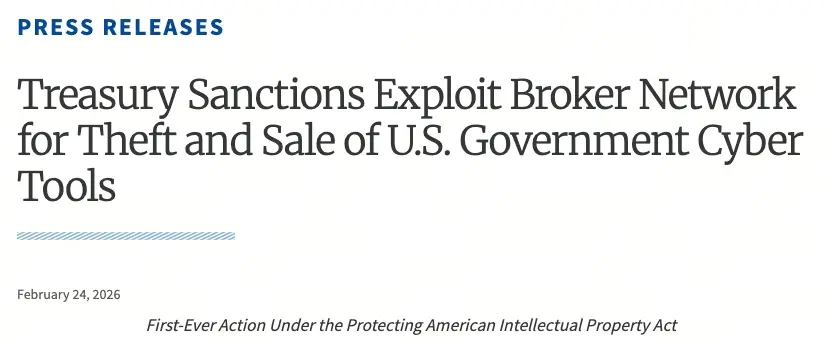
The U.S. Department of the Treasury’s Office of Foreign Assets Control (OFAC) announced on February 25th sanctions against Russian exploitation broker Sergei Zelenyuk and his St. Petersburg company Matrix LLC (also known as “Operation Zero”). They are accused of selling stolen U.S. government proprietary network tools, marking the first law enforcement case under the “Protecting American Intellectual Property Act” to target digital trade secrets theft.
Operation Zero’s Operations and Sanctioned Entities
(Source: U.S. Department of the Treasury)
“Operation Zero” was launched in 2021, employing a public bounty system to purchase security vulnerabilities targeting mainstream operating systems and encrypted communication apps. Multiple bounties have been publicly posted on the X platform. Known rewards include $500,000 for 26 iOS vulnerabilities (November 2025) and $4 million for a complete attack chain vulnerability in Telegram (March 2025).
OFAC states that the exploits sold by “Operation Zero” enable attackers to gain unauthorized access, steal information, or remotely control targeted systems. The client base is explicitly limited to “private and government organizations in Russia,” focusing on offensive security research and software tools.
The sanctions also target two individuals: Oleg Vyacheslavovich Kucherov, suspected member of the Trickbot cybercriminal group, and Marina Evgenyevna Vasanovich, described as Zelenyuk’s assistant.
Australian Contractor Data Theft Case: $1.3 Million in Cryptocurrency as Key Evidence
The sanctions stem from investigations by the U.S. Department of Justice and FBI into Australian citizen Peter Williams. Williams, a former employee of a U.S. defense contractor, is accused of stealing eight “commercial secret zero-day exploits” between 2022 and 2025, selling them to “Operation Zero” for $1.3 million in cryptocurrency. Williams pleaded guilty in October 2025 to two counts of commercial secrets theft.
The U.S. State Department emphasized in an independent statement that the stolen tools were originally intended solely for sale to the U.S. government and its allies. Unauthorized resale poses a direct threat to U.S. intelligence capabilities. The Treasury also disclosed that “Operation Zero” is involved in developing espionage software and AI-driven tools to steal personal identification information, recruiting hackers via social media, and establishing contacts with foreign intelligence agencies.
Key Information on the Sanctions
Sanctioned Parties: Sergei Zelenyuk and Matrix LLC (“Operation Zero”), Kucherov, Vasanovich
Legal Basis: Protecting American Intellectual Property Act, marking its first application to digital trade secrets theft cases
Stolen Tools: Eight U.S. government proprietary network tools, originally intended for U.S. government and specific allies
Cryptocurrency Payments: Peter Williams sold stolen zero-day exploits for $1.3 million in cryptocurrency
Highest Bounty: “Operation Zero” previously offered a $4 million reward for a Telegram attack chain vulnerability
Frequently Asked Questions
What is the historical significance of the legal basis for these U.S. Treasury sanctions?
These sanctions are executed under the Protecting American Intellectual Property Act, which is the first time this law has been used to combat the theft and sale of digital trade secrets. OFAC states this signifies an expansion of U.S. enforcement tools against cyber tool theft into the realm of commercial secrets law, setting an important legal precedent.
What is “Operation Zero,” and how do their vulnerability trading operations work?
“Operation Zero” is a Russian exploitation broker led by Sergei Zelenyuk, purchasing security vulnerabilities for operating systems and encrypted communication apps through public bounties. Its clients are limited to Russian private and government organizations. The bounty rewards can reach up to $4 million, with transactions publicly posted on X, reflecting transparency in their dealings.
What implications does the use of cryptocurrency payments in this case have for crypto regulation?
Peter Williams paid $1.3 million in cryptocurrency to acquire stolen U.S. government zero-day exploits, highlighting cryptocurrency’s role as a primary payment method in transnational cyber espionage. This case raises regulatory concerns about the role of cryptocurrencies in national security crimes and underscores the importance of on-chain tracking tools and anti-money laundering measures in combating such transactions.
Disclaimer: The information on this page may come from third parties and does not represent the views or opinions of Gate. The content displayed on this page is for reference only and does not constitute any financial, investment, or legal advice. Gate does not guarantee the accuracy or completeness of the information and shall not be liable for any losses arising from the use of this information. Virtual asset investments carry high risks and are subject to significant price volatility. You may lose all of your invested principal. Please fully understand the relevant risks and make prudent decisions based on your own financial situation and risk tolerance. For details, please refer to
Disclaimer.
Related Articles
Swissborg Secures MiCA License From France’s AMF, Expanding Regulated Crypto Services Across EU
Europe’s Markets in Crypto-Assets regulation is rapidly reshaping the region’s crypto industry, with Swissborg obtaining regulatory approval in France that allows the platform to expand digital asset services across the European Union.
Swissborg Secures MiCA Approval From French AMF, Expanding
Coinpedia1m ago
BPI thúc đẩy miễn thuế cho giao dịch Bitcoin nhỏ nhằm thúc đẩy ứng dụng tiền điện tử
The Bitcoin Policy Institute (BPI) advocates for a de minimis tax exemption for small Bitcoin transactions to ease tax reporting burdens and encourage cryptocurrency use. They are collaborating with stakeholders to build support for the bill during a crucial legislative period. The proposed exemption aims to simplify tax regulations and promote Bitcoin for daily payments, potentially impacting the cryptocurrency market significantly.
TapChiBitcoin1h ago
加密行业已投入2.71亿美元影响2026年美国中期选举
加密行业游说组织已投入约2.71亿美元影响2026年美国中期选举,伊利诺伊州参议院初选引发关注,副州长候选人Stratton遭加密PAC攻击广告。加密行业正逐渐成为重要政治力量。
GateNews2h ago
Argentine Securities Regulator Blocks Peso Stablecoin Operations
The institution reported that argt, a peso-linked stablecoin, constitutes a security, subject to the regulatory regime for capital markets for these instruments. The stablecoin, issued by Twin Finance and listed by Belo, offered up to 32% APR.
Regulator Classifies Argentine Peso Stablecoin as a
Coinpedia11h ago
Social media platform X submits remedial measures to the European Commission regarding blue verification mark issues
Elon Musk's social media platform X submitted a remediation plan under pressure from the European Commission, following a €120 million fine for violations including "blue badge certification" issues. The EU pointed out problems including X's paid verification, insufficient advertising transparency, and non-compliant data access.
GateNews11h ago


