Deep Dive into RTX Price Action: Current Market Conditions & Future Outlook

Beginner
Quick Reads
Last Updated 2026-04-03 15:38:14
Reading Time: 1m
This article leverages the most up-to-date market data and technical indicators to provide a comprehensive analysis of RTX’s current price performance, historical peaks and troughs, and key influencing factors. It aims to equip new investors with the insights they need to understand market dynamics and to strategically time their market entry and profit-taking.

RTX Overview and Market Positioning

RTX serves as the native token for the OrbitX community and ecosystem, primarily facilitating transactions, content rewards, and governance voting on its decentralized social platform. As a DeFi project within the BNB Chain ecosystem, RTX offers decentralization and robust security measures, making it an ideal choice for users interested in social Web3 and payment applications.

Current Price and Trading Volume Analysis
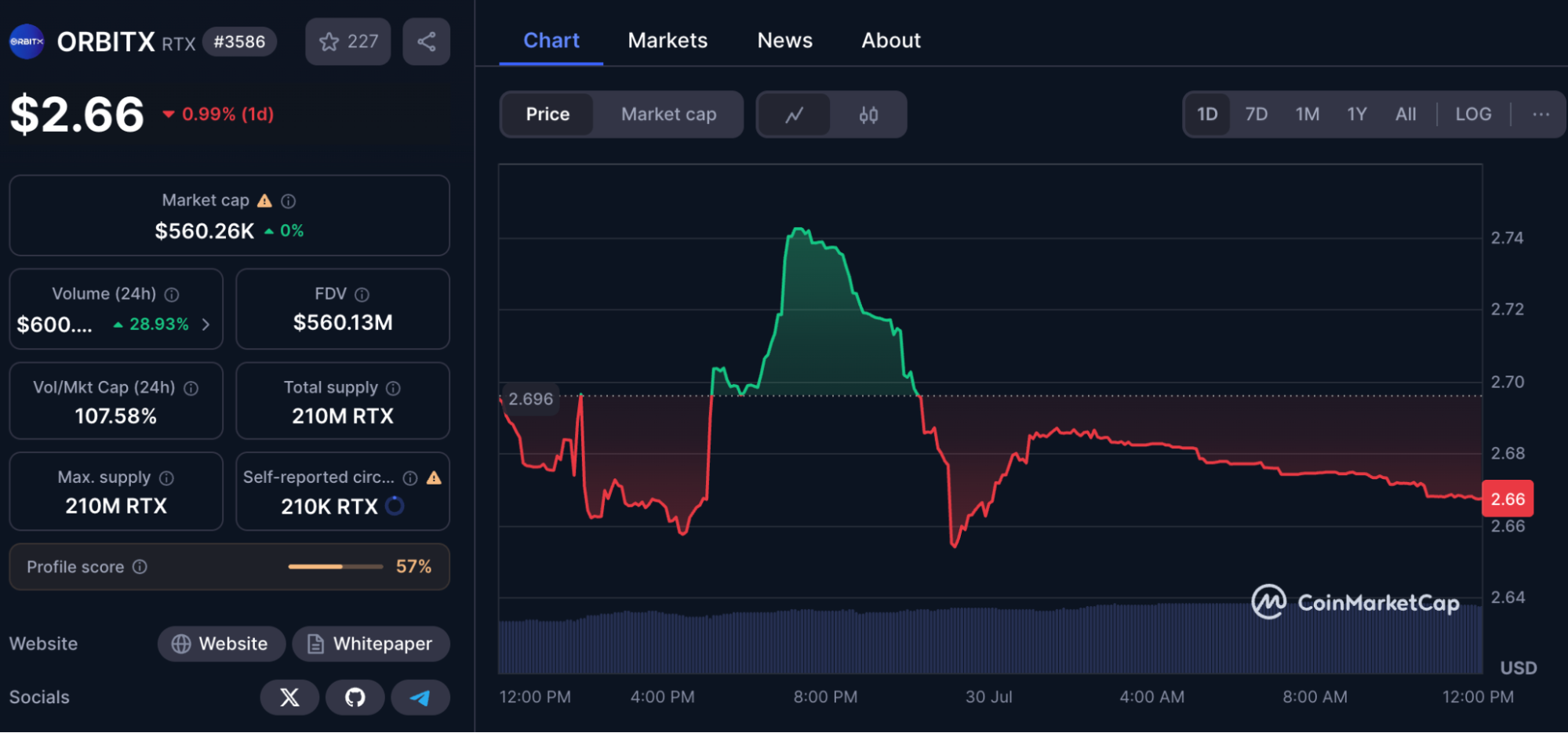

Chart source: https://coinmarketcap.com/currencies/orbitx/

As of July 30, 2025, the real-time price of RTX is $2.67, representing a 1.11% decrease from the previous trading day. The 24-hour trading volume stands at $602,416, indicating moderate activity and attracting notable market attention.

Real-time price: $2.67 USD, 24-hour trading volume: $602,416 USD, 24h change: -1.11%

Broader short-term adjustments in the crypto market or increased competition among projects within the BNB Chain ecosystem may have caused this modest pullback. For investors tracking short-term volatility, it is important to monitor trading volume shifts and key support levels.

Historical Highs and Lows Review

RTX hit an all-time high of $2.76 on July 28, 2025—just two days prior—highlighting strong short-term capital inflows and increased market interest. All-time high: Jul 28, 2025 $2.76 (down 3.46% from peak)

Conversely, RTX reached an all-time low of $0.9405 on June 27, 2025. The price has increased by more than 183% compared to its value on June 27, 2025. This highlights RTX’s strong resilience and ability to rebound even during periods of pronounced market pessimism. All-time low: Jun 27, 2025 $0.9405 (+183.67%)

Key Factors Influencing Price

  • Market sentiment volatility: Price action in the broader crypto market directly affects RTX’s short-term performance;
  • Ecosystem adoption: Growth in social platform users and rollout of new features can drive token demand higher;
  • On-chain liquidity: The depth of liquidity on major decentralized exchanges impacts price stability;
  • Macroeconomic environment: The US Dollar Index, interest rate policy, and other macro factors strongly influence the entire crypto asset landscape.

Short- and Medium-to-Long-Term Trend Outlook

In the near term, if RTX holds above the $2.60 support level alongside rising trading volume, the token may continue to trend upward within a consolidation range. If it falls below this level, the price could test the next support level near $2.40. Looking ahead, the medium-to-long-term outlook will depend on the successful rollout of new features and ongoing user growth within the OrbitX ecosystem, which can both reinforce RTX’s intrinsic value.

Author: Max
Disclaimer
* The information is not intended to be and does not constitute financial advice or any other recommendation of any sort offered or endorsed by Gate.
* This article may not be reproduced, transmitted or copied without referencing Gate. Contravention is an infringement of Copyright Act and may be subject to legal action.

Related Articles

AI-Native Settlement Layers: How United Stables Is Building the Next Financial Rail
Beginner

AI-Native Settlement Layers: How United Stables Is Building the Next Financial Rail

Stablecoins were originally designed as dollar substitutes within exchanges, primarily used for asset pricing and trade settlement. As on-chain financial ecosystems have matured, their role has expanded beyond simple payments to include collateral assets, cross-chain liquidity mediums, and unified settlement units. In particular, as AI systems and automated agents begin to participate directly in economic activity, demand has risen sharply for programmable value units capable of instant settlement. This shift is pushing stablecoins toward the role of foundational financial infrastructure.
2026-03-25 03:16:17
The ve(3,3) Flywheel Explained: How AERO Tokenomics Powers Aerodrome’s DeFi Economy
Beginner

The ve(3,3) Flywheel Explained: How AERO Tokenomics Powers Aerodrome’s DeFi Economy

In the competition for DeFi liquidity, high-inflation mining alone is no longer enough to build lasting advantages. Aerodrome applies the ve(3,3) economic model to redesign token emissions, voting mechanisms, and revenue distribution, creating a liquidity flywheel centered on governance and cash flow. This article examines AERO tokenomics, the veAERO locking mechanism, and protocol revenue models to explain how Aerodrome builds a sustainable DeFi economic system.
2026-03-25 06:41:58
Aerodrome Tokenomics: How ve(3,3) Powers Base's Most Profitable DEX
Beginner

Aerodrome Tokenomics: How ve(3,3) Powers Base's Most Profitable DEX

AERO is the native token of Aerodrome Finance, a core decentralized exchange and liquidity protocol in the Base ecosystem. It is primarily used for liquidity incentives and ecosystem operations. veAERO is a governance NFT that users receive by locking AERO, representing both voting power and the right to share protocol revenue. Through a dual track structure of AERO as a utility token and veAERO as a governance credential, Aerodrome separates liquidity usage value from long term governance power, allowing participants to act as liquidity providers, governance decision makers, and revenue sharers within the same system.
2026-03-25 06:40:31
DePIN Identity Network and Real World Applications: How Humanity Protocol Brings on-chain Identity Into the Physical World
Beginner

DePIN Identity Network and Real World Applications: How Humanity Protocol Brings on-chain Identity Into the Physical World

Most Web3 identity systems remain confined to on-chain environments and struggle to achieve meaningful adoption in real world settings. Through a DePIN architecture and physical verification hardware, Humanity Protocol aims to bring decentralized identity into access control systems, hospitality, public services, and offline events, allowing on-chain identity to function not just as a digital credential, but as foundational infrastructure for real world access.
2026-03-25 07:40:53
How is the price of PAXG determined? Pegging mechanism, trading depth, and influencing factors
Beginner

How is the price of PAXG determined? Pegging mechanism, trading depth, and influencing factors

PAXG (Pax Gold) is a tokenized asset backed by physical gold reserves, launched by fintech firm Paxos and issued as an ERC-20 token on the Ethereum blockchain. The core concept is to digitally represent real-world gold assets, allowing investors to hold and trade gold via the blockchain network. Because each PAXG token corresponds to a specific quantity of physical gold, its price is theoretically expected to closely track the global gold market.
2026-03-24 19:11:40
Aster vs Hyperliquid: Which Perp DEX Will Prevail?
Beginner

Aster vs Hyperliquid: Which Perp DEX Will Prevail?

Aster and Hyperliquid are the two representative protocols of the "purpose-built L1 path" within the current decentralized perpetual exchange (Perp DEX) sector. As a pioneer in the field, Hyperliquid has built a deep liquidity moat through its highly mature order book architecture and strong community consensus. Conversely, Aster, as a rising challenger, seeks to leapfrog the competition in high-performance trading through more aggressive multi-chain aggregation logic, private transaction modules, and an underlying execution environment optimized for 2026 market demands.
2026-03-24 11:58:33





