Ao avaliar o valor de aplicação do House Party Protocol (HPP), a questão central não está apenas em suas capacidades, mas em como seus módulos tratam, de forma independente, computação, verificação, execução de estratégias, obtenção de dados e análise de ativos.
Esse desafio abrange cinco dimensões — Noösphere, ArenAI, Booost, Alpha Quark e colaboração multi-módulo — que, em conjunto, compõem a base da infraestrutura do HPP para aplicações de IA e Web3.
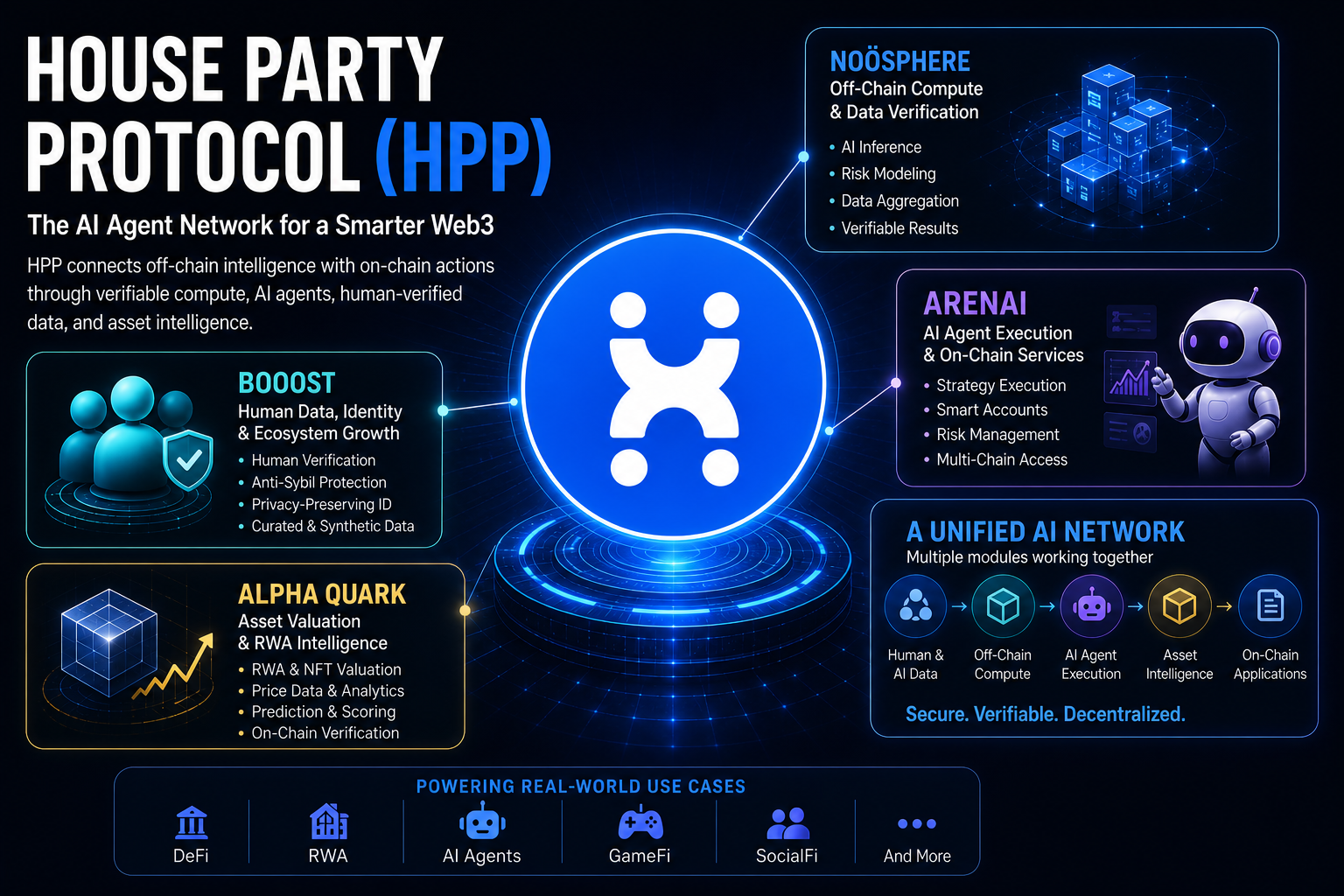
Casos de uso do HPP e visão geral da arquitetura
Os casos de uso do HPP se estruturam como uma rede modular focada em serviços de IA, verificação de dados e execução on-chain. Seu diferencial está na integração de computação off-chain, agentes inteligentes, verificação de identidade e análise de ativos em uma infraestrutura unificada, nativa de IA.
Noösphere responde pela computação inteligente off-chain e caminhos de dados verificáveis; ArenAI é responsável pela execução de estratégias de AI Agent; Booost oferece camadas de dados humanos e sintéticos; Alpha Quark se dedica à análise inteligente de ativos RWA e NFT. O whitepaper oficial define o HPP como um ecossistema de dados e blockchain orientado por IA, conectando sistemas corporativos e tecnologia descentralizada.
O fluxo começa com usuários ou desenvolvedores submetendo demandas — como inferência de IA, verificação de dados ou execução de estratégias on-chain. O sistema aciona o módulo correspondente ao tipo de tarefa. Cada módulo realiza computação, verificação ou execução. Os resultados são utilizados em aplicações on-chain, mercados de dados ou cenários de análise de ativos.
| Módulo oficial |
Funcionalidade principal |
Caso de uso típico |
| Noösphere |
Computação e verificação off-chain |
Inferência de IA, scoring de risco, agregação de dados |
| ArenAI |
Execução de AI Agent |
Estratégias automatizadas, serviços financeiros on-chain |
| Booost |
Camada de dados e identidade |
Verificação humana, dados sintéticos, anti-sybil |
| Alpha Quark |
Inteligência de ativos |
Valuation de RWA, valuation de NFT, análise de risco |
A tabela evidencia que o HPP não é um produto isolado, mas uma rede de aplicações sustentada por módulos oficiais.
Noösphere é o framework inteligente off-chain do HPP, conectando ambientes determinísticos de blockchain a tarefas computacionais do mundo real. Permite que smart contracts solicitem e validem operações off-chain como inferência de IA, modelagem de risco e agregação de dados de múltiplas fontes.
Na prática, usuários ou smart contracts iniciam pedidos de computação off-chain — como scoring de risco ou inferência de modelos. Noösphere executa a tarefa por meio de agentes descentralizados. O sistema retorna resultados por caminhos verificáveis e integra as saídas em ambientes compatíveis com EVM. Aplicações on-chain utilizam esses resultados de inteligência off-chain validados.
Esse mecanismo amplia a capacidade de contratos inteligentes para interpretação de dados e computação. Para DeFi, DeSci, análise inteligente de RWA e mercados de inferência, a computação off-chain reduz custos e latência de execução de tarefas de IA complexas diretamente on-chain.
ArenAI é a camada de execução inteligente do HPP, permitindo que usuários implementem estratégias on-chain e tarefas de gestão de risco por meio de AI Agents. ArenAI encapsula a execução de estratégias de IA como serviços on-chain acessíveis aos usuários.
O usuário seleciona ou configura um AI Agent, gerenciando-o por contas inteligentes e permissões de sessão. O Agent executa tarefas com base em dados de mercado, regras de estratégia e parâmetros de risco. O sistema garante transparência, verificabilidade e controle do usuário on-chain. Assim, usuários acessam serviços de estratégias automatizadas sem necessidade de programação. Segundo a documentação oficial, ArenAI permite que usuários utilizem estratégias de trading baseadas em IA e que provedores liberem estratégias como AI Agents.
Com isso, AI Agents deixam de ser apenas ferramentas analíticas off-chain e passam a atuar como unidades de execução que interagem com contas on-chain, DEX, CEX e camadas de liquidez multi-chain.
O papel do Booost em incentivos ao usuário e crescimento do ecossistema
Booost é a camada de dados humanos e sintéticos do ecossistema HPP, viabilizando verificação de identidade, sistemas anti-sybil, ferramentas de identidade com privacidade e datasets curados. Sua função é fornecer fontes de dados confiáveis e bases de interação para a rede de IA.
Usuários entram em cenários de interação do ecossistema por meio de verificação de identidade ou comportamento. O Booost identifica usuários genuínos e mitiga riscos de ataques sybil. Dados humanos ou sintéticos curados são usados para treinar IA e otimizar aplicações. O ecossistema conquista dados de participação mais confiáveis para cenários sociais, de jogos, metaverso ou governança.
Esse desenho garante que as aplicações de IA do HPP dependam não apenas de computação de modelos, mas também de inserção de dados confiáveis. Booost aumenta a credibilidade de identidade, qualidade dos dados e eficiência do crescimento do ecossistema para aplicações que exigem participação autêntica.
Alpha Quark é o módulo de análise inteligente de ativos do HPP, cobrindo RWA, NFT, ferramentas de valuation on-chain, dados de preço e análises preditivas. Utiliza IA para aprimorar precificação, verificação e financeirização de ativos on-chain.
Usuários ou aplicações submetem dados de ativos — como NFTs, imóveis tokenizados, colecionáveis ou instrumentos financeiros. Alpha Quark combina modelos de valuation com IA, verificação on-chain e dados de preço em tempo real para análise. O sistema gera valuations, scoring de risco ou análises preditivas. Esses resultados são aplicados em empréstimos, staking, seguros ou precificação de mercado. Fontes oficiais confirmam que Alpha Quark suporta valuation de RWA e NFT com IA, verificação on-chain e ferramentas financeiras.
Assim, Alpha Quark soluciona desafios centrais de ativos RWA e NFT — valuation opaco, riscos não mensuráveis e dados off-chain de difícil validação — ao criar um fluxo estruturado para análise inteligente de ativos.
Estrutura de rede de aplicações de IA por colaboração multi-módulo
A colaboração multi-módulo é essencial para a rede de aplicações do HPP. Cada módulo é especializado em computação, execução, dados, identidade ou análise de ativos, formando uma cadeia de aplicações completa por meio de um protocolo unificado.
Fluxo típico: usuários submetem pedidos de serviços de IA por uma aplicação; Noösphere realiza computação off-chain ou validação de dados; ArenAI executa estratégias ou operações on-chain; Booost fornece credibilidade de identidade e dados; Alpha Quark entrega valuation de ativos ou análise de risco. O sistema retorna resultados para aplicações on-chain, sistemas corporativos ou mercados descentralizados.
Essa estrutura permite que o HPP cubra todo o ciclo — geração, validação, computação, execução de dados e comercialização. O modelo de negócios é segmentado em data-as-a-service, computação e deployment de IA, verification-as-a-service e inteligência de ativos baseada em IA.
Principais limitações no deployment de aplicações do HPP
O deployment do HPP é limitado pela complexidade da computação off-chain, custos de validação de dados, riscos de execução de Agent e desafios de coordenação multi-módulo. Com a expansão dos módulos, crescem as demandas por coordenação sistêmica, eficiência de validação e compreensão do usuário.
Nos fluxos de uso, usuários definem tipos de tarefas e permissões. O sistema aloca recursos e valida resultados entre módulos. As aplicações precisam gerenciar obtenção de dados, confiabilidade de modelos, permissões de execução e registro on-chain. Apenas com alinhamento entre resultados computacionais, controle do usuário e incentivos econômicos a rede de AI Agent opera com confiabilidade.
Essas limitações não reduzem o valor da aplicação; evidenciam que o sucesso do HPP depende de execução técnica, qualidade dos dados, mecanismos de validação e colaboração contínua do ecossistema.
Resumo
Os casos de uso do House Party Protocol são baseados nos módulos oficiais — Noösphere, ArenAI, Booost e Alpha Quark. Noösphere cuida de computação off-chain e validação de dados; ArenAI executa estratégias de AI Agent; Booost entrega camadas de identidade e dados; Alpha Quark permite análise inteligente de ativos RWA e NFT.
A implementação envolve usuários iniciando solicitações, o sistema acionando módulos, realizando computação ou validação, gerando resultados e atendendo aplicações on-chain. O valor do HPP está na colaboração multi-módulo; suas principais limitações são custos computacionais, eficiência de validação, qualidade dos dados e risco de execução.
Perguntas Frequentes
Quais são os casos de uso do House Party Protocol?
Os casos de uso do House Party Protocol incluem inferência de IA off-chain, validação de dados, execução de estratégias de AI Agent, verificação de identidade de usuário, dados sintéticos, valuation de RWA, valuation de NFT e análise de ativos on-chain.
Qual é o papel do Noösphere no HPP?
Noösphere gerencia computação off-chain e validação de dados, permitindo que smart contracts acionem inferência de IA, scoring de risco e agregação de dados de múltiplas fontes, integrando resultados em aplicações on-chain por caminhos verificáveis.
Como o ArenAI suporta aplicações de AI Agent?
ArenAI permite que usuários gerenciem AI Agents via contas inteligentes e permissões de sessão, viabilizando execução automatizada de estratégias, gestão de risco e operações on-chain, com transparência e controle do usuário.
Como o Booost se relaciona com aplicações do HPP?
Booost fornece ao HPP dados humanos, dados sintéticos, verificação de identidade e funções anti-sybil, aumentando a qualidade da interação do usuário, confiabilidade dos dados e eficiência do crescimento do ecossistema.
Para que serve principalmente o Alpha Quark?
Alpha Quark é usado principalmente para valuation inteligente, validação on-chain, análise de preço e scoring de risco de RWA, NFT e outros ativos tokenizados, facilitando integração com DeFi, empréstimos e seguros.