As competition among Layer1 public blockchains continues to intensify, more blockchain projects are turning to ecosystem integration and resource coordination to strengthen their long-term competitiveness. Kaia was created through the merger of two Asian Web3 public blockchains, Klaytn and Finschia. This integration involves not only technical architecture and governance systems, but also the migration and unification of the native tokens KLAY and FNSA into KAIA.
For the blockchain industry, token migration is not merely a branding upgrade. It also represents a realignment of network governance, developer resources, and ecosystem direction. Kaia’s case shows that Web3 infrastructure is gradually moving away from “single-chain competition” and toward “ecosystem coordination.” Rather than focusing only on on-chain performance, Kaia places greater emphasis on driving Web3 user growth in Asia through LINE, stablecoin payments, and the super app ecosystem.
KLAY is the native token of the Klaytn network. It was originally used to pay Gas Fees, support network governance, and incentivize validator nodes. Klaytn was promoted through the ecosystem of the South Korean internet company Kakao, with a focus on enterprise blockchain, NFTs, and DeFi applications.
FNSA is the native token of the Finschia network. Finschia originated from LINE’s Web3 strategy, and its ecosystem leans more toward social networking, payments, and digital content services.
KAIA is the unified native token created after the merger into the Kaia network. After Klaytn and Finschia completed their integration, KAIA gradually replaced KLAY and FNSA and became the core asset of the new network.
In addition to continuing to support Gas payments and governance, KAIA is also used in new ecosystem scenarios such as stablecoin payments, Mini DApps, and on-chain finance.
The merger between Klaytn and Finschia is closely connected to the current competitive environment in the Layer1 market.
Over the past few years, the blockchain industry has seen the emergence of many public blockchain networks. However, many projects have faced ecosystem fragmentation, a shortage of developers, and slowing user growth. At the same time, large ecosystems such as Ethereum, Solana, and TON have continued to expand their market influence.
Against this backdrop, Klaytn and Finschia began exploring ways to improve their competitiveness through resource integration.
Klaytn has certain strengths in South Korea’s internet ecosystem and enterprise partnerships, while Finschia relies on LINE’s social platform resources to build Web3 applications. After the merger, the two sides can share developer tools, user entry points, and ecosystem resources, helping to build a more complete Web3 infrastructure for Asia.
Kaia’s merger process involved several stages, including governance proposals, community voting, network upgrades, and token integration.
In blockchain networks, major upgrades usually require approval through governance mechanisms. Governance participants from Klaytn and Finschia discussed and voted on the merger proposals separately to decide whether to move forward with the network integration.
After the proposals were approved, the development teams began implementing technical upgrades, including changes to the validator node structure, governance mechanism, and on-chain system integration.
At the same time, the original token systems also began to converge. As the Kaia mainnet gradually went live, KAIA became the new native token, while KLAY and FNSA entered the migration phase.
The whole process involved not only technical upgrades, but also the unification of ecosystem branding and long-term development direction.
After the Kaia network went live, existing KLAY holders could gradually convert their assets into KAIA according to the official migration rules.
For most users, if their assets were held on trading platforms or custodial wallets that supported the upgrade, the migration process may have been completed automatically by the platform, with no additional action required from the user.
On-chain users, however, may need to complete asset mapping through an official swap tool or network upgrade process.
After KLAY is converted into KAIA, its core uses still include paying Gas Fees, participating in governance, and staking with validator nodes. However, KAIA has a broader ecosystem positioning, and its future applications are expected to further cover stablecoin payments, Mini DApps, and the super app ecosystem.
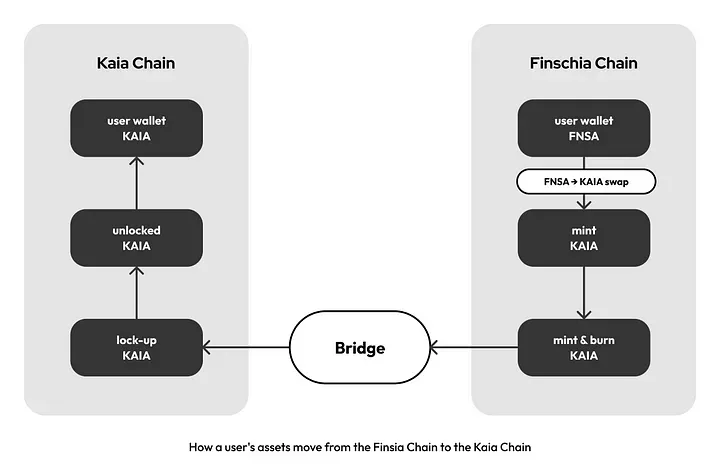
The migration logic for FNSA is similar to that of KLAY, but because FNSA originally operated on the Finschia network, the process involves cross-ecosystem integration.
During the migration, the official team usually provides network upgrade instructions, swap tools, and wallet compatibility solutions to help users complete the asset conversion.
After users complete the migration, the original FNSA will gradually stop being used as the native token of the mainnet, while KAIA becomes the unified core asset.
The conversion of KLAY and FNSA into KAIA is not just a change in token name. It also marks the unification of the entire network ecosystem.
First, the governance structure begins to integrate. Governance systems that originally belonged to two separate chains are gradually unified within the Kaia network, reducing the problem of dispersed ecosystem resources.
Second, developers can deploy applications on a unified network without having to adapt separately to different ecosystems. This helps lower development costs and improve application scalability.
For users, a unified token system can also reduce confusion around assets and networks. In the future, more payment, stablecoin, and Mini DApp services will be built around KAIA.
From a branding perspective, KAIA also represents the image of a new Asian Web3 network, rather than being limited to the background of a single ecosystem.
After the merger, Kaia’s key areas of focus mainly center on stablecoin payments, Mini DApps, and the super app ecosystem.
Compared with traditional public blockchains that focus more on on-chain finance and developer tools, Kaia places greater emphasis on combining internet platforms with Web3 services.
Among these, LINE is seen as one of the important user entry points. Kaia hopes to make blockchain applications easier for ordinary internet users to access through messaging apps, digital payments, and lightweight Web3 services. In addition, Kaia is also exploring areas such as RWA, on-chain finance, and cross-border payments, with the goal of extending stablecoin infrastructure into more real-world scenarios.
KAIA is the unified native token of the Kaia network after the merger, created through the integration of KLAY and FNSA.
This conversion involves not only token migration, but also the unification of governance structures, validator systems, and ecosystem resources. Kaia’s goal is not simply to build another Layer1 public blockchain. Instead, it aims to drive Web3 user growth in Asia through LINE, stablecoin payments, and the Mini DApp ecosystem.
From an industry development perspective, Kaia’s merger also shows that Web3 infrastructure is gradually shifting from a model of “single-chain competition” to one of “ecosystem coordination.” Its long-term growth will still depend on the developer ecosystem, user activity, and the real-world adoption of its applications.
KLAY was the native token of Klaytn, and after the Kaia network went live, it was gradually converted into KAIA.
After Finschia and Klaytn merged, the network and token systems needed to be unified, so FNSA was gradually migrated to KAIA.
The two sides aimed to integrate Asian market resources, developer ecosystems, and user entry points in order to improve the competitiveness of the Layer1 network.
After the conversion, KAIA serves as the Gas Fee payment token on the Kaia network.
Kaia is deeply integrated with the LINE Web3 ecosystem, and its Mini DApps and certain on-chain services can connect to the LINE ecosystem.
Users should confirm the official migration rules, supported platforms, and wallet compatibility, while staying alert to phishing websites and fake swap links.