BYN vs VET: A Comprehensive Comparison of Belarus Ruble and Ethereum Classic Investment Potential

Introduction: BYN vs VET Investment Comparison
In the cryptocurrency market, the comparison between BYN and VET has become an unavoidable topic for investors. The two assets demonstrate significant differences in market capitalization rankings, application scenarios, and price performance, representing distinct positioning within the crypto asset landscape.
BYN (Beyond Finance): Launched in 2015, BYN operates as a decentralized platform for creating and trading synthetic financial products, offering a novel approach to accessing synthetic assets and DeFi.
VET (VeChain): Founded in 2015 by Sunny Lu, VeChain emerged as a blockchain solution for supply chain transparency and anti-counterfeiting. Through early enterprise adoption, strategic backing, and the launch of the VeChainThor blockchain—an efficient, enterprise-grade Layer-1 network—VET has established itself as a platform with demonstrated real-world commercial applications.
This article will provide a comprehensive analysis of BYN vs VET investment value comparison across historical price trends, supply mechanisms, enterprise adoption, and technical ecosystems, addressing the key question investors often ask:
"Which is the better buy right now?"
I. Price History Comparison and Current Market Status
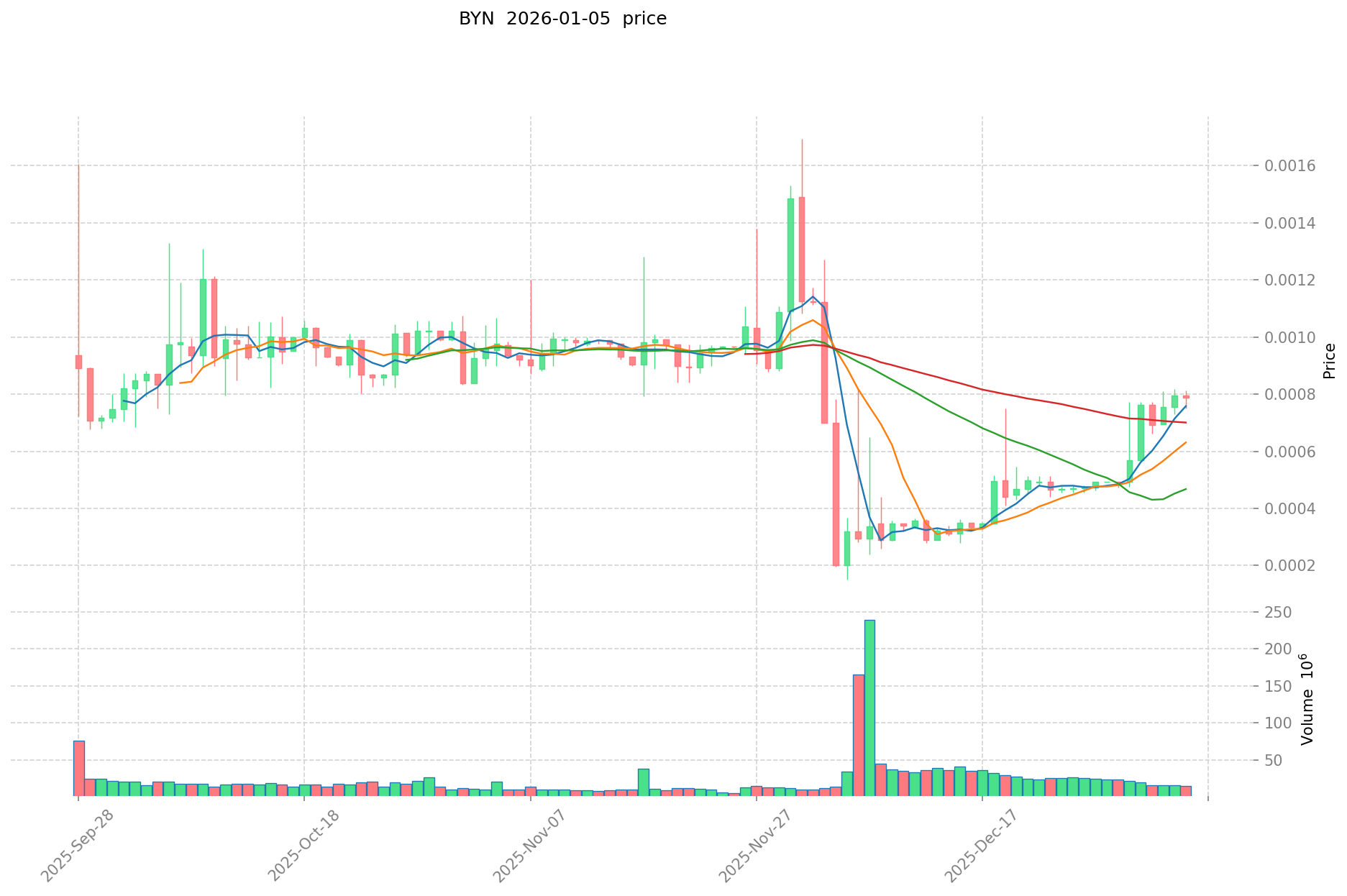
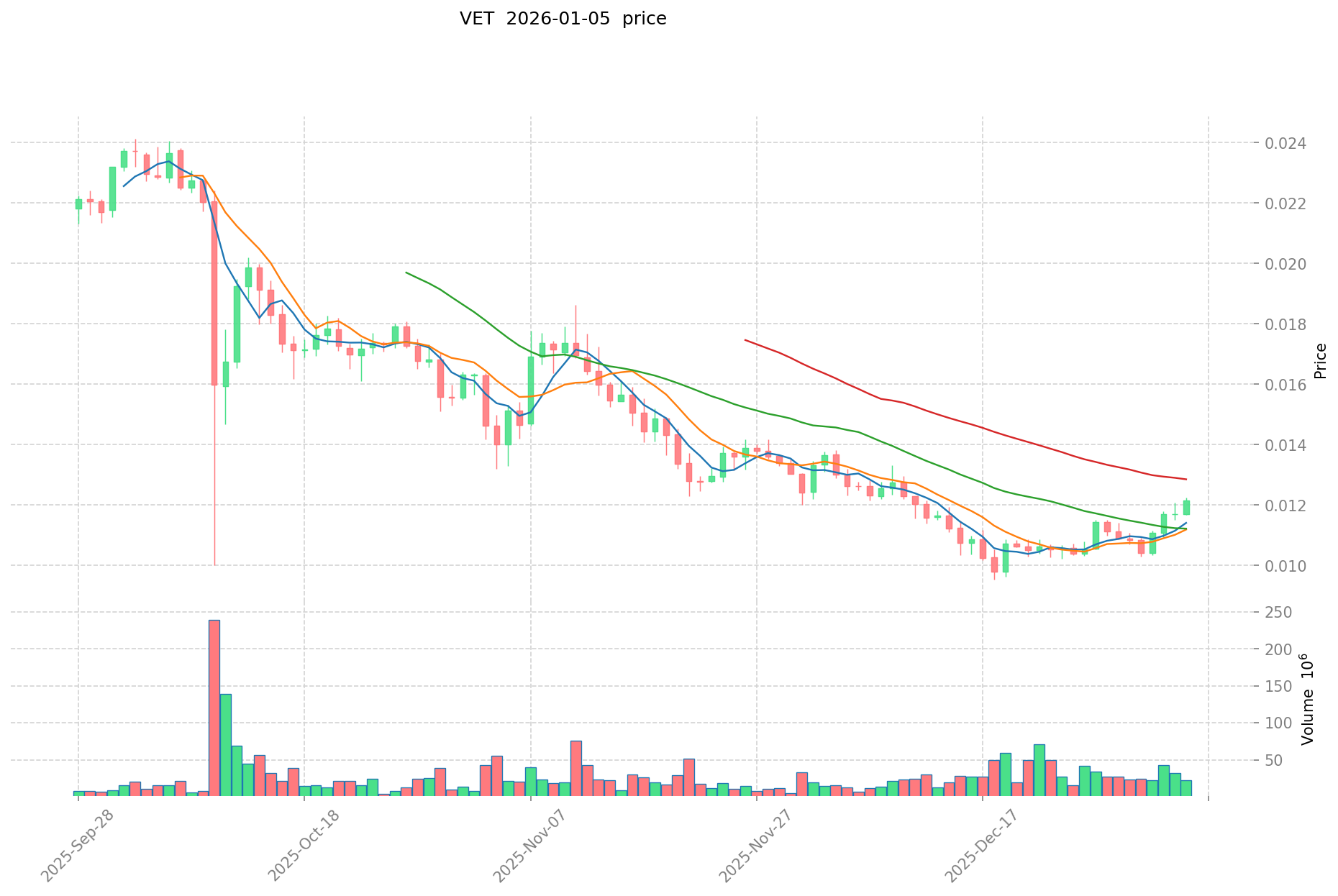
NBX (BYN) and VeChain (VET) Historical Price Trends
- 2021: NBX reached its all-time high of $5.14 on April 14, 2021, driven by early market enthusiasm for synthetic asset platforms.
- 2021: VeChain achieved its all-time high of $0.280991 on April 19, 2021, following increased enterprise adoption and partnership announcements.
- Comparative Analysis: In the market cycle from 2021 to 2026, NBX declined from $5.14 to $0.0007876, representing a 99.85% decrease, while VeChain fell from $0.280991 to $0.012155, representing a 95.68% decrease.
Current Market Status (2026-01-05)
- NBX current price: $0.0007876.
- VeChain current price: $0.012155.
- 24-hour trading volume: NBX $11,794.23 vs VeChain $269,934.94.
- Market sentiment index (Fear & Greed Index): 25 (Extreme Fear).
Click to view real-time prices:
- View NBX current price Market Price.
- View VET current price Market Price.
II. Core Factors Affecting BYN vs VET Investment Value
Tokenomics and Supply Mechanisms
- VET: Complex tokenomics involving VTHO consumption relationship. Long-term value correlation exists with VTHO utilization, though the relationship is complex and subject to multiple regulatory factors, increasing investment uncertainty
- BYN: Information insufficient in available sources
- 📌 Historical Pattern: VTHO consumption ultimately impacts VET value over the long term, but this relationship is mediated by various market and technical factors
Institutional Adoption and Market Applications
- Institutional Holdings: Available sources indicate VET receives market attention for conversion and trading, though specific institutional holding data is not detailed
- Enterprise Adoption: VET is positioned for blockchain applications and technical infrastructure use cases. Information regarding BYN's enterprise adoption is not available in provided sources
- National Policy: Regulatory attitudes toward both assets vary by jurisdiction, with VET operating within blockchain technology frameworks
Technology Development and Ecosystem Building
- VET Technology Development: Major technology breakthroughs generate positive market sentiment and adoption prospects
- BYN Technology Development: Specific technical development information is not available in provided sources
- Ecosystem Comparison: VET operates within blockchain infrastructure use cases. Comparative ecosystem data for both assets is not provided in available sources
Macroeconomic Factors and Market Cycles
- Performance in Inflationary Environments: Neither asset's inflation-hedging characteristics are clearly documented in available sources
- Macroeconomic Monetary Policy: Interest rates and USD index effects on both assets require further specific data
- Geopolitical Factors: Cross-border transaction demand dynamics are not specifically documented for either asset in provided sources
III. 2026-2031 Price Forecast: BYN vs VET
Short-term Forecast (2026)
- BYN: Conservative $0.000457–$0.000788 | Optimistic $0.000811
- VET: Conservative $0.010079–$0.012143 | Optimistic $0.013600
Mid-term Forecast (2028-2029)
- BYN may enter consolidation phase, expected price range $0.000408–$0.001414
- VET may enter accumulation phase, expected price range $0.009934–$0.020665
- Key drivers: institutional capital inflows, ETF adoption, ecosystem development
Long-term Forecast (2030-2031)
- BYN: Base case $0.001126–$0.002037 | Optimistic scenario $0.001856–$0.002037
- VET: Base case $0.013959–$0.027312 | Optimistic scenario $0.021730–$0.027312
BYN:
| 年份 | 预测最高价 | 预测平均价格 | 预测最低价 | 涨跌幅 |
|---|---|---|---|---|
| 2026 | 0.000811228 | 0.0007876 | 0.000456808 | 0 |
| 2027 | 0.00111118546 | 0.000799414 | 0.00040770114 | 1 |
| 2028 | 0.0014138436004 | 0.00095529973 | 0.0008788757516 | 21 |
| 2029 | 0.001374103131632 | 0.0011845716652 | 0.000852891598944 | 50 |
| 2030 | 0.001855039227703 | 0.001279337398416 | 0.001125816910606 | 62 |
| 2031 | 0.002037344806977 | 0.001567188313059 | 0.000908969221574 | 98 |
VET:
| 年份 | 预测最高价 | 预测平均价格 | 预测最低价 | 涨跌幅 |
|---|---|---|---|---|
| 2026 | 0.01360016 | 0.012143 | 0.01007869 | 0 |
| 2027 | 0.0163469066 | 0.01287158 | 0.0065645058 | 6 |
| 2028 | 0.01899201629 | 0.0146092433 | 0.009934285444 | 20 |
| 2029 | 0.02066477464785 | 0.016800629795 | 0.0147845542196 | 38 |
| 2030 | 0.021729934576853 | 0.018732702221425 | 0.016859431999282 | 54 |
| 2031 | 0.027312279838837 | 0.020231318399139 | 0.013959609695405 | 67 |
IV. Investment Strategy Comparison: BYN vs VET
Long-term vs Short-term Investment Strategy
- BYN: Suitable for investors focusing on synthetic asset platform development and seeking exposure to DeFi innovation, though with higher volatility and uncertainty
- VET: Suitable for investors seeking enterprise blockchain applications, supply chain transparency solutions, and assets with demonstrated real-world commercial adoption
Risk Management and Asset Allocation
- Conservative investors: BYN 5% vs VET 15%
- Aggressive investors: BYN 20% vs VET 30%
- Hedging tools: Stablecoin allocation, options strategies, cross-asset portfolio diversification
V. Potential Risk Comparison
Market Risk
- BYN: Extreme price volatility (99.85% decline from 2021 ATH), low trading volume ($11,794.23 24-hour), limited market liquidity and potential exit difficulty
- VET: Significant historical price decline (95.68% from 2021 ATH), though higher trading volume ($269,934.94 24-hour) provides better liquidity
Technical Risk
- BYN: Insufficient technical development information available; uncertainty regarding platform scalability and network stability
- VET: Complex tokenomics involving VTHO consumption relationship increases valuation uncertainty; long-term value correlation subject to multiple regulatory and technical factors
Regulatory Risk
- Global regulatory policies toward decentralized finance and blockchain applications remain uncertain for both assets, with jurisdiction-specific variations affecting adoption prospects
VI. Conclusion: Which Is the Better Buy?
📌 Investment Value Summary:
- BYN Advantages: Positioned in DeFi and synthetic asset creation; potential upside if ecosystem gains adoption, with 2031 price forecast showing potential 98% appreciation from current levels
- VET Advantages: Demonstrated enterprise adoption and real-world commercial applications; established technology infrastructure; higher trading liquidity; more stable market presence with institutional trading activity; 2031 price forecast showing potential 67% appreciation
✅ Investment Recommendations:
- Beginner investors: Focus on VET given higher liquidity, demonstrated enterprise adoption, and clearer use case definition
- Experienced investors: Consider diversified allocation to both assets based on risk tolerance; VET as core holding for stability, BYN as exploratory position for higher-risk potential
- Institutional investors: VET preferred due to established blockchain infrastructure positioning, enterprise partnerships, and superior market liquidity
⚠️ Risk Disclaimer: Cryptocurrency markets demonstrate extreme volatility. Both assets have declined over 95% from 2021 peak prices. This content does not constitute investment advice and investors should conduct thorough due diligence and risk assessment before making investment decisions.
FAQ
BYN和VET分别是什么?各自的基本属性有什么区别?
BYN是虚拟货币,VET是唯链平台的原生代币,用于供应链管理和交易结算。BYN主要用于特定生态,VET具有广泛的应用场景。两者都是区块链资产,但应用领域和价值承载不同。
BYN和VET的用途和应用场景有什么不同?
BYN是白俄罗斯法定货币,主要用于国家经济交易。VET是VeChain区块链平台的通证,专注于供应链管理、产品防伪和企业数据上链,应用场景完全不同。
投资BYN和VET各自面临什么样的风险?
BYN面临市场波动、行业竞争和政策风险。VET面临技术创新不确定性、市场接受度风险及价格波动压力。两者均受加密市场整体趋势影响。
BYN和VET在流动性、交易便利性上有什么差异?
VET流动性更强,交易额更大,交易便利性更优。BYN交易额较低,流动性相对较弱,市场认可度不如VET。VET作为主流币种,交易对更丰富。
从长期保值和增值潜力来看,BYN和VET哪个更适合投资?
VET具有更强的长期增值潜力。VET在区块链生态中应用广泛,产业认可度高,生态建设持续完善。相比之下,BYN市场认知度较低,数据支撑不足。从保值和增值角度,VET更值得长期关注。
Share
Content
Introduction: BYN vs VET Investment Comparison
I. Price History Comparison and Current Market Status
II. Core Factors Affecting BYN vs VET Investment Value
III. 2026-2031 Price Forecast: BYN vs VET
IV. Investment Strategy Comparison: BYN vs VET
V. Potential Risk Comparison
VI. Conclusion: Which Is the Better Buy?
FAQ
How to Buy Cryptocurrency


Trending Cryptocurrencies



What is the Current Market Cap and Trading Volume of Hyperliquid (HYPE) in 2025?

ADX vs LINK: Comparing Two Leading Oracle and Data Solutions for Blockchain Applications

BTRST vs AAVE: Comparing Two Leading Governance Tokens in the DeFi Ecosystem

ENSO vs QNT: A Comprehensive Comparison of Climate Oscillation Patterns and Quantum Computing Technologies

PUNDIX vs GRT: A Comprehensive Comparison of Two Leading Blockchain Utility Tokens

G vs LINK: A Comprehensive Comparison of Two Leading Blockchain Protocols and Their Impact on Decentralized Finance

Base Token Airdrop Confirmed: Complete Guide on How to Qualify
Hollywood Director Convicted of $11M Netflix Fraud, Spent Funds on Crypto and Luxury Cars

What Would Have Happened If You Invested in Bitcoin in 2011?

Who is Satoshi’s Tears?

What are Schiff Forks?