As AI-generated content (AIGC) and 3D digital production continue to grow rapidly, demand for GPU computing power is rising just as fast. From film rendering to real-time interaction and large-scale model inference, traditional cloud computing models are increasingly showing their limits, particularly in cost and scalability. In this context, efficiently coordinating global compute resources has become a key challenge for the industry.
Render Network emerged as a critical piece of infrastructure in response to this trend. As a representative project in the DePIN (Decentralized Physical Infrastructure Network) space, Render integrates distributed GPU resources into a unified marketplace through blockchain and token mechanisms. This allows creators to access compute power on demand, while enabling node operators to monetize their hardware, effectively bridging Web3 and the digital content economy.
The Full Lifecycle of Render’s Operating Mechanism
From the perspective of a single task, Render operates as a closed-loop process consisting of submission, splitting, execution, verification, and settlement.
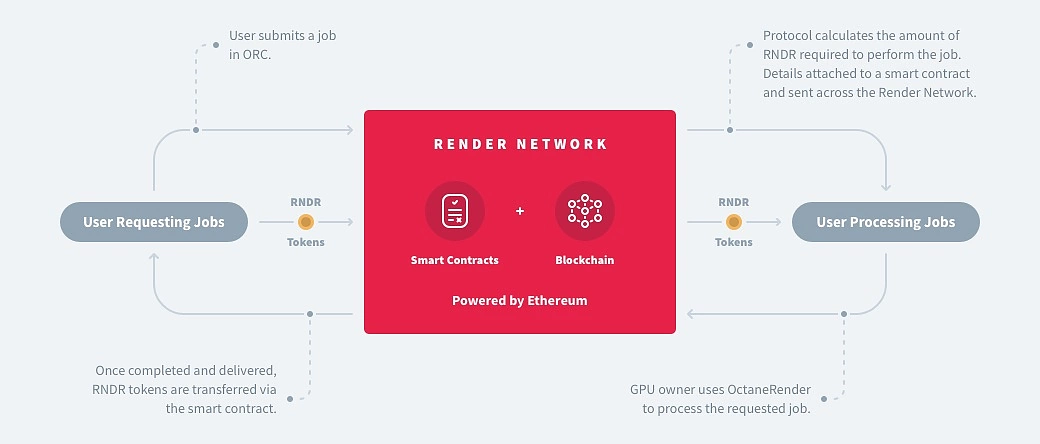
First, creators configure rendering or AI task parameters within supported software or applications. These include scene files, resolution, frame count, and timing requirements. Based on these inputs, the system estimates the required compute resources and associated cost, while offering different service tiers depending on user needs.
The task is then packaged into an order and registered either on-chain or within a coordination layer. Creators must lock a corresponding amount of RENDER tokens in advance, which will later be used for settlement.
During execution, the network splits the task into multiple parallelizable subtasks, such as by frame or segment. These subtasks are distributed based on node hardware performance, geographic location, and reputation scores. GPU nodes receive the assigned tasks, perform rendering or computation, and generate both results and verification data.
Once computation is complete, all subtask outputs are aggregated and post-processed into a final result, which is delivered to the creator. After validation, the system distributes the locked tokens to participating nodes according to their contributions, while updating node reputation scores for future task allocation.
Task Submission and Splitting Mechanism
At the submission stage, creators typically upload standardized scene files, such as ORBX format, through plugins and configure rendering parameters. Based on these inputs, the system estimates GPU usage time and cost, offering multiple service tiers to accommodate different needs.
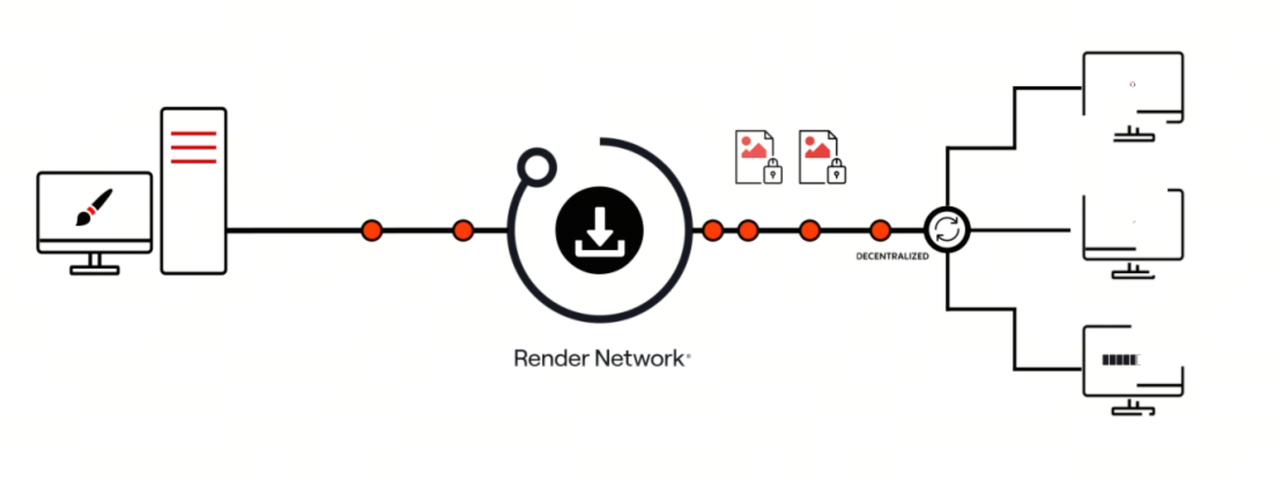
Task splitting is a key factor in improving efficiency. Large rendering jobs are divided into smaller, independent subtasks that can run in parallel across multiple nodes. Each subtask includes resource hashes and output requirements, forming the basis for later validation and result aggregation.
How Render Distributes Tasks to GPU Nodes
During task distribution, Render acts as a scheduling layer, aiming to optimize resource utilization while maintaining output quality.
When nodes join the network, they must submit hardware specifications and pass validation checks. Over time, they build reputation by completing tasks successfully. When assigning tasks, the system considers node load, geographic proximity, and historical performance. High-priority tasks are typically assigned to nodes with stronger reputations.
To reduce the risk of failure, some critical tasks use redundancy strategies, where multiple nodes execute the same task simultaneously. If errors occur or deadlines are missed, the system reallocates the task and penalizes underperforming nodes.
How GPU Nodes Execute Rendering Tasks
From the node’s perspective, Render functions like a compute marketplace. Nodes can either actively accept tasks or receive them passively through allocation, using local GPUs to perform rendering or AI inference.
During execution, GPUs handle tasks such as ray tracing, image generation, and AI denoising. After completion, nodes upload result data along with hashes and log information, which are later used for verification and auditing.
Proof of Render (PoR): Result Verification Mechanism
Proof of Render (PoR) is one of the core mechanisms of the Render network. It combines useful computation with verifiable results as a form of consensus.
Unlike traditional Proof of Work (PoW), which relies on mathematically intensive but practically useless computations, PoR requires nodes to complete real rendering or compute tasks. Nodes prove the validity of their work through output data and corresponding hashes. Each subtask result can be independently verified, ensuring the integrity of the computation process.
In addition, PoR is integrated with a node reputation system, which evaluates reliability based on long-term performance. This allows the network to maintain order without centralized arbitration.
RENDER Token Settlement: On-Chain Payments and Incentives
Render’s economic model revolves around the RENDER token, which is used for payments, node rewards, and governance participation.
During the payment process, creators lock tokens at the time of task submission, with funds held in smart contracts. Once the task is completed and verified, tokens are distributed proportionally to contributing nodes, forming a complete settlement loop.
Render also introduces a Burn-Mint Equilibrium (BME) mechanism. A portion of tokens paid by users is burned, while new tokens are minted according to predefined rules to reward nodes. This “burn on usage, mint on contribution” design creates a dynamic balance between token supply and network demand.
Advantages and Limitations of Render’s Model
On the advantages side, Render improves GPU utilization by aggregating distributed resources and reduces overall costs. Its parallel processing capabilities provide strong efficiency gains for large-scale rendering tasks, while on-chain settlement increases transparency in payments and incentives.
Its decentralized nature also enhances resistance to censorship and single points of failure, offering a more open compute service for global users.
However, there are still practical challenges. Ensuring result consistency and quality control in a distributed environment remains complex. Large-scale data transfer across regions may be constrained by bandwidth limitations. Additionally, regulatory differences across jurisdictions introduce uncertainty for long-term development.
Render’s Role in the DePIN Ecosystem
As a representative GPU-focused DePIN project, Render plays a significant role in connecting compute supply with demand.
On one hand, it lowers the barrier for small teams to access high-performance rendering resources. On the other hand, it enables individuals and organizations to monetize idle GPU capacity. Render can also integrate with decentralized storage and bandwidth networks, contributing to a more complete Web3 infrastructure stack.
Conclusion
Overall, Render Network brings together globally distributed GPU resources into a programmable and incentive-driven decentralized compute network through task splitting, scheduling, PoR verification, and token-based settlement.
Compared with traditional centralized solutions, this model offers advantages in cost, efficiency, and transparency. However, its long-term success will depend on continued growth in compute demand, improvements in network performance, and sustained ecosystem expansion.
FAQs
What are the main use cases of Render Network?
Render is primarily used for 3D rendering, visual effects, gaming and virtual production, architectural visualization, as well as certain GPU-based AI inference and computation tasks.
Can ordinary users participate as nodes?
Yes. As long as users meet basic hardware and network requirements, they can contribute GPU power and earn rewards.
How is Proof of Render different from PoW?
PoR is based on real computational tasks such as rendering and AI inference, rather than meaningless mathematical calculations, and it combines result verification with a reputation system.
What is the role of the RENDER token?
It is used to pay for compute resources, reward nodes, and participate in governance, with its supply dynamically linked to network usage through the BME model.
What is the core difference between Render and traditional cloud rendering?
The key differences lie in decentralized compute sourcing, market-driven pricing, and more transparent settlement, although challenges remain in stability and consistency control.







