As DeFi lending continues to expand the range of supported assets, a key challenge emerges: how to introduce new assets without allowing risk to spill over into the broader system. A single liquidity pool helps concentrate capital, but it can also amplify systemic risk during extreme market conditions. By managing established assets and long-tail assets in separate layers, protocols can maintain stable core liquidity while giving high-volatility assets their own independent space to operate. This creates a clearer boundary between safety and innovation.
From the perspective of on-chain financial architecture, this layered pool design reflects a broader trend toward modular risk management and more segmented market structures. By differentiating asset types, parameter configurations, and risk isolation mechanisms, the dual-track system reshapes how lending markets operate. It also allows participants with different risk preferences to allocate capital more precisely within the same protocol. Through the coordinated operation of core and isolated pools, the lending market can continue expanding its asset coverage and strategy space while preserving overall stability, resulting in a system that is both secure and flexible.
Core Pool vs Isolated Pool Overview
Within the Venus Protocol lending system, the market is not built on a single pool. Instead, it adopts a dual-layer structure consisting of a Core Pool and multiple Isolated Pools.
The primary goal of this design is to enhance asset support while enabling more refined risk management..
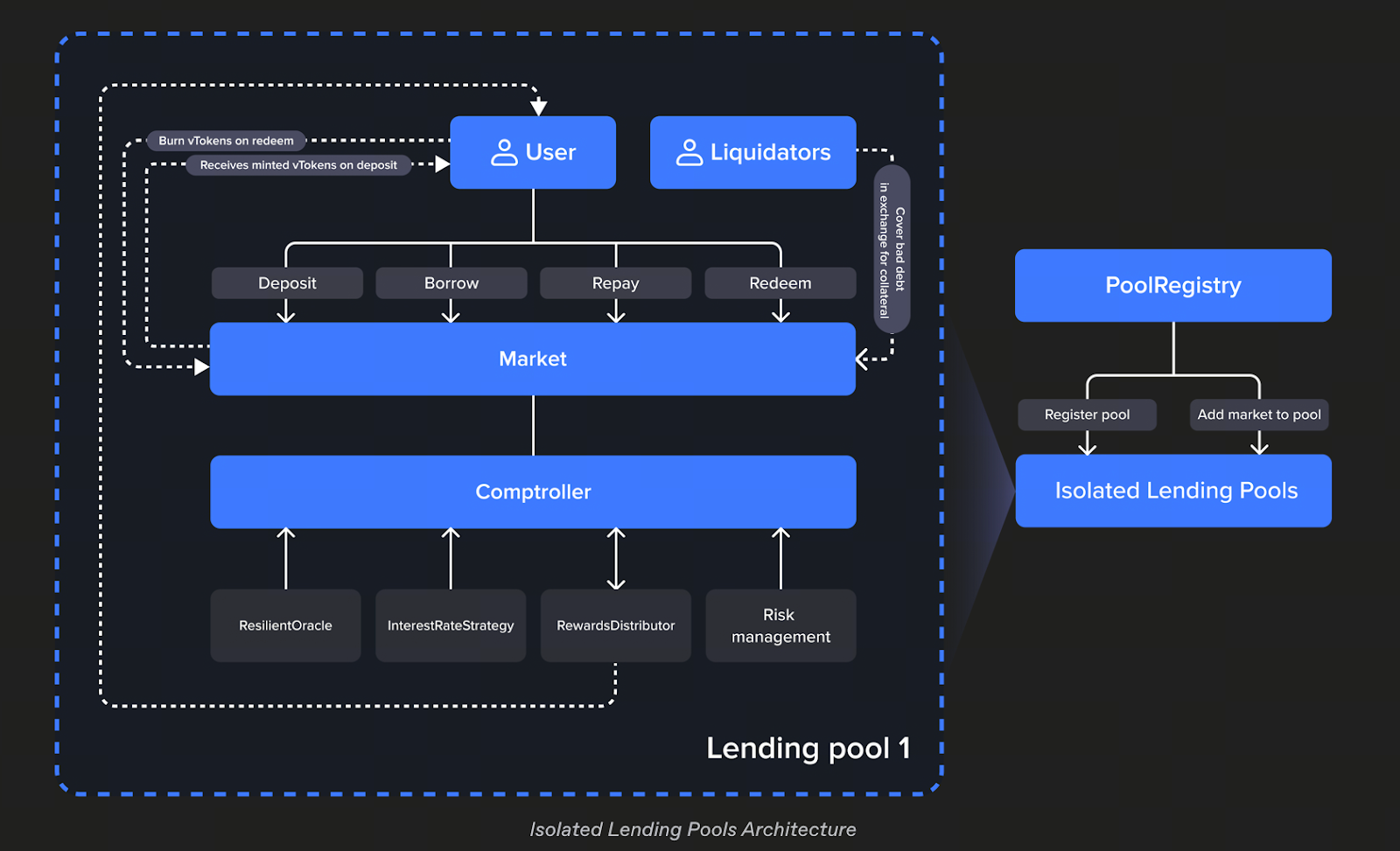
(Source: docs-v4.venus)
Together, they form a DeFi lending market that balances stability with scalability.
What Are the Key Differences Between Core Pool and Isolated Pool?
In Venus’s lending architecture, Core Pool and Isolated Pool serve distinct roles. Their differences in asset types, risk management mechanisms, and parameter settings work together to create a more flexible and secure market structure.
Asset Types
-
Core Pool: Supports mainstream assets such as BTC, ETH, BNB, and stablecoins, with higher liquidity and more mature markets
-
Isolated Pool: Supports emerging or long-tail assets, which tend to be more volatile and carry higher risk
Risk Isolation Mechanism
-
Core Pool: All assets share the same liquidity pool, meaning extreme volatility in one asset can affect the entire system
-
Isolated Pool: Each pool operates independently, with risk confined to a single asset pool and prevented from spreading
Parameters and Risk Controls
-
Core Pool: Uses relatively conservative parameters, such as LTV and liquidation thresholds, prioritizing stability
-
Isolated Pool: Features highly customizable parameters, allowing flexible risk models tailored to specific assets
Market Function Positioning
-
Core Pool: Serves as the foundational lending market, providing primary liquidity
-
Isolated Pool: Acts as an experimental and expansion layer, supporting the listing of new assets
What Scenarios Are Core Pool and Isolated Pool Best Suited For?
In the Venus lending system, different pool designs correspond to fundamentally different risk structures and use cases. The distinction between Core Pool and Isolated Pool is not just functional, but strategic, reflecting choices around asset types, risk isolation, and capital efficiency. Understanding these scenarios helps users align their capital allocation and strategies with their own risk preferences.
Core Pool Use Cases
Core Pool is better suited for users with lower risk tolerance and a preference for stability. It is commonly used for large-scale lending and borrowing, as well as portfolio strategies centered on mainstream assets like BTC and ETH. In environments with deep liquidity and mature market structures, it is particularly effective for long-term lending and stable yield strategies. Its design emphasizes safety and capital availability.
Isolated Pool Use Cases
Isolated Pool is more suitable for users looking to engage with new assets or niche market opportunities. It is often used in higher-yield strategies or experimental setups, such as testing new markets or exploring alternative trading approaches. While it offers greater potential returns, it also introduces higher uncertainty. The core idea is to pursue higher upside within a controlled risk boundary.
Key Risk Differences When Using Two Types of Pools
Under different pool structures, Core Pool and Isolated Pool exhibit clear differences in risk profiles, particularly across systemic risk, liquidity, liquidation mechanisms, and asset characteristics.
-
Systemic Risk vs Localized Risk
Core Pool uses a shared liquidity model, concentrating risk. In extreme market conditions, this can impact the entire pool. In contrast, Isolated Pool confines risk to individual asset pools, ensuring that issues in one market do not spread to others.
-
Liquidity Risk
Core Pool typically has deeper liquidity, allowing smoother capital inflows and outflows and supporting a more stable lending environment. Isolated Pools, however, may have limited liquidity, which can lead to more volatile interest rates and greater uncertainty in borrowing costs.
-
Liquidation Risk
In Core Pool, parameters are relatively conservative, making liquidation triggers more predictable. Isolated Pools often use more aggressive parameter settings and are more sensitive to price fluctuations, increasing the likelihood of liquidation events.
-
Asset Risk
Core Pool primarily supports well-established assets with relatively stable price behavior. Isolated Pool focuses on newer or niche assets, which tend to have higher volatility and greater price uncertainty, amplifying overall risk exposure.
Core Pool prioritizes stability and system security, while Isolated Pool offers greater flexibility at the cost of increased uncertainty and risk exposure.
Conclusion
Through its layered design of Core Pool and Isolated Pool, Venus achieves a dynamic balance between stability and scalability in the DeFi lending market. Core Pool serves as the foundation, providing essential liquidity and overall security, while Isolated Pool enables the introduction of new assets and strategic innovation. At the same time, its risk isolation mechanism prevents cascading effects across the system. This modular architecture allows the protocol to expand its market boundaries without compromising overall safety. For users, the key to understanding these pools lies in aligning their choices with their own risk tolerance and strategic goals, ultimately achieving the best balance between efficiency and risk.







