As a leveraged token designed to amplify Bitcoin’s daily price movements, BTC3L is not a direct representation of Bitcoin ownership but a packaged form of derivatives exposure in a tradable token format. It aims to deliver roughly three times the daily price movement of Bitcoin on the long side and emerged as exchanges developed structured products to simplify access to leveraged trading. This design makes directional exposure more accessible to users who do not want to post collateral, monitor margin, or manage perpetual futures positions directly. At the same time, its reliance on daily targeting and rebalancing introduces structural complexities, meaning BTC3L is better understood as a short-term trading instrument rather than a simple substitute for spot Bitcoin.
What is BTC3L?
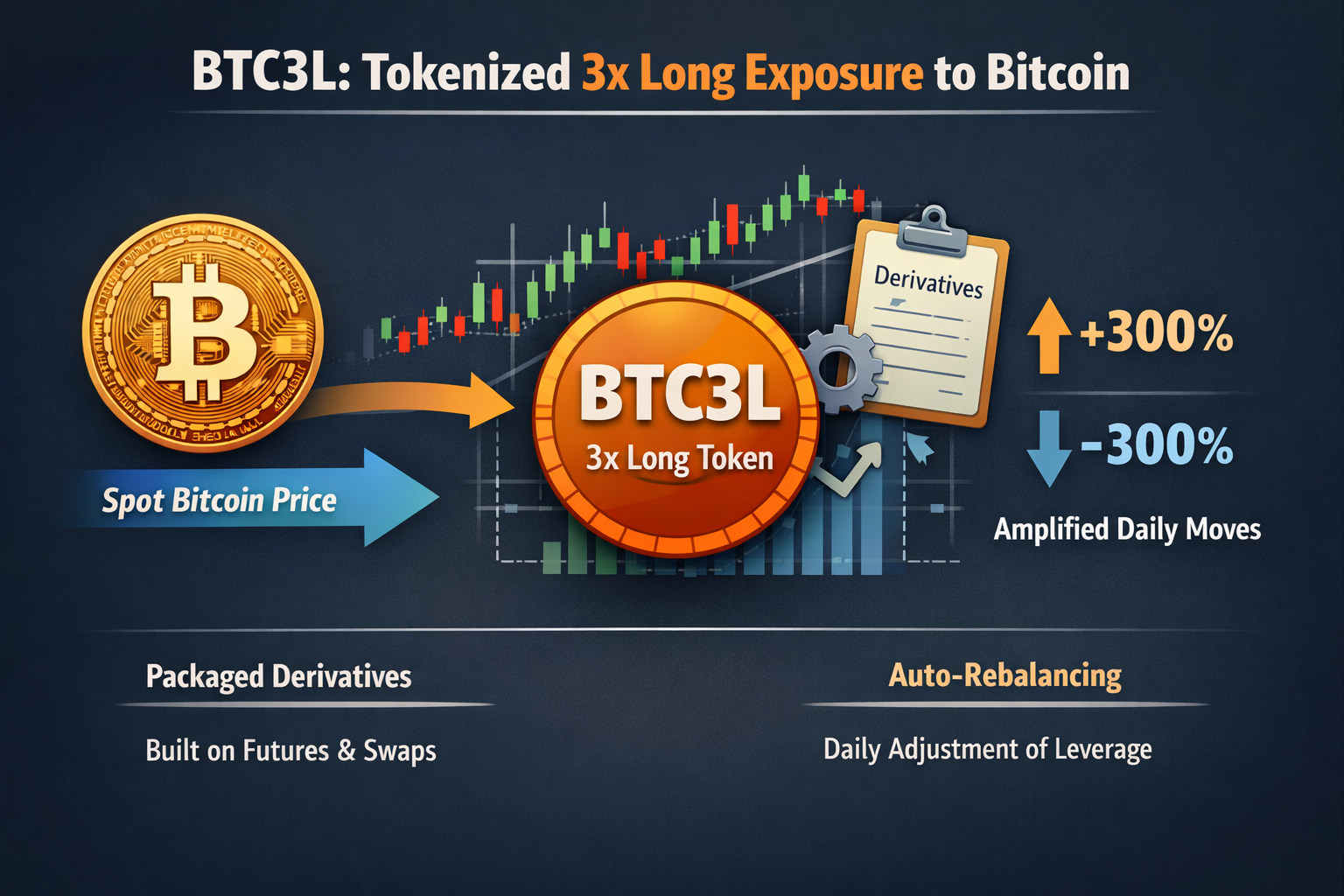
BTC3L is not a simple Bitcoin holding but a tokenized leveraged long product structured to target approximately three times Bitcoin’s daily return. In simple terms, it is not designed to match Bitcoin’s price directly; instead, it amplifies daily movements, so a 1% rise in Bitcoin may result in about a 3% increase in BTC3L, while a 1% decline may lead to about a 3% loss, before fees, slippage, and tracking effects.
It exists to solve a practical trading problem: some market participants want leveraged upside exposure to Bitcoin without borrowing funds themselves or opening a perpetual futures position with margin requirements. BTC3L packages that are exposed into a token that can usually be bought and sold in a spot-style interface.
Conceptually, BTC3L belongs to the category of leveraged tokens. These are derivative-based products, not plain spot assets. Even when they trade like ordinary tokens, their value is generally driven by a managed position behind the scenes, often using perpetual contracts or similar instruments.
BTC3L exists as a response to the growing demand for leveraged trading, where users seek amplified market exposure. Traditional leverage often requires active management of margin, collateral, and liquidation risk, which can be operationally complex, leading to the development of simplified tokenized alternatives.
Common reasons such products were introduced include:
-
giving users amplified directional exposure in a simplified token format
-
reducing the need for manual collateral management
-
avoiding the direct liquidation process associated with many margin or futures accounts
-
making leveraged exposure tradable through standard buy and sell orders on an exchange interface
That convenience is the core appeal. The trade-off is that convenience does not remove risk; it changes the form of risk.
How does BTC3L work?
BTC3L usually works by holding or referencing a basket of leveraged derivative positions tied to Bitcoin, rather than by holding three times as much spot BTC. In many exchange models, the product maintains long exposure through perpetual futures and adjusts that exposure as market conditions change.
A simplified mechanism looks like this:
-
Underlying exposure: The token tracks Bitcoin through derivative positions, commonly perpetual contracts.
-
Target leverage: The product aims for roughly 3x long exposure to Bitcoin’s daily move.
-
Net asset value adjustment: As Bitcoin rises or falls, the token’s net asset value changes by a magnified amount.
-
Rebalancing: The manager or algorithm rebalances the position periodically, often daily and sometimes during extreme market moves, to maintain the target leverage profile.
This rebalancing process is central. It is the reason BTC3L is often described as targeting daily leveraged performance, not a fixed 3x multiple over weeks or months. In trending markets, compounding can sometimes help returns exceed a simple 3x multiple of spot performance. In choppy markets, repeated rebalancing can erode value, causing underperformance relative to what many users expect.
For that reason, BTC3L should be understood as a path-dependent product. The sequence of price moves matters, not just the starting and ending Bitcoin price.
Core Components and Key Features of BTC3L
Understanding BTC3L requires looking beyond its surface as a tradable token and examining the structural elements that define how it behaves in different market conditions.
-
3x long directional exposure BTC3L is designed to provide bullish exposure to Bitcoin by amplifying its daily price movements. Gains and losses are magnified relative to spot BTC, typically targeting about three times the daily change.
-
Tokenized wrapper around derivatives Although it trades like a standard token, BTC3L is built on underlying derivative positions. Its value is therefore influenced not only by Bitcoin’s price but also by how these positions are structured and managed.
-
Automatic rebalancing mechanism BTC3L maintains its target leverage through periodic rebalancing. This process adjusts exposure as the market moves, removing the need for user intervention but introducing potential performance drag in volatile conditions.
-
No direct margin management by the holder Users do not need to handle collateral, borrowing, or liquidation thresholds directly. The operational complexity of leveraged trading is internalized within the product structure.
-
Tracking differences and cost factors BTC3L may not perfectly reflect a 3x return due to fees, funding rates, slippage, spreads, and compounding effects. As a result, its actual performance can diverge from simple expectations based on Bitcoin’s price movement.
BTC3L is a leveraged token defined by amplified daily exposure, derivative-based structure, automatic rebalancing, simplified user interaction, and performance variation due to costs and compounding effects.
Main uses and applications of BTC3L
BTC3L is mainly used in situations where a trader expects Bitcoin to rise over a short horizon and wants amplified exposure without directly operating a leveraged derivatives account.
Typical use cases include:
| Use Case |
When It Is Used |
Explanation |
| Short-term bullish trading |
When a trader expects Bitcoin to rise over a short period |
Provides amplified exposure in a simpler format than perpetual futures, prioritizing ease of use over long-term efficiency |
| Event-driven positioning |
During macro events, ETF-related sentiment shifts, or strong market momentum |
Functions as a tactical instrument for capturing short-term price movements rather than long-term holding |
| Simplified access to leverage |
When users want leverage without managing futures positions |
Offers a tokenized way to access leverage without handling margin, though exposure to amplified risk remains |
BTC3L is commonly used for short-term bullish trades, event-driven strategies, and simplified access to leveraged Bitcoin exposure without direct margin management.
What are the risks and limitations of BTC3L?
While BTC3L simplifies access to leveraged exposure, its structure introduces a distinct set of risks that differ from both spot Bitcoin and traditional derivatives trading.
-
Volatility amplification BTC3L magnifies Bitcoin’s price movements, meaning losses can accumulate much faster than in spot markets. Even a relatively small adverse move in Bitcoin can lead to a disproportionately large decline in value.
-
Rebalancing drag Automatic rebalancing can reduce performance in volatile or sideways markets. Repeated price swings may erode value over time, even if Bitcoin ends near its initial level.
-
Daily target, not long-term tracking BTC3L is designed to reflect a multiple of Bitcoin’s daily return, not its long-term performance. Over extended periods, results can diverge significantly from a simple 3x expectation due to compounding effects.
-
Tracking differences and cost impact Fees, funding rates, spreads, and execution costs can affect returns. As a result, actual performance may differ from the expected leveraged outcome, even when the market direction is correct.
-
Limited suitability for long holding periods The combined effects of rebalancing and compounding make BTC3L less effective as a long-term holding instrument, particularly in volatile market conditions.
-
Misinterpretation of “no liquidation” Although some structures avoid traditional liquidation mechanisms, this does not eliminate risk. The token can still lose a substantial portion of its value, as leverage remains embedded in its design.
BTC3L is defined by amplified volatility, rebalancing effects, daily performance targeting, cost-related tracking differences, limited long-term efficiency, and structural leverage risk despite simplified access.
BTC3L vs. Spot vs. Perpetual Futures: Brief Comparison
Understanding BTC3L becomes clearer when it is compared with spot Bitcoin and perpetual futures, as each represents a different way of gaining exposure to Bitcoin with distinct structural characteristics.
BTC3L provides leveraged long exposure to Bitcoin in a tokenized format. It simplifies access compared to managing a futures position directly, but its internal rebalancing and path-dependent performance make it structurally more complex than it appears.
Spot Bitcoin represents direct ownership of the asset without leverage. It does not amplify returns, does not rely on rebalancing, and is generally easier to interpret, especially for long-term holding.
Perpetual futures offer direct and flexible leverage, allowing users to choose their exposure level. However, they require active management of collateral, awareness of liquidation risk, and understanding of funding rates. BTC3L can be viewed as a simplified wrapper around similar exposure, but with less user control over leverage adjustments.
Conceptual Comparison
| Instrument |
Exposure Type |
Leverage |
Rebalancing |
Margin Management |
Typical Use |
| Spot BTC |
Direct asset ownership |
1x |
No |
No |
Holding, basic directional exposure |
| BTC3L |
Tokenized leveraged long exposure |
~3x daily target |
Yes |
Internalized within product |
Short-term tactical bullish trades |
| Perpetual Futures |
Direct derivative contract |
User-defined |
No automatic token rebalancing |
Required |
Active trading, hedging, custom leverage |
BTC3L differs from spot Bitcoin and perpetual futures by combining leveraged exposure with simplified access, while introducing rebalancing effects and reduced user control over leverage management.
Summary
BTC3L is a tokenized product designed to provide roughly three times Bitcoin’s daily upside and downside exposure through an underlying leveraged derivatives structure. Its main purpose is to give traders simplified access to long leverage without manually running a margined futures position.
The key point is that BTC3L is not just “Bitcoin, but faster.” It is a rebalanced leveraged instrument whose performance depends on volatility, compounding, and holding period. That makes it most understandable as a short-term tactical tool rather than a straightforward replacement for spot BTC.
FAQs
Is BTC3L the same as holding Bitcoin with 3x leverage?
Not exactly. BTC3L is usually a packaged leveraged token that targets about 3x daily Bitcoin performance through managed derivative exposure. Over longer periods, actual results can differ significantly from a simple 3x multiple because of rebalancing and compounding.
Does BTC3L always move exactly three times Bitcoin?
No. It is designed to target approximately three times Bitcoin’s relevant short-term move, but fees, spreads, funding, slippage, and rebalancing effects can all create differences between expected and actual performance.
Why can BTC3L lose value even if Bitcoin is flat over time?
Because the path matters. In volatile back-and-forth markets, automatic rebalancing can cause value erosion, so the token may decline even when Bitcoin ends near where it started.
Is BTC3L safer than perpetual futures?
It may be operationally simpler because the holder usually does not manage margin directly, but that does not make it inherently low risk. BTC3L still carries amplified market exposure and can suffer large losses quickly.
Is BTC3L suitable for long-term investing?
In most cases, it is better understood as a short-term trading instrument. The daily target structure and rebalancing mechanics can make long holding periods inefficient, especially in volatile conditions.