What Is a Bitcoin Order Book (BitcoinOrderBook)?
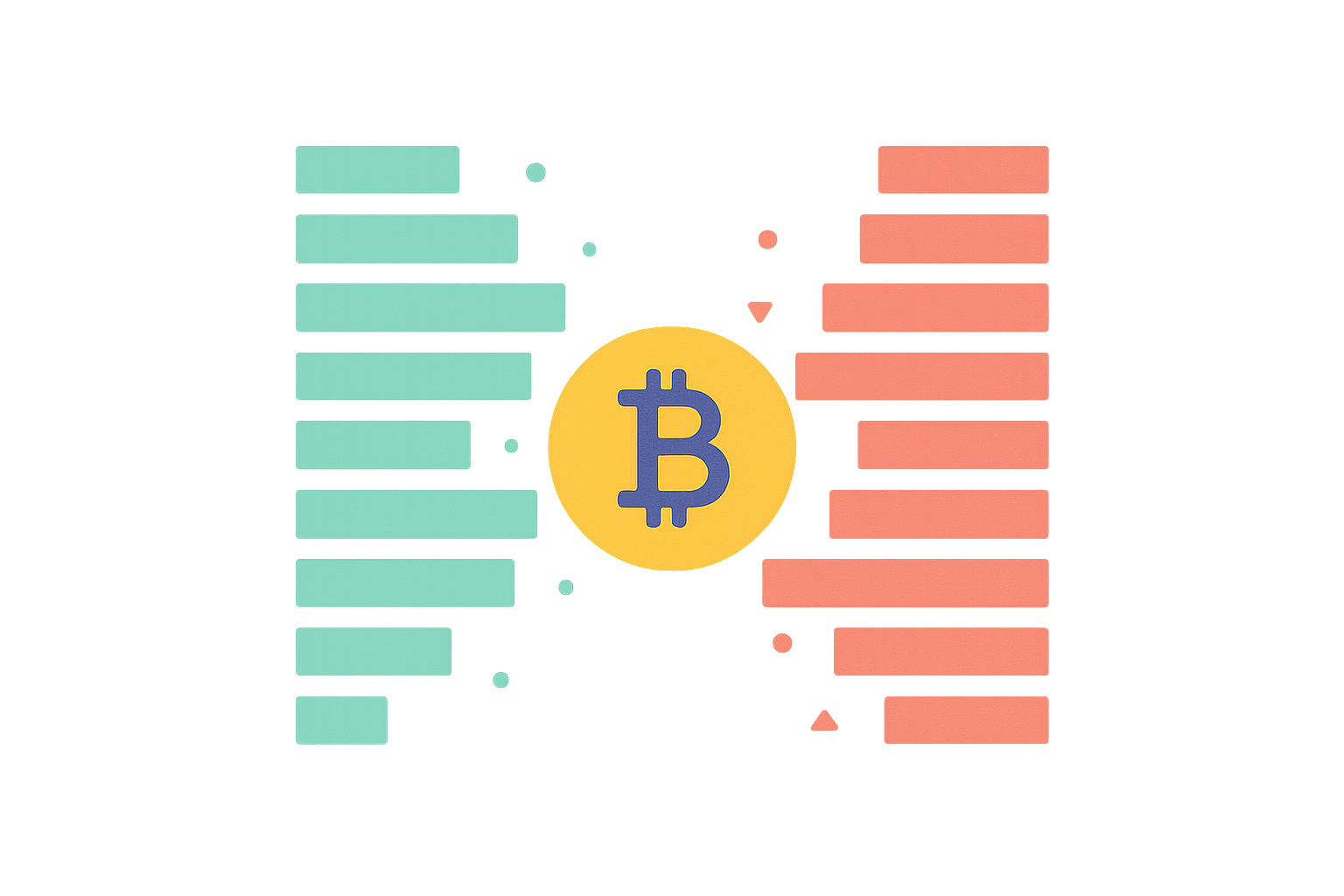
A Bitcoin order book is a real-time, continuously updated list that displays all open buy and sell orders for Bitcoin. It organizes bids (buy orders) and asks (sell orders) by price level, with bids typically on the left side and asks on the right. The closest bid and ask prices determine the bid-ask spread—a key metric reflecting how easily trades can be executed. A narrower spread means higher trading efficiency, while a wider spread signals lower liquidity. The total quantity across price levels is known as market depth; greater depth indicates a lower chance of significant price movement from single trades.
Order books dynamically update as new orders are placed, canceled, or filled. As the primary interface for observing market sentiment and executing trades, the order book is not a price predictor, but it provides transparency on current market supply and demand—helping you see “how much you can buy now” and “where larger buy or sell walls are positioned.”
Why Is Understanding the Bitcoin Order Book Important?
The order book directly impacts your transaction costs and risk management. By reading it effectively, you can avoid trading during periods with wide spreads or shallow depth—minimizing slippage and increasing the likelihood of order execution.
For example, when the spread is narrow and there is sufficient volume within the top five price levels, a market order to buy typically won’t drive the price up significantly. Conversely, with thin depth, even a moderately sized market order may move the price several ticks, immediately increasing your cost.
Order books are essential for short-term and grid strategies to find optimal entry points, while long-term holders use them to assess whether averaging purchases over time is more prudent. For risk control, monitoring large orders (buy or sell walls) can help determine if resistance or support levels are reliable.
The order book operates through two main actions: making (placing) orders and taking orders. Placing an order means posting your intent to buy or sell at a specific price, waiting for someone to match it. Taking an order means accepting an existing order’s price for immediate execution.
Matching engines typically prioritize orders by price first, then by time—better prices are filled first, with same-priced orders queued by submission time. For example, if you place a bid at 60,000 USDT, your order will only fill when someone submits an ask at 60,000 USDT or lower.
The bid-ask spread is the difference between the best buy and sell prices; a smaller spread means trades match more easily. Depth refers to the cumulative volume at each price level—critical for estimating potential price impact from larger orders. Slippage is the deviation between your expected trade price and its actual average execution price, which increases when market depth is insufficient.
Market makers—either individuals or algorithms—routinely place both buy and sell orders across multiple price levels to provide liquidity and keep spreads tight. Retail users also contribute to depth by placing orders, but frequent cancellations can cause volatile shifts in the order book.
How Does the Bitcoin Order Book Behave in Different Crypto Trading Contexts?
On spot exchanges, order books typically display green buy orders and red sell orders; prices closer to the midpoint are more likely to be filled quickly. During significant news events, sellers may pull orders rapidly or buyers may step in with large volumes—causing sudden changes in both spread and depth.
In contract trading, order books function similarly, but leverage can amplify volatility—thin depth may result in sharp short-term price movements, increasing risk exposure.
On Gate’s BTC/USDT page, you can view aggregated quantities across the top five or more levels. For instance, a cluster of sell orders between 60,100 and 60,200 USDT may signal short-term resistance; a growing concentration of buy orders from 59,800 to 59,900 USDT may act as support. Comparing the order book with recent trade history helps determine whether large posted orders are actually being executed or simply “spoofed.”
In decentralized trading, some platforms employ on-chain order books (e.g., for derivatives), but most use automated market makers (AMMs) with pricing formulas instead of traditional order books. Understanding this difference helps you decide when to analyze the order book versus monitoring pool size and slippage curves.
How to Use the Bitcoin Order Book to Lower Trading Costs
Step 1: Check the bid-ask spread. A spread within 1 USDT usually signals high liquidity; when spreads widen, prefer limit orders over market orders.
Step 2: Examine top-five level depth. Sum the quantity available on both sides within the top five levels and compare to your intended trade size. If your order exceeds one-third of this total, be cautious about slippage.
Step 3: Choose your order type accordingly. When depth is strong, market orders can execute quickly without much price impact; when depth is average or weak, split large trades into several limit orders across adjacent price levels.
Step 4: Execute in batches. Divide your target trade into three to five parts and monitor how each fill affects the order book—pause or adjust prices as needed.
Step 5: Time your trades strategically. Around major data releases or early weekend mornings, order books tend to thin out—try to avoid these periods. For strategies requiring precise execution, trade during peak liquidity hours.
Example from Gate: If you plan to buy 5 BTC and see over 300 BTC available across the top five asks with a 0.5 USDT spread, a single market order should not move the price. If only 20 BTC is available within those levels, splitting your purchase into multiple limit orders will help minimize average execution cost.
Noteworthy Recent Trends or Data in Bitcoin Order Books
In recent months, leading exchanges have maintained consistently low spreads on major BTC pairs—typically between 0.1 and 1 USDT—indicating robust baseline liquidity. Spreads tend to widen on weekends and holidays; this seasonality has become more pronounced over the past six months.
From Q3 to Q4 of 2025, industry data shows that aggregate depth within 1% of spot price has rebounded compared to all of 2024—often fluctuating within tens of thousands of BTC except during extreme market events. Platform differences exist, but overall, “market depth is generally deeper under normal conditions but becomes fragile during sharp volatility.”
Over the past year, trading activity has increased in both spot and derivatives markets; order books refresh more rapidly as a result. This leads to two outcomes: tighter average spreads and reduced slippage for regular-sized trades; but also quicker rotation of orders during news-driven events—making temporary “gaps” more likely and requiring stricter risk controls.
On Gate’s BTC/USDT pair, users commonly observe stable clustering of volume near top price levels; however, in key event windows over recent months there have been instances of “rapid depth collapse followed by quick recovery.” For execution strategies, it’s prudent to break up large trades and complete core positions outside volatile event windows.
What’s the Difference Between an Order Book and Trade History?
The order book shows intentions—all active buy and sell orders yet to be filled—while trade history records completed transactions.
For example: If a particular price level displays a large number of sell orders but no corresponding large sales appear in trade history, it may be an attempt to influence sentiment or attract attention (spoofing). Conversely, if trade history shows persistent buying at a given level while visible volume at that level declines in the order book, it indicates genuine absorption of liquidity.
Therefore, use the order book for planning executions and assessing support/resistance; combine it with trade history to determine whether these key levels are being broken through. Together they help minimize misjudgments and reduce trading costs.
Key Terms
- Proof-of-Work (PoW): A consensus mechanism where miners validate transactions by solving cryptographic puzzles; used by Bitcoin for network security.
- Mining: The process where miners validate transactions and generate new blocks by solving complex problems—earning Bitcoin rewards.
- Order Book: A real-time ledger listing all open buy and sell orders in the market; reflects supply/demand dynamics and prevailing price levels.
- Hashrate: A measure of total computational power across miners; higher hashrate means greater network security.
- Block: A bundled set of transactions grouped together chronologically to form a blockchain.
- Wallet Address: A unique identifier derived from a public key used for receiving and storing Bitcoin.
FAQ
What Does "Depth" Mean in an Order Book?
Depth refers to the total volume of open orders at various price levels within the order book. Greater depth means better market liquidity and more stable prices. On exchanges like Gate, you’ll find a depth chart below the candlestick chart—with red representing sell orders on the left and green representing buy orders on the right. Thicker sides indicate a more stable market.
How Do You Identify Large Orders (Whale Orders) in an Order Book?
Large orders typically appear at the top of the order book with sizes significantly larger than surrounding entries. These often belong to institutional investors or high-net-worth traders (“whales”) who may withdraw them quickly during volatile events. On Gate’s live markets page, you can sort by size to monitor such entries—and watch out for sudden appearances or rapid disappearances.
What Does It Mean When the Bid-Ask Spread Is Wide?
A wide bid-ask spread usually signals insufficient liquidity or low trading activity. In such cases, trading costs rise—so it’s advisable to wait for higher market activity before executing trades. On high-liquidity platforms like Gate, Bitcoin spreads are usually narrow—enabling efficient execution.
Why Does the Order Book Change Quickly After I Place an Order?
The order book updates in real time as participants submit new orders or cancel existing ones. High-frequency traders and algorithms can cause rapid fluctuations—this is normal in liquid markets. However, if changes become extremely erratic it could signal potential market manipulation; exercise caution in such scenarios.
Can You Predict Short-Term Bitcoin Price Moves Using the Order Book?
The order book offers insights into short-term supply/demand imbalances but cannot guarantee accurate forecasts. If buy orders dominate sell orders, upward pressure is likely—and vice versa—but large players may use fake volume (“spoofing”) to mislead others. Combine order book analysis with candlestick charts and technical indicators for well-rounded decisions; don’t rely solely on it for trading calls.
References & Further Reading