 Ripple has initiated a share buyback of up to $750 million through a tender offer, valuing the blockchain payments firm at approximately $50 billion, according to a source with direct knowledge of the matter.
The repurchase program, expected to run through April 2026, allows investors and employees to sell shares back to the company, following a previous attempt last October that saw limited participation as holders were reluctant to sell at a $40 billion valuation.
Share Buyback Details and Company Valuation
Tender Offer Structure
Ripple’s latest buyback represents a tender offer allowing existing shareholders—including investors and employees—to sell their stakes back to the company. The program is expected to continue through April 2026, though specific terms and conditions of the offering have not been publicly disclosed.
The $50 billion valuation marks a 25 percent increase from the company’s previous valuation of $40 billion, established during a $500 million strategic funding round in November 2025. That round was led by funds affiliated with Fortress Investment Group and Citadel Securities, with participation from Pantera Capital, Galaxy Digital, Brevan Howard, and Marshall Wace.
Previous Buyback Attempt
The new tender offer follows an earlier reported attempt to repurchase $1 billion of shares at a $40 billion valuation in October 2025. That effort saw limited participation as private holders were reluctant to sell their stakes, indicating strong investor confidence in Ripple’s long-term prospects even at lower valuation levels.
Strategic Positioning and Acquisition History
No IPO Plans
Ripple president Monica Long stated earlier this year that the company has no plans to pursue an initial public offering, citing the firm’s strong financial position and preference for expanding privately through acquisitions and product development. This strategy allows Ripple to maintain operational flexibility without the reporting requirements and market pressures associated with public markets.
Acquisition Track Record
Ripple has spent billions expanding beyond its core payments business through strategic acquisitions. In 2025, the company acquired prime brokerage Hidden Road for approximately $1.25 billion and purchased stablecoin platform Rail for $200 million. Ripple has disclosed that it has invested “approximately $4 billion into the crypto ecosystem” through investments, mergers, and acquisitions.
Earlier this week, Ripple announced plans to acquire BC Payments to secure an Australian Financial Services License, continuing its global regulatory expansion strategy. The company now holds over 75 regulatory licenses worldwide, including payment licenses in Singapore, the UAE, and the UK, plus conditional approval for a U.S. national trust bank charter.
Market Context and Financial Performance
Crypto Market Headwinds
Ripple’s buyback offer comes during a challenging period for the broader cryptocurrency market. Bitcoin has fallen more than 40 percent from its October 2025 peak, while XRP—the cryptocurrency closely associated with Ripple—has dropped by more than 50 percent over the same period, currently trading near $1.37.
Payment Volume Growth
Despite market volatility, Ripple reported that it has processed more than $100 billion in payment volume, citing strong adoption among fintech firms worldwide using stablecoins to address cross-border liquidity and settlement inefficiencies. This operational growth demonstrates continued demand for Ripple’s payment infrastructure independent of token price fluctuations.
XRP Ledger Network Activity Surge
Transaction Volume Milestone
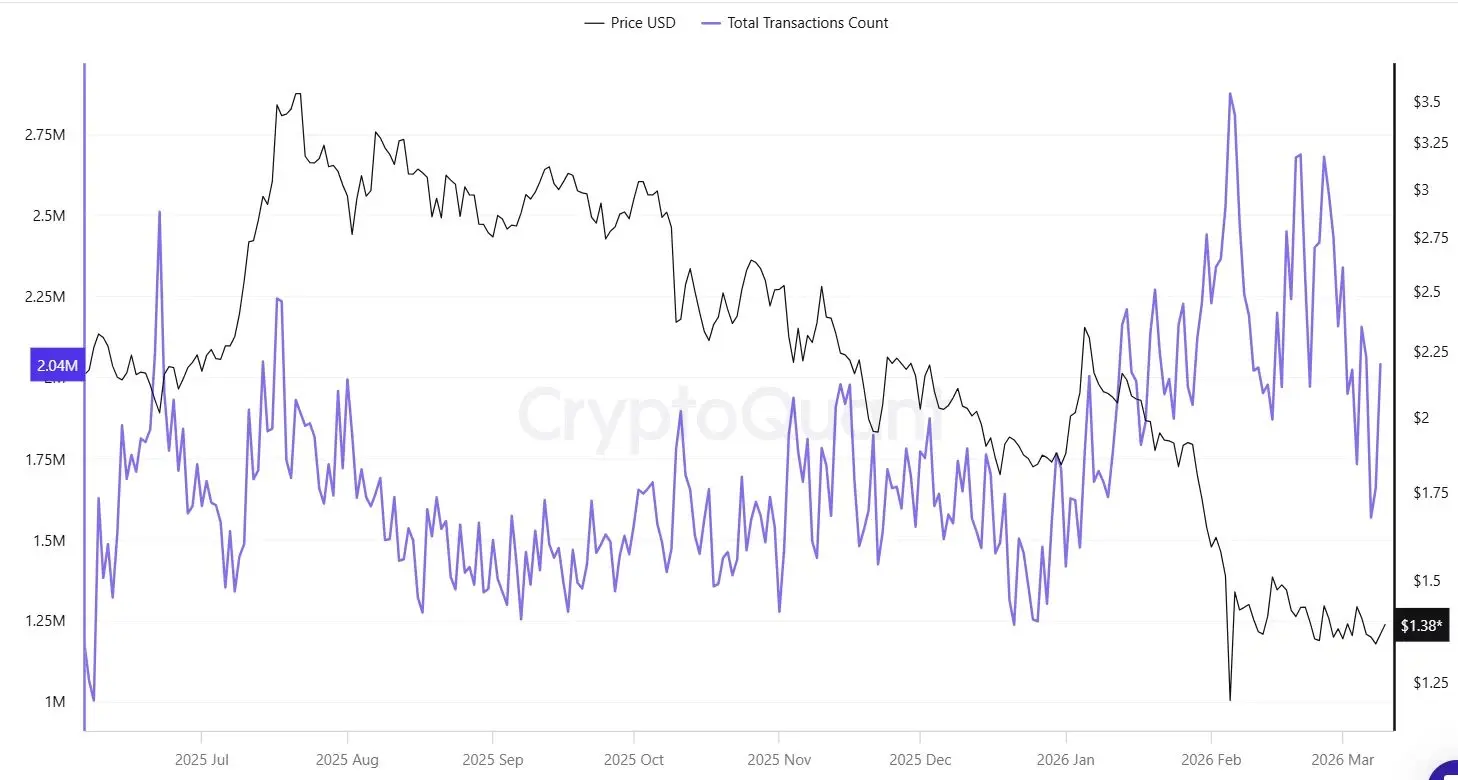
Daily transactions on the XRP Ledger have climbed past 2.7 million, reaching one of the highest levels observed in months. Payments, transfers, and other on-chain activity have all increased simultaneously, pushing network usage sharply higher.
(Source: CryptoQuant)
This surge in network activity creates an interesting divergence from XRP’s price action. Despite the increased usage, XRP has remained relatively stagnant near $1.37, suggesting that market participants are not yet pricing in the network growth.
Interpreting On-Chain Activity
Not every transaction represents new money entering the market. Some activity stems from internal transfers, exchange movements, or automated processes, which may explain why price has not responded to the volume increase. Traders appear to be waiting for stronger catalysts before committing to larger positions.
XRP Price Technical Analysis
Current Trading Range
XRP found a major bottom around $1.12 earlier in 2026 and has since been forming higher lows along a rising support line. The token is currently trading between rising support and resistance near $1.50, with the range tightening as the market bounces between both levels.
Key Levels to Watch
The first resistance level bulls need to break is $1.50, a zone that has rejected several rallies. Above that sits a larger barrier around $1.61, representing the toughest ceiling on the chart. If XRP clears that level, next upside targets appear near $1.90 and $2.20.
On the downside, key support is around $1.30, which aligns with the rising trendline guiding the recovery from the $1.12 bottom. A break below this level could send the market sliding back toward those lows again.
Potential for Institutional Impact
If the surge in network activity eventually translates into real buying demand, a break above $1.61 could quickly push the price back toward the $2 area. While $100 remains a distant target, continued development and adoption could support gradual appreciation over time.
FAQ: Ripple Buyback and XRP Outlook
Q: Why is Ripple buying back shares at a $50 billion valuation?
A: The buyback allows investors and employees to sell shares back to the company through a tender offer expected to run through April. It follows a previous attempt at a $40 billion valuation that saw limited participation due to holder reluctance to sell, suggesting strong investor confidence in Ripple’s long-term prospects.
Q: Does Ripple plan to go public?
A: No. Ripple president Monica Long stated earlier this year that the company has no plans to pursue an initial public offering, citing its strong financial position and preference for expanding privately through acquisitions and product development.
Q: Why is XRP price not rising despite record network activity?
A: Daily transactions on the XRP Ledger have surpassed 2.7 million, but not all activity represents new money entering the market. Some transactions stem from internal transfers, exchange movements, or automated processes. Traders appear to be waiting for stronger catalysts before committing to larger positions.
Q: What are the key price levels for XRP?
A: Key resistance sits at $1.50 and $1.61, with upside targets at $1.90 and $2.20 above those levels. Key support is at $1.30, aligning with the rising trendline from the $1.12 bottom. A break below support could lead to a retest of those lows.


