A report issued by Renmin University’s International Monetary Institute argues against maintaining large foreign exchange reserves, mainly U.S. Treasuries, as the yuan adoption and trust grow. The document advises holding “moderately ample” levels of foreign reserves, with dollar bonds being their largest component.
Report: China Should Reduce Forex Reserves As Yuan Matures
China’s level of foreign reserves, one of the largest in the world, and its ownership of U.S. Treasuries, are under scrutiny by the country’s leading economic institutions.
A report recently issued by Sun Jiaqi of Renmin University’s International Monetary Institute calls for reducing the level of foreign reserves, including U.S. Treasuries, as the Chinese yuan’s internalization grows.
“For the yuan’s internationalization, maintaining moderately ample forex reserves can support the currency. That said, a gradual reduction will be inevitable, once the yuan matures and becomes more adopted globally as a medium of settlement and storage of value, supported by a large circulation abroad,” the report states.
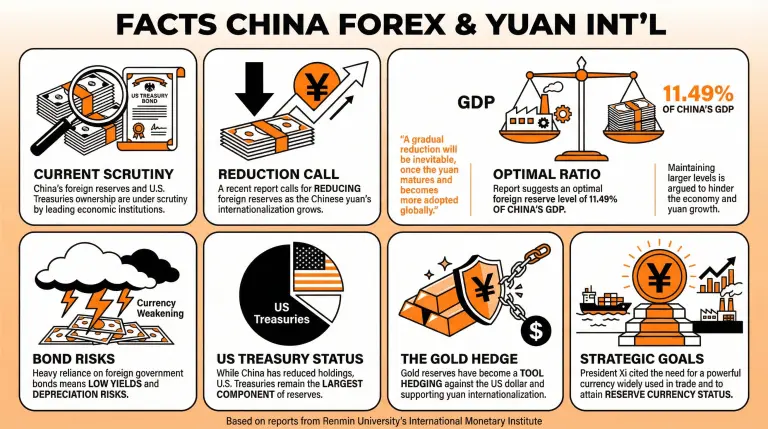
The report suggests that an optimal level of foreign reserves should reach 11.49% of China’s gross domestic product (GDP), and that maintaining a larger level would hinder the country’s economy and the yuan’s growth.
“Since a substantial portion of China’s reserves is foreign government bonds, this means low yields and depreciation risks should an issuing country’s currency weaken,” it argues.
While China has reduced its U.S. Treasury holdings, they still constitute the largest component of its foreign reserves.
Gold’s value as an instrument that allows China to detach from the dollar and promote the yuan’s independence is also remarked, as Jiaqi states that gold reserves “have become a tool hedging against the risks of the US dollar, enhancing long-term value preservation and providing solid credit support for the yuan’s internationalization.”
In February, the Communist Party of China (CCP) journal published an article citing President Xi’s statements pointing out that the nation needed a powerful currency that can be “widely used in international trade, investment and foreign exchange markets, and attain reserve currency status.”
China has also allowed the yuan to revalue against the dollar, even if it has recently been losing ground because of the ongoing geopolitical events.
FAQ 🔎
- Why is China considering a reduction in its foreign reserves? An economic report suggests decreasing these holdings, including U.S. Treasuries, to accelerate the global internationalization of the Chinese yuan.
- What is the proposed optimal level for China’s foreign reserves? Researchers from Renmin University recommend capping reserves at 11.49% of the country’s GDP to avoid stifling domestic economic growth.
- What risks do current foreign government bond holdings carry? Maintaining a substantial portion of reserves in foreign bonds exposes China to low yields and depreciation risks if the issuing currency weakens.
- How is gold being used in this new economic approach? Gold serves as a strategic hedge against U.S. dollar volatility while providing solid credit support to elevate the yuan to a global reserve currency.
Disclaimer: The information on this page may come from third parties and does not represent the views or opinions of Gate. The content displayed on this page is for reference only and does not constitute any financial, investment, or legal advice. Gate does not guarantee the accuracy or completeness of the information and shall not be liable for any losses arising from the use of this information. Virtual asset investments carry high risks and are subject to significant price volatility. You may lose all of your invested principal. Please fully understand the relevant risks and make prudent decisions based on your own financial situation and risk tolerance. For details, please refer to
Disclaimer.


