On March 23, Trump announced a five-day delay in strikes against Iran’s energy infrastructure, claiming that there had been “very good, productive dialogue” and “major consensus points” between the U.S. and Iran. Following the announcement, Brent crude oil dropped from $112 to $99.94, a 10.92% single-day plunge—the largest since Epic Fury began.
However, Iran’s Speaker of Parliament, Ali Larijani, denied any direct negotiations taking place that day. Turkey, Egypt, and Pakistan acted as intermediaries, while Kushner and Witkoff coordinated, but there were disagreements over whether talks were even happening.
This isn’t the first time Trump has issued a “final warning” and then retreated on Iran. Since 2018, similar patterns have occurred seven times.
Seven threats, two fulfilled
Looking at all major threats Trump has made against Iran since 2018, the pattern is clear.
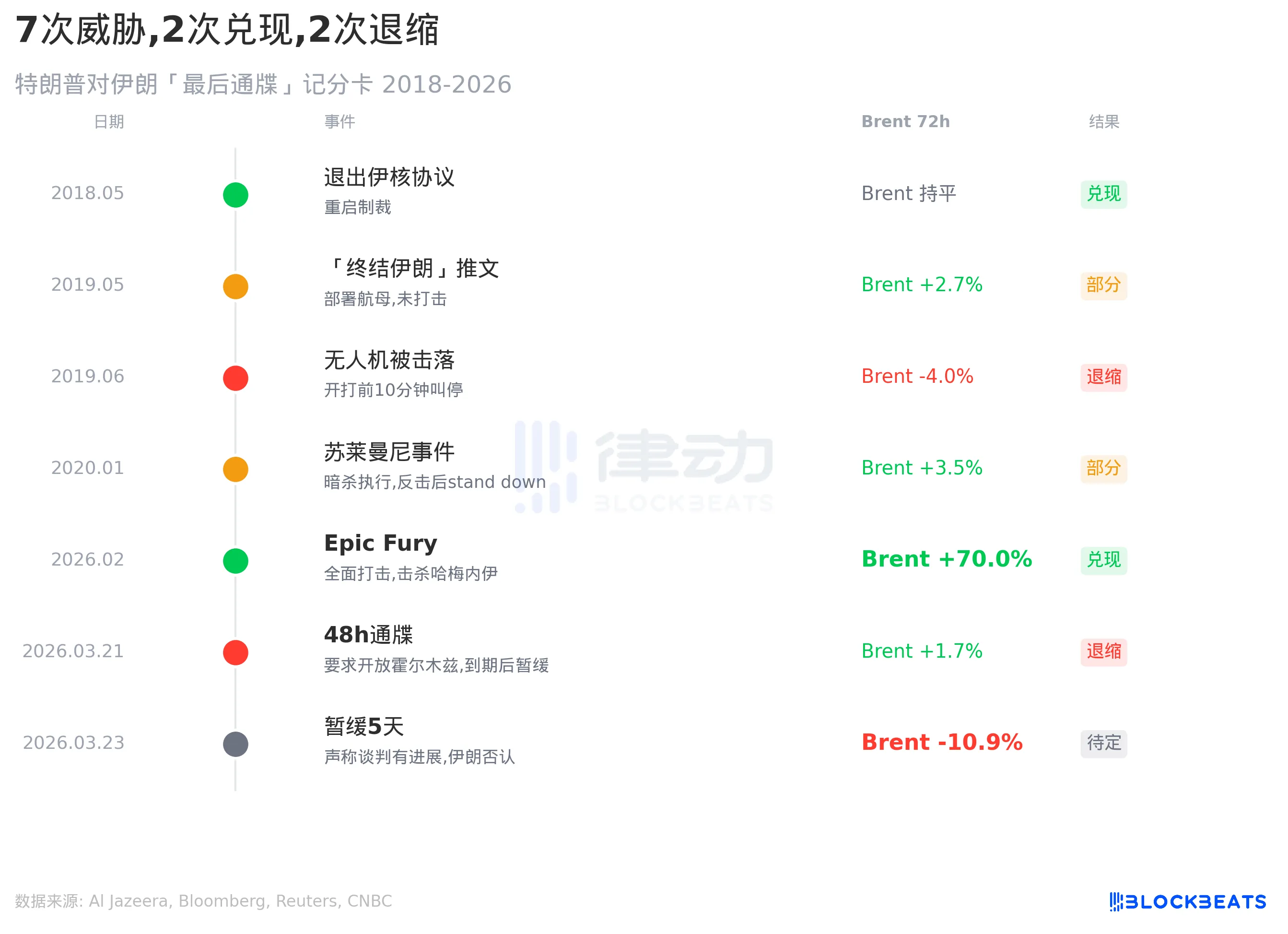
In 2018, Trump withdrew from the JCPOA, following through on sanctions. In February 2026, he launched Epic Fury—again, keeping his word—killing Qasem Soleimani within 24 hours and destroying over 70% of Iran’s missile launchers (according to Israeli intelligence). Both actions were fully carried out, causing sharp oil price reactions: Brent surged from $71 to $119.50, a 70% increase.
But the other side is equally notable. In June 2019, Iran shot down a US drone; Trump ordered strikes on Iranian radar and missile sites, with troops “cocked and loaded,” but called them off 10 minutes before execution. On March 21, 2026, he issued a 48-hour ultimatum to reopen the Strait of Hormuz, which was not followed by action, instead delaying for five days.
Out of seven threats, two were fully fulfilled, two partially executed, two retracted, and one remains undecided. Market reactions are also evolving. After the 2019 halt, oil prices only dropped 3-5%. This time, the five-day delay caused a 10.92% drop. The market is increasingly reacting strongly to “delay” signals, as investors rapidly price in the devaluation of threats.
What does $100 oil price imply?
After the five-day window expires, there are three possible scenarios:
-
A framework agreement is reached. Not a comprehensive deal, but perhaps a 30-60 day temporary freeze to buy time for negotiations. In this case, Brent could fall back to the $80-90 range, close to Goldman Sachs’s 2026 average price forecast of $85.
-
Negotiations are extended. After five days, no attack or deal, just a new delay window. Oil prices could stabilize between $95 and $110, with no elimination or escalation of war risk premiums.
-
Strikes resume and the Strait of Hormuz remains blocked. According to CSIS scenario models, if Iran expands attacks on Gulf oil facilities after being struck, Brent could surge to $130-150. Goldman Sachs’s extreme scenario is more aggressive: if the blockade lasts 60 days and Middle Eastern production drops by 2 million barrels per day, prices could surpass the 2008 high of $147.
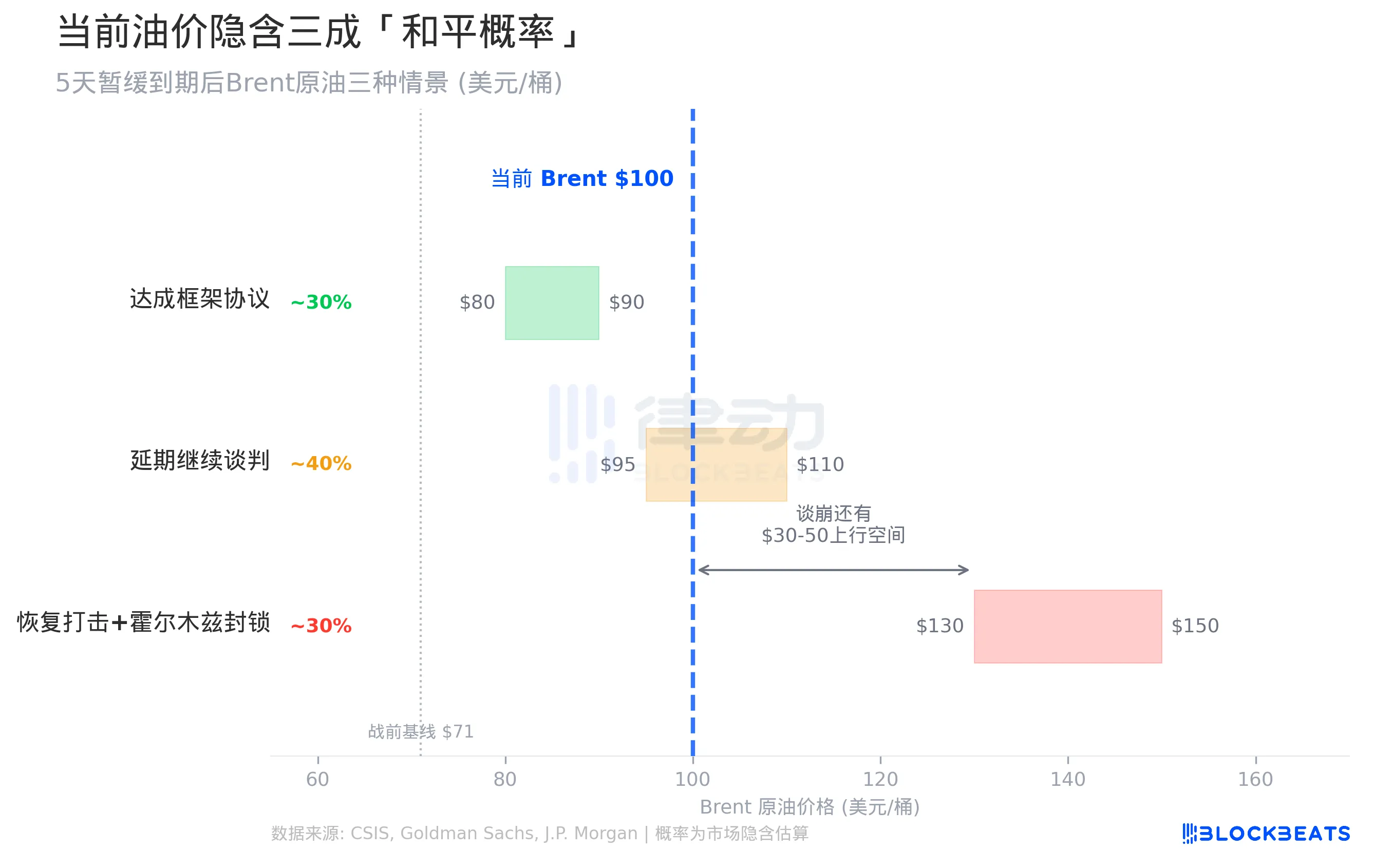
The current $100 Brent price roughly implies a 30-40% probability of reaching a deal. In other words, the market believes there is a 60-70% chance that the situation won’t fundamentally improve after five days. If negotiations collapse, oil prices could rise another $30-50.
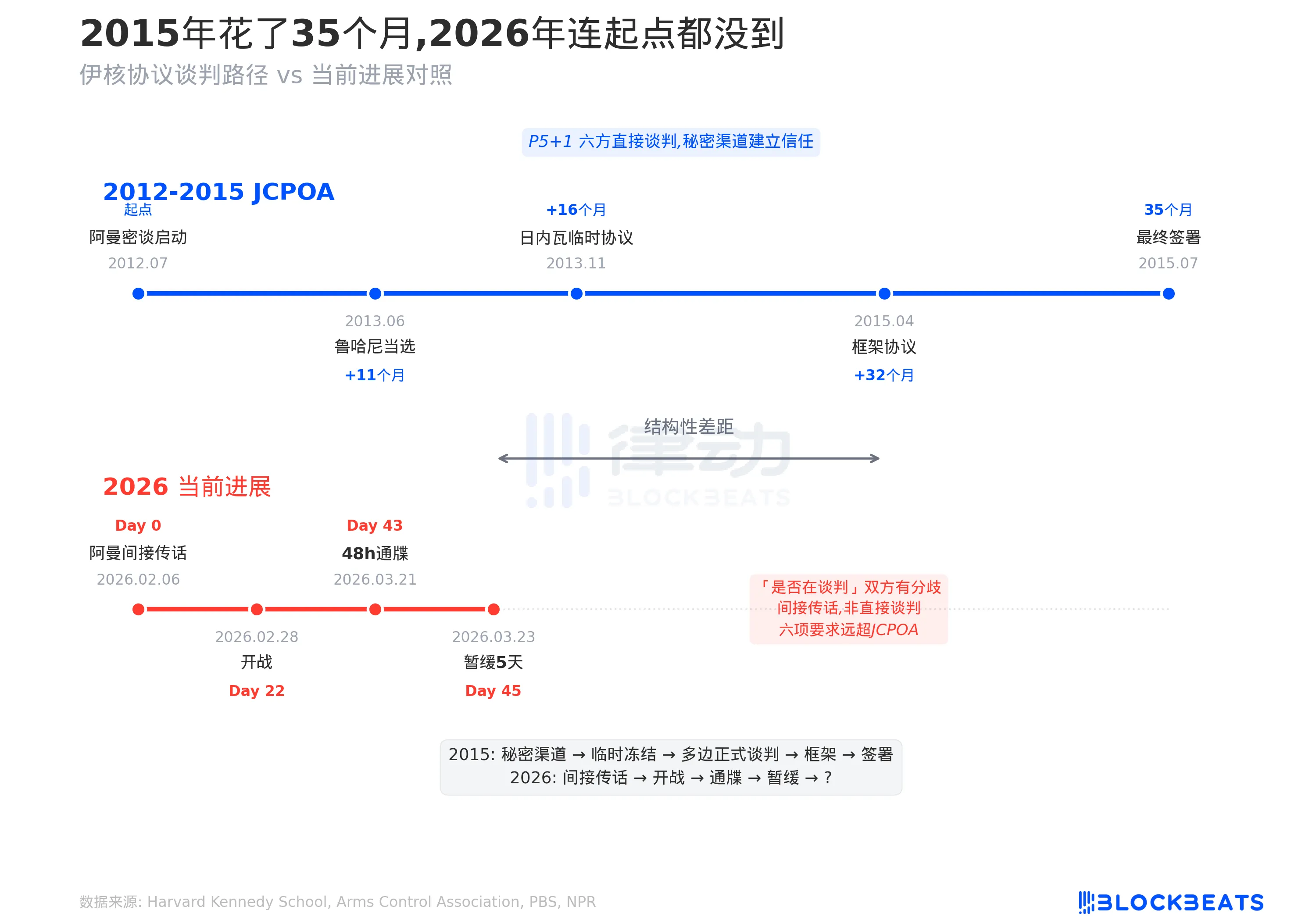
2015 negotiations took 35 months
Trump’s six core demands include zero uranium enrichment, dismantling nuclear facilities, a five-year freeze on missile development, halting support for proxy armed groups, recognition of Israel’s right to exist, and physical takeover of Iran’s high-enriched uranium stockpile. These demands far exceed the framework of the 2015 JCPOA, which only limited enrichment to 3.65%, kept facilities operational, and did not address missiles or proxies.
The 2015 JCPOA process started with secret contacts in July 2012 in Oman and culminated in Vienna after 35 months. The process included pragmatic shifts with Rouhani’s election, trust-building through a Geneva interim agreement, and 20 rounds of direct negotiations among P5+1.
Where does the 2026 progress stand? On February 6, Oman had an indirect message, then on February 28, hostilities began. By March 23, only 45 days later, the status of negotiations was unclear, with parties giving inconsistent statements. Intermediaries—Turkey, Egypt, Pakistan—acted as messengers, not the P5+1 multilateral direct talks. The preconditions for negotiations (mutual acknowledgment) were not met, unlike 2015, when trust was built over a year through secret channels before public negotiations.
What options does Trump have if talks fail?
Military options are the most direct. Striking power plants is the immediate target for the five-day delay, with the lowest threshold for resumption. More escalated options include blockading or occupying Kharg Island, which, according to Al Jazeera on March 20, is already under discussion. Kharg handles about 90% of Iran’s oil exports, roughly 1.3-1.6 million barrels per day (EIA data). Regarding nuclear facilities, Natanz was damaged in the first week of conflict, and Fordow’s high-enriched uranium remains unmoved after being struck in June 2025 (FDD analysis). However, Iran’s new facility at Pickaxe Mountain, built beneath a granite mountain 100 meters underground near Natanz, exceeds the reach of airstrikes. Currently, the U.S. military has deployed two carrier strike groups, over 16 surface ships, and more than 100 aircraft in the Middle East— the largest since the 2003 Iraq War (Military Times).
On the economic front, Trump announced in January tariffs of 25% on countries doing business with Iran, mainly targeting China (which accounts for over 90% of Iran’s oil trade), India, UAE, and Turkey. Iran’s current oil exports remain around 1.5-1.6 million barrels per day, generating about $140 million daily (Defense News).
Cyber warfare is already underway. According to Foreign Policy, before Epic Fury’s kinetic strikes, the U.S. Cyber Command launched “non-kinetic effects,” crippling parts of Iran’s communications and warning systems.
Iran also has countermeasures. The DIA assesses Iran could sustain a blockade of the Strait of Hormuz for 1-6 months. The Strait transports 20% of global oil consumption—about 20 million barrels daily (EIA). Saudi Arabia and UAE pipelines have a capacity of only 3.5-5.5 million barrels per day, creating a shortfall of up to 14.5 million barrels daily. Iran possesses approximately 1,500 ballistic missiles and 200 launchers (Israeli estimates), and Hezbollah reportedly has around 25,000 missiles (Israeli assessment).
This is the underlying strategic logic of the five-day window. Trump faces a credibility trap: striking risks oil prices spiraling out of control and domestic economic pressure, while not striking risks weakening the military threat’s pricing power through the cycle of ultimatums and delays. Iran faces a similar dilemma: negotiations are blocked domestically by hardliners, but without talks, future strikes could target power plants and Kharg Island. The March 28 deadline is not the end but a turning point in this trap.
Click to learn about Rhythm BlockBeats job openings
Join the Rhythm BlockBeats official community:
Telegram Subscription Group: https://t.me/theblockbeats
Telegram Discussion Group: https://t.me/BlockBeats_App
Twitter Official Account: https://twitter.com/BlockBeatsAsia


