Business activity in the U.S. slowed down in March, and the latest PMI data is signaling what the market is beginning to reflect: growth is weakening just as price pressures are returning.
This creates a rather unfavorable environment for Bitcoin. When the economy cools but inflation remains high, traders tend to expect the U.S. Federal Reserve (Fed) to keep interest rates elevated for longer. This is usually a negative environment for risk assets.
According to S&P Global, the preliminary composite PMI index fell to 51.4 in March from 51.9 in February.
The services sector — which accounts for a large portion of the U.S. economy — decreased to 51.1 from 51.7. Conversely, manufacturing increased to 52.4 from 51.6. At the same time, input costs rose at the fastest pace in 10 months, while employment declined for the first time in over a year.
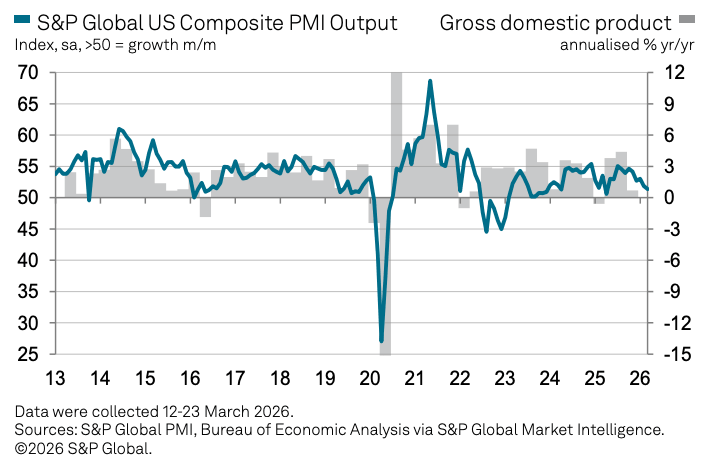 Chart showing S&P Global’s preliminary composite PMI index for March 2026 (Source: S&P Global)## Concerning Divergence in the Economy
While the overall index still indicates growth, the most important message lies in the increasing divergence between sectors.
Demand-related activities are beginning to weaken, while manufacturing is accelerating as companies stockpile goods to hedge against supply disruptions and rising costs, especially due to higher energy prices related to geopolitical conflicts.
This disparity reflects an economy preparing for instability rather than growth driven by actual demand.
Longer supplier delivery times indicate companies are reacting to cost pressures and supply risks, rather than experiencing a surge in demand.
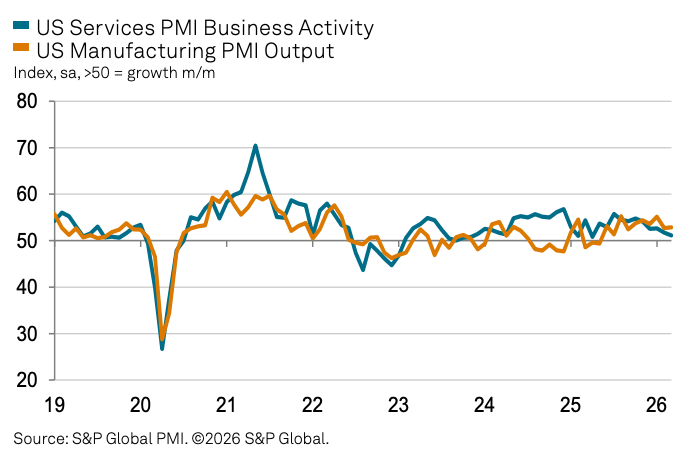 Chart showing S&P Global’s service PMI and manufacturing PMI for March 2026 (Source: S&P Global) Conversely, the services sector signals more negative trends: new order growth is slowing, exports are declining, and business confidence is weakening. Companies cite high living costs, expensive borrowing, and geopolitical instability as factors hampering activity.
S&P Global estimates that the U.S. economy grew at about 1% (annualized) in March, while price trends suggest inflation could approach 4% again.
The combination of weak growth and high inflation raises concerns about “stagflation” — a particularly adverse scenario for financial markets.
Bitcoin Under Pressure from Macroeconomic Conditions
Immediately after the data was released, Bitcoin dipped slightly below $70,000 as investors digested the information.
The broader market reaction was similar: oil prices remained high, bond yields increased, while the USD index stayed nearly flat. This indicates investors are gradually accepting the possibility that inflation may be “stickier” even as growth slows.
Historically, Bitcoin has often benefited from loose monetary policy and abundant liquidity. However, this time the data suggests the opposite: the Fed may have less room to cut rates than expected, as inflation pressures have not eased quickly enough.
The situation becomes more tense with energy prices surging due to conflicts in Iran, complicating the inflation outlook further. As input costs rise and supply risks increase, markets become more sensitive to any signals that the Fed will maintain its tightening stance.
Outlook
Bitcoin currently faces a more challenging macro environment. While some believe it could benefit if confidence in economic policy wanes, this PMI data does not support that scenario.
The clear message at this moment is: interest rates may stay high for longer.
The next test will come from upcoming inflation and labor market data. If these figures confirm the current trend — slowing growth but persistent price pressures — Bitcoin is likely to continue facing headwinds from the macro environment that cannot be ignored.
Vương Tiễn
Disclaimer: The information on this page may come from third parties and does not represent the views or opinions of Gate. The content displayed on this page is for reference only and does not constitute any financial, investment, or legal advice. Gate does not guarantee the accuracy or completeness of the information and shall not be liable for any losses arising from the use of this information. Virtual asset investments carry high risks and are subject to significant price volatility. You may lose all of your invested principal. Please fully understand the relevant risks and make prudent decisions based on your own financial situation and risk tolerance. For details, please refer to
Disclaimer.


