Between 4 billion dollars and 15 billion dollars, what lies between is not a growth curve but a self-revolution in business models.
On March 24, Arm announced its first self-developed data center CPU in its 35-year history. Named AGI CPU, this chip features 136 Neoverse V3 cores, TSMC’s 3nm process, 300W TDP, with Meta as the first customer, planning large-scale deployment within the year. Also announced were collaborations with OpenAI, Cerebras, Cloudflare, SAP, and SK Telecom.
Arm CEO Rene Haas provided a set of target figures at the launch, stating that the chip business aims to reach $15 billion in annual revenue by 2031, with the entire company’s total revenue at $25 billion and earnings per share of $9.
What does this mean? Arm’s total revenue for FY2025 (ending March 2025) is $4.007 billion, according to Arm’s annual report, with licensing income of $1.839 billion and royalty income of $2.168 billion, and a gross margin of 97%. In other words, a company with $4 billion in annual revenue is expected to grow nearly to the scale of Intel’s entire data center division within five years based on a new business. According to Intel’s Q4 2024 financial report, Intel’s Data Center and AI (DCAI) division will generate $12.8 billion in revenue for 2024.
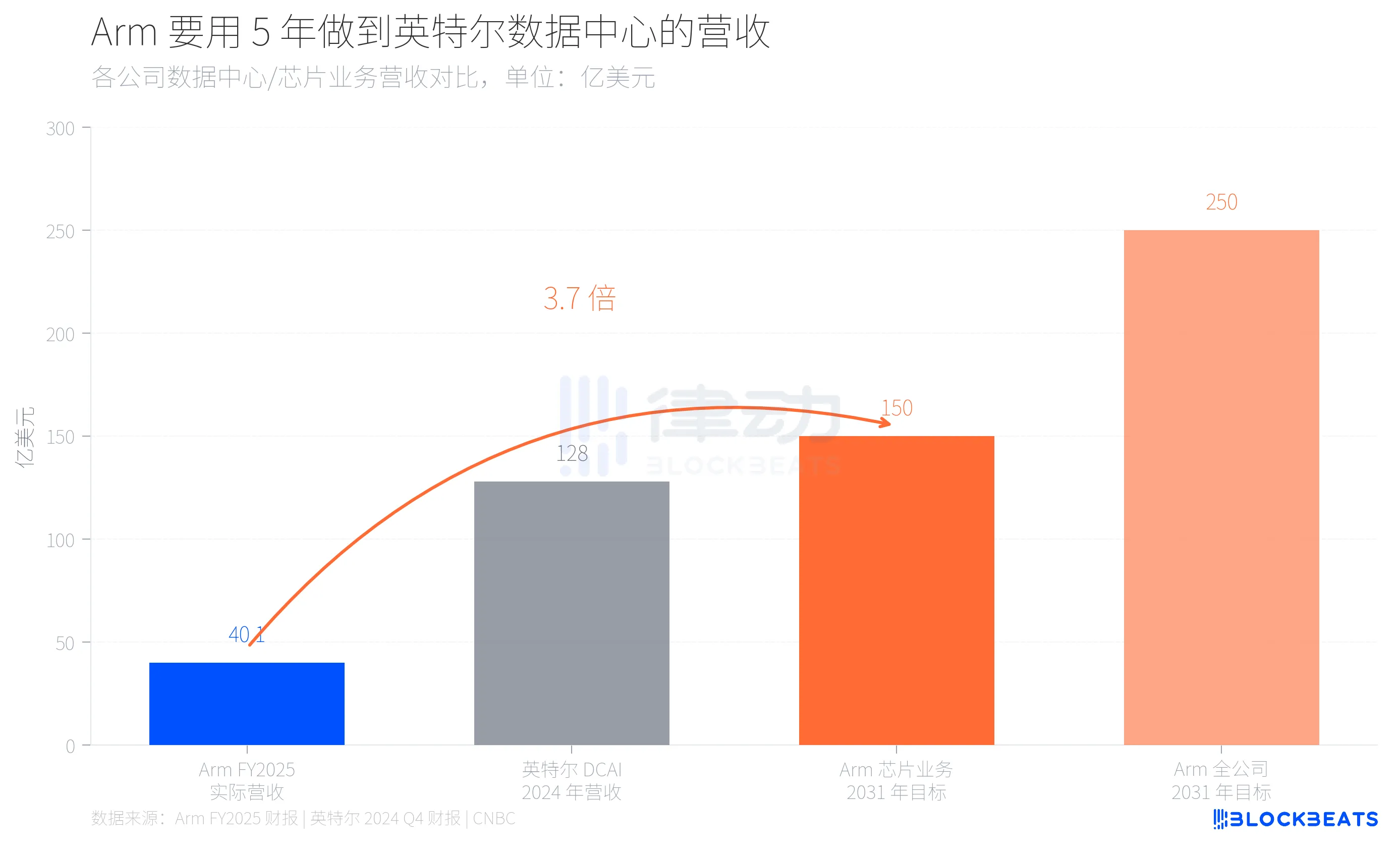
From $4 billion to $15 billion, a 3.7x leap, behind which is Arm’s attempt to transform from a pure IP licensing company into a hybrid that sells both design blueprints and finished products. This has no precedent in the chip industry.
Why is Arm taking this risk? The answer lies in its customer list.
Over the past three years, Arm’s largest data center clients have been doing the same thing. According to publicly available data from AWS, Amazon has migrated over 50% of its EC2 compute capacity to its self-developed Graviton chips, with the latest Graviton5 reaching 192 cores. Google Cloud disclosed that its Axion chips have migrated over 30,000 internal applications, improving efficiency by 80%. Microsoft’s Cobalt 200, based on Arm Neoverse architecture, uses TSMC’s 3nm process and has 132 cores.
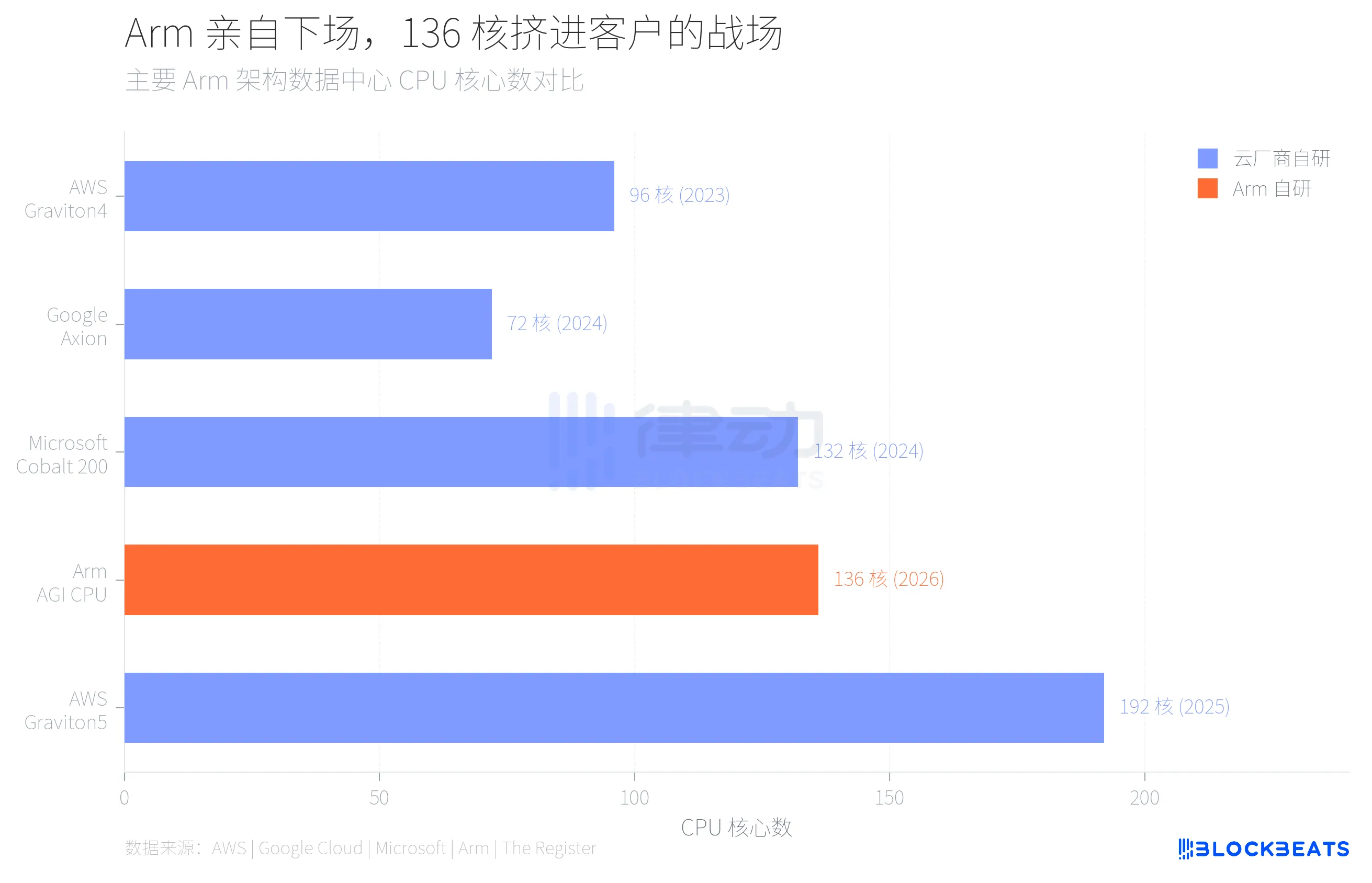
These cloud providers are using Arm architecture licenses, but the chips are designed, fabricated, and deployed by themselves. Arm earns licensing fees and royalties, not chip profits. As more computing power is absorbed by these self-developed chips, Arm’s revenue ceiling in data centers becomes increasingly clear.
Looking at Arm’s revenue structure over the past four years, the outline of this ceiling becomes more concrete. According to Arm’s financial reports, from FY2022 to FY2025, the company’s total revenue grew from $2.7 billion to $4 billion, with an average annual growth of about 14%. Royalties increased from $1.562 billion to $2.168 billion, and licensing income from $1.141 billion to $1.839 billion. The growth rate of royalties has slowed to around 20%, largely driven by upgrades to the mobile Armv9 architecture, not data center developments.
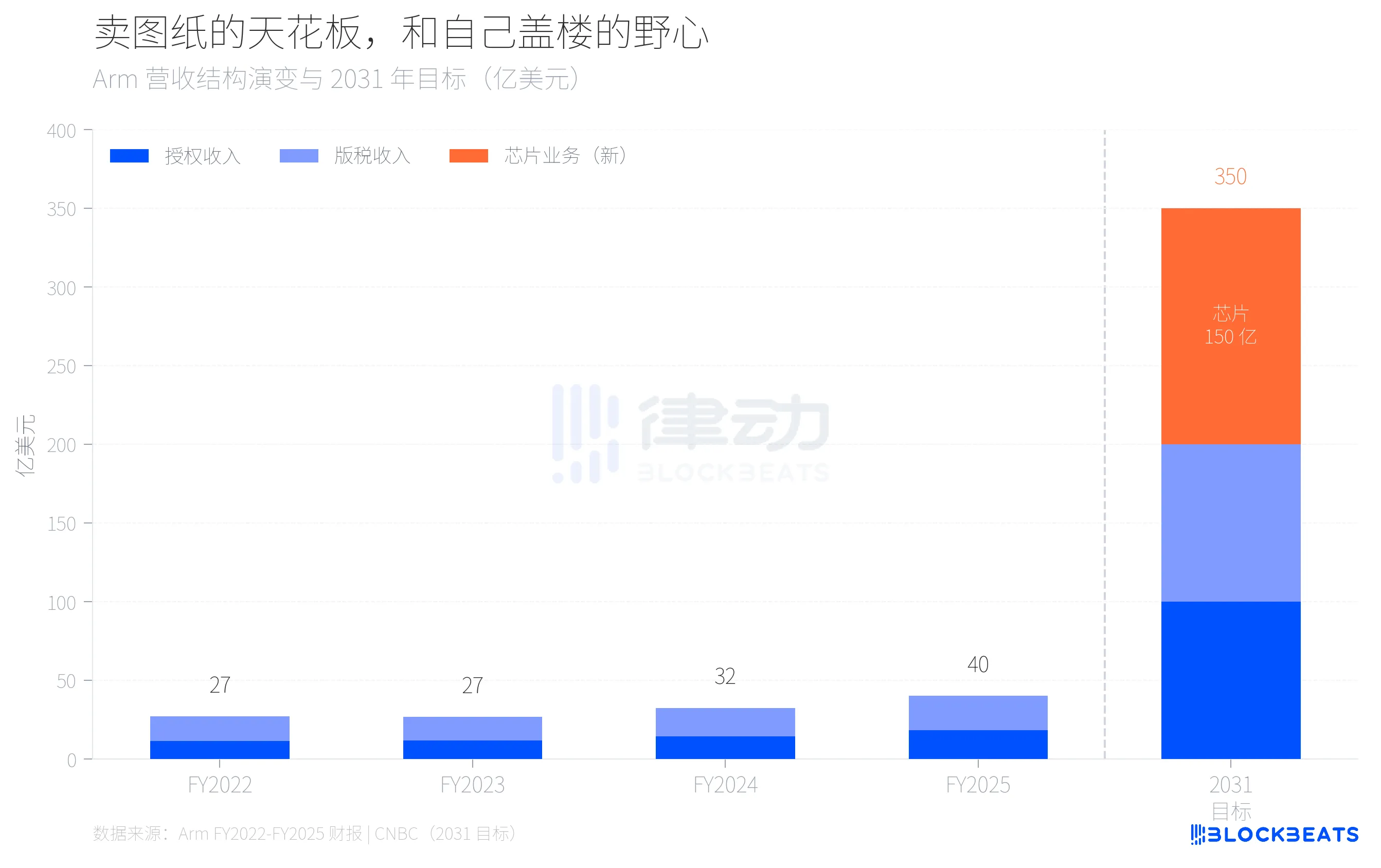
Extrapolating this growth rate, even if licensing and royalty income grow about 20% annually, the total would reach only around $10 billion by 2031. The remaining $15 billion must come from a new business that doesn’t yet exist today. This is the arithmetic behind Arm’s decision to build its own chips.
Choosing to develop chips in-house essentially means competing with its own customers. A company that sells blueprints starts building its own buildings, while its blueprint buyers have been constructing for years.
This is the real background of the 136-core AGI CPU. According to The Register, this chip has a base frequency of 3.2 GHz, up to 3.7 GHz, 12 DDR5 memory channels, 6 GB/s bandwidth per core, 96 PCIe 6.0 lanes, and supports CXL 3.0. Arm positions it as “the computing foundation for the agentic AI cloud era,” focusing on CPU-side task scheduling and data flow management in AI inference, not directly competing with GPUs.
The pace of market share change also tells the story. According to Omdia, by 2025, Arm-based servers will account for about 21% of global shipments, with a 70% growth rate. But within hyperscale data centers, this share is already close to 50%. The 40-year monopoly of x86 isn’t collapsing but being replaced chip by chip.
The risk of Arm’s self-developed chips isn’t technological but relational. Meta’s willingness to be the first customer is partly because Meta itself lacks a mature in-house chip project like Amazon or Google. But how will Amazon, Google, and Microsoft view this? If a supplier starts competing for your business, will you still entrust it with your most core architecture licensing?
Arm’s gamble is that the overall growth of the data center market outpaces the deterioration of customer relationships. Rene Haas clearly believes that the incremental demand for CPUs in the AI era is large enough for self-developed chips and architecture licensing to coexist. The $15 billion target is a pricing of this judgment.
Selling blueprints for 35 years, now building its own buildings for the first time. The blueprints are still being sold, and the buildings are being constructed—only whether they can fit on the same land remains to be seen.
Click to learn more about Rhythm BlockBeats job openings.
Join the Rhythm BlockBeats official community:
Telegram Subscription Group: https://t.me/theblockbeats
Telegram Group Chat: https://t.me/BlockBeats_App
Twitter Official Account: https://twitter.com/BlockBeatsAsia
Disclaimer: The information on this page may come from third parties and does not represent the views or opinions of Gate. The content displayed on this page is for reference only and does not constitute any financial, investment, or legal advice. Gate does not guarantee the accuracy or completeness of the information and shall not be liable for any losses arising from the use of this information. Virtual asset investments carry high risks and are subject to significant price volatility. You may lose all of your invested principal. Please fully understand the relevant risks and make prudent decisions based on your own financial situation and risk tolerance. For details, please refer to
Disclaimer.


