Lido DAO has formally approved a $60 million operating budget for 2026 and outlined a strategy to move beyond its core liquid- staking product into yield vaults, institutional wrappers, and what the protocol calls “real-business DeFi.”
Lido DAO Targets Corporate Treasuries and Tokenized Assets in Three-Year DeFi Plan
The plan, detailed in the GOOSE-3 governance proposal published Nov. 24, 2025, sets four priorities: expanding stETH adoption, upgrading protocol infrastructure, scaling new revenue through Lido Earn, and building products that connect off-chain corporate finance activity with onchain liquidity.
Lido remains Ethereum’s largest liquid- staking provider. The protocol holds roughly 28–30% of all staked ETH, with total value locked fluctuating between $18 billion and $40 billion depending on market conditions.
Staking yields have compressed as more validators enter the network. Base APRs now run 3–5%, down from higher levels in prior cycles. Lido’s governance cited that pressure as the primary reason for diversifying its revenue base.
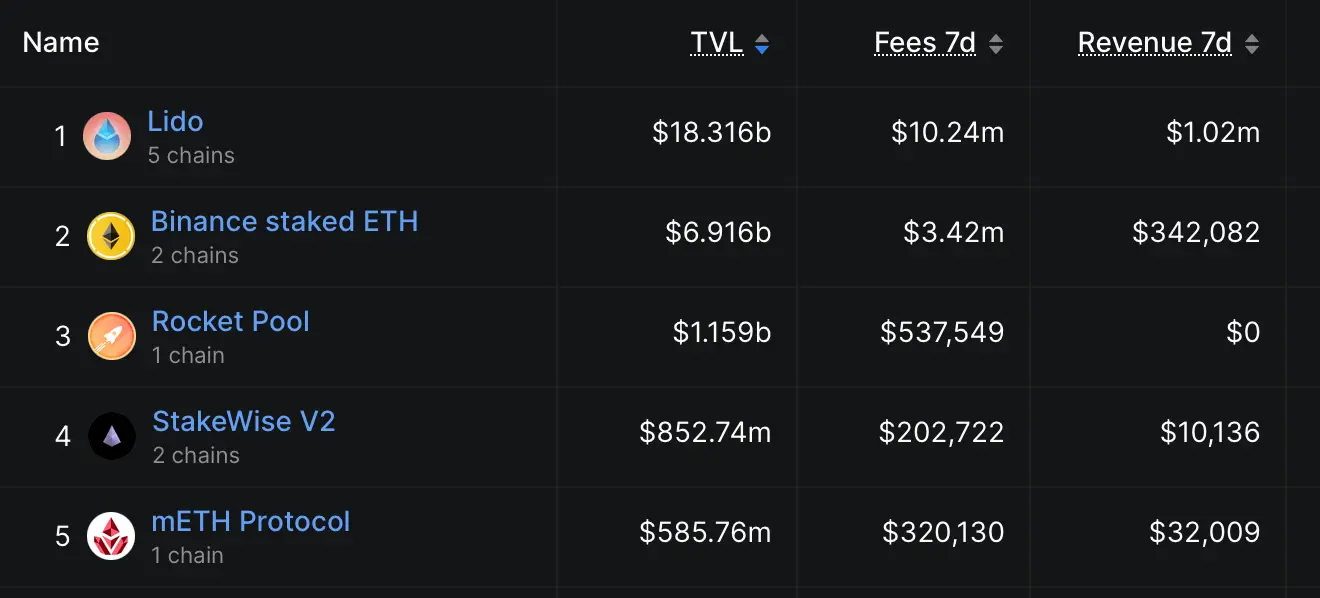 Lido is the largest liquid staking protocol on Ethereum. Image source: Top five liquid staking applications via defillama.com on March 29, 2026.
Lido V3 and its stVaults product launched on Ethereum mainnet on Jan. 30, 2026. The upgrade replaces Lido’s previous single-product staking model with a modular infrastructure that lets institutional operators customize vaults for specific custody, compliance, or yield requirements.
Lido is the largest liquid staking protocol on Ethereum. Image source: Top five liquid staking applications via defillama.com on March 29, 2026.
Lido V3 and its stVaults product launched on Ethereum mainnet on Jan. 30, 2026. The upgrade replaces Lido’s previous single-product staking model with a modular infrastructure that lets institutional operators customize vaults for specific custody, compliance, or yield requirements.
Two Lido Earn products, EarnETH and EarnUSD, are also live. They offer structured yield strategies with daily compounding, targeting both retail DeFi users and stablecoin holders seeking returns above base staking rates.
The $60 million budget splits into $43.8 million for core operations and growth, and $16.2 million in discretionary funds for high-impact items, including liquidity incentives and institutional product development.
On the infrastructure side, the protocol plans to deliver Curated Module v2, Staking Router v3, and a new tool called ValMart, a validator routing system designed to optimize for performance, cost, and decentralization simultaneously. Lido currently operates with more than 683 unique node operators.
Institutional access is a separate track. Vaneck filed an S-1 with the U.S. SEC on Oct. 20, 2025, for a Lido Staked ETH exchange-traded fund (ETF), the first U.S. ETF proposal referencing stETH directly. The filing remains pending as of March 2026.
In Europe, Wisdomtree launched a Physical Lido Staked Ether ETP in December 2025. The product is 100% stETH-backed, listed on Xetra, SIX, and Euronext, and opened with assets under management between $36 million and $50 million.
Lido’s participation in the Crypto Council for Innovation and the Proof of Stake Alliance has supported both filings. The GOOSE-3 proposal calls for more ETF and ETP partnerships to package stETH and stVaults for traditional capital markets.
The three-year vision in the proposal describes staking becoming a stable core revenue line while the protocol builds products for corporate treasury management, borrowing, and tokenized assets.
Key performance indicators for 2026 include stVaults TVL, Lido Earn revenue contribution, ETF and ETP approvals, and early traction from real-business pilots.
FAQ 🔎
- What is Lido’s GOOSE-3 proposal? It is a governance plan outlining Lido DAO’s 2026 strategy to expand beyond liquid staking into yield products and institutional DeFi infrastructure.
- What is the Lido DAO 2026 budget? Lido DAO approved $60 million for 2026, split between $43.8 million in baseline spending and $16.2 million in discretionary funds.
- Is there a Lido stETH ETF in the United States? Vaneck filed an S-1 for a Lido Staked ETH ETF with the SEC on October 20, 2025; the application remains under review as of March 2026.
- What is Lido Earn? Lido Earn is a suite of structured yield products, including EarnETH and EarnUSD, offering higher returns than base staking through daily compounding strategies.
Disclaimer: The information on this page may come from third parties and does not represent the views or opinions of Gate. The content displayed on this page is for reference only and does not constitute any financial, investment, or legal advice. Gate does not guarantee the accuracy or completeness of the information and shall not be liable for any losses arising from the use of this information. Virtual asset investments carry high risks and are subject to significant price volatility. You may lose all of your invested principal. Please fully understand the relevant risks and make prudent decisions based on your own financial situation and risk tolerance. For details, please refer to
Disclaimer.


