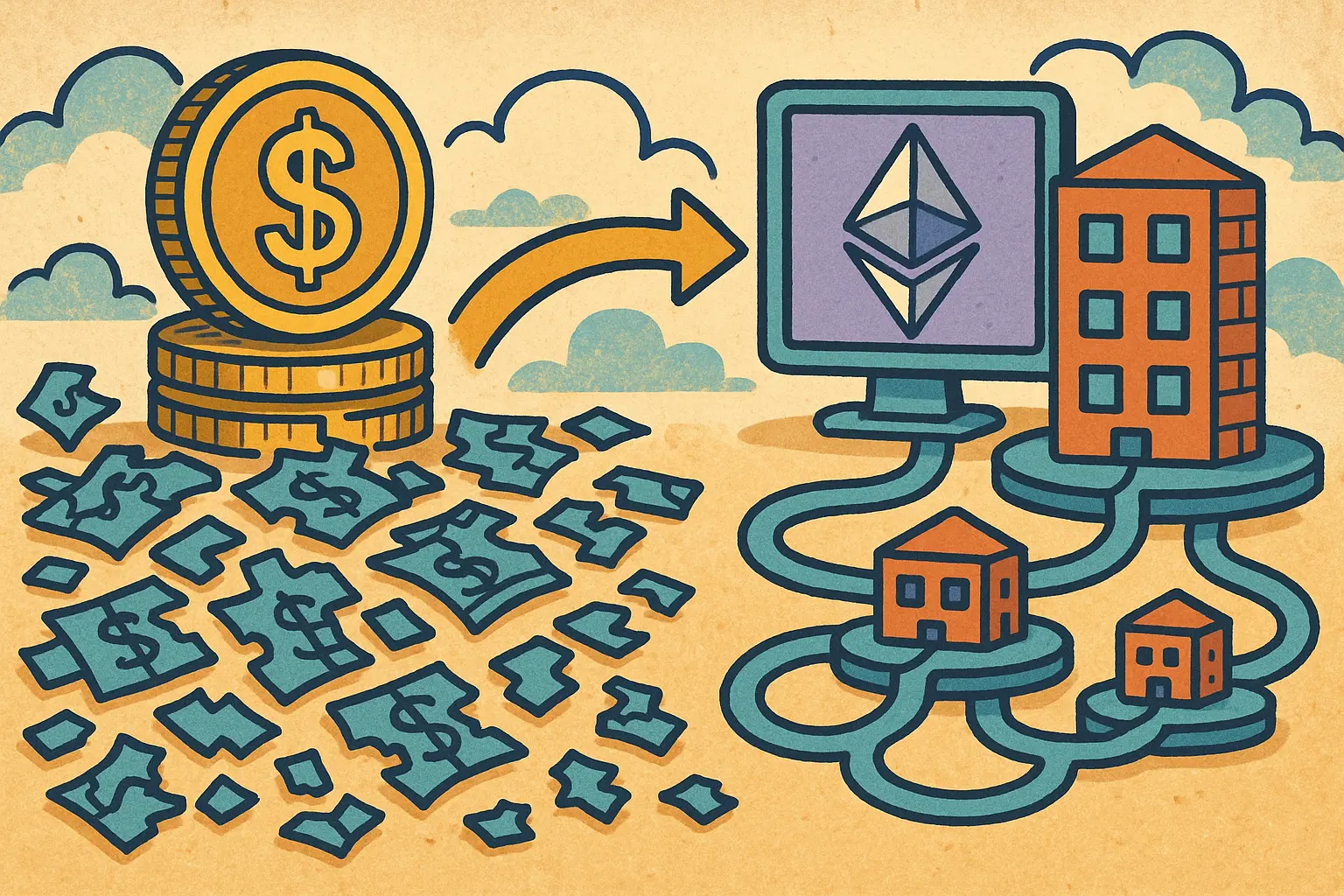
Developers from Gnosis and Zisk, supported by the Ethereum Foundation, have officially proposed the “Ethereum Economic Zone” (EEZ) framework, aiming to enable smart contracts on different Rollups to execute synchronously across networks within a single transaction without relying on bridges. According to L2BEAT data, over 20 active Layer 2 networks collectively secure nearly $40 billion in total value locked, but liquidity is fragmented across multiple environments.
EEZ Framework Design: Three Core Mechanisms to Solve the L2 Island Problem
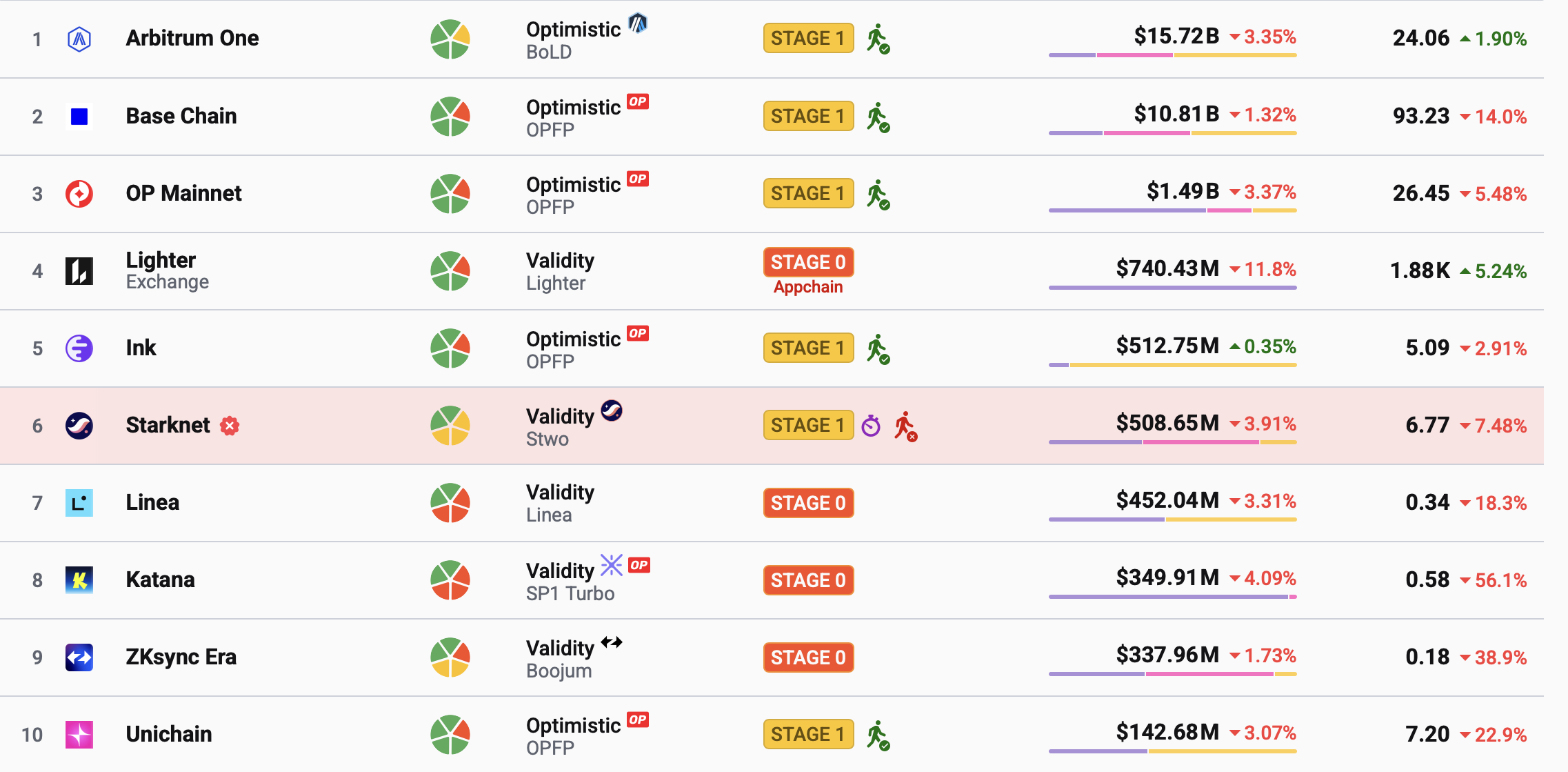 (Source: L2Beat)
The goal of the “Ethereum Economic Zone” design is to eliminate cross-chain friction through a standardized interoperability layer without changing the existing L2 architecture. The core mechanisms listed in the proposal are as follows:
Bridge-less Cross-Chain Execution: Smart contracts on different Rollups can interact synchronously within a single transaction, without relying on the trust assumptions of existing bridging protocols.
Shared Infrastructure Architecture: Applications can share underlying infrastructure across Rollups and directly fallback to the Ethereum mainnet when necessary, reducing redundant development costs.
EEZ Alliance Unified Standards: The proposal also introduces the “EEZ Alliance,” composed of infrastructure providers and ecosystem participants such as DeFi protocols, responsible for coordinating technical standards and interoperability protocols.
Zisk is led by Jordi Baylina, the core creator of Polygon zkEVM, whose background in zero-knowledge proof technology provides critical foundational support for the EEZ framework. The development team plans to release detailed technical specifications and performance benchmarks in the coming weeks.
Vitalik’s Public Doubt: Fundamental Restructuring Pressure on the L2 Roadmap
The timing of the EEZ proposal coincides with a peak in the Ethereum community’s debate over the Rollup roadmap. Ethereum co-founder Vitalik Buterin posted on X on February 3, stating: “The original vision of L2 and its role within Ethereum no longer makes sense; we need a new path.” This is his most direct public criticism of the current Layer 2 scaling architecture.
Buterin previously pointed out that some L2 networks rely on centralized sequencers and trusted bridging mechanisms, which present structural weaknesses in their security assumptions. These criticisms touch on the core architectural trade-offs of the Rollup model, prompting widespread responses within the industry.
Divergent Responses from the Builder Community: The Scaling Definition Dispute
Buterin’s comments sparked very different reactions within the L2 builder community, reflecting the ecosystem’s divisions over the future role of Rollups.
Optimism co-founder Karl Floersch agreed that L2 needs to go beyond a simple scaling framework, acknowledging current technical limitations. Conversely, Steven Goldfeder, co-founder of Offchain Labs behind Arbitrum, emphasized that scaling remains the core function of Rollups, with transaction throughput still significantly higher than that of the Ethereum mainnet.
The EEZ framework represents a compromise approach, attempting to address fragmentation through an interoperability standard layer while maintaining the diversity of the existing L2 ecosystem, rather than requiring each Rollup to undergo fundamental architectural changes.
Frequently Asked Questions
What is the core challenge of Ethereum L2 fragmentation?
Over 20 Layer 2 networks operate independently, leading to liquidity, user activity, and infrastructure becoming isolated. Nearly $40 billion in total value locked is dispersed across different L2 environments, and cross-chain transfers depend on bridges, which introduce additional costs, delays, and security risks.
How does the Ethereum Economic Zone (EEZ) achieve L2 interoperability without bridges?
The EEZ framework allows smart contracts on different Rollups to execute synchronously across networks within a single transaction. Applications can share underlying infrastructure across various L2s and directly fallback to the Ethereum mainnet, fundamentally bypassing the trust assumptions and operational complexities of existing bridges.
Why did Vitalik Buterin publicly question the current L2 roadmap?
Buterin’s main concerns include the centralization risks posed by centralized sequencers, security issues of trusted bridging mechanisms, and liquidity fragmentation weakening the overall performance of the Ethereum ecosystem. On February 3, he stated that the current L2 roadmap “no longer makes sense,” implying that the entire scaling architecture may need a systematic re-evaluation.
Disclaimer: The information on this page may come from third parties and does not represent the views or opinions of Gate. The content displayed on this page is for reference only and does not constitute any financial, investment, or legal advice. Gate does not guarantee the accuracy or completeness of the information and shall not be liable for any losses arising from the use of this information. Virtual asset investments carry high risks and are subject to significant price volatility. You may lose all of your invested principal. Please fully understand the relevant risks and make prudent decisions based on your own financial situation and risk tolerance. For details, please refer to
Disclaimer.


