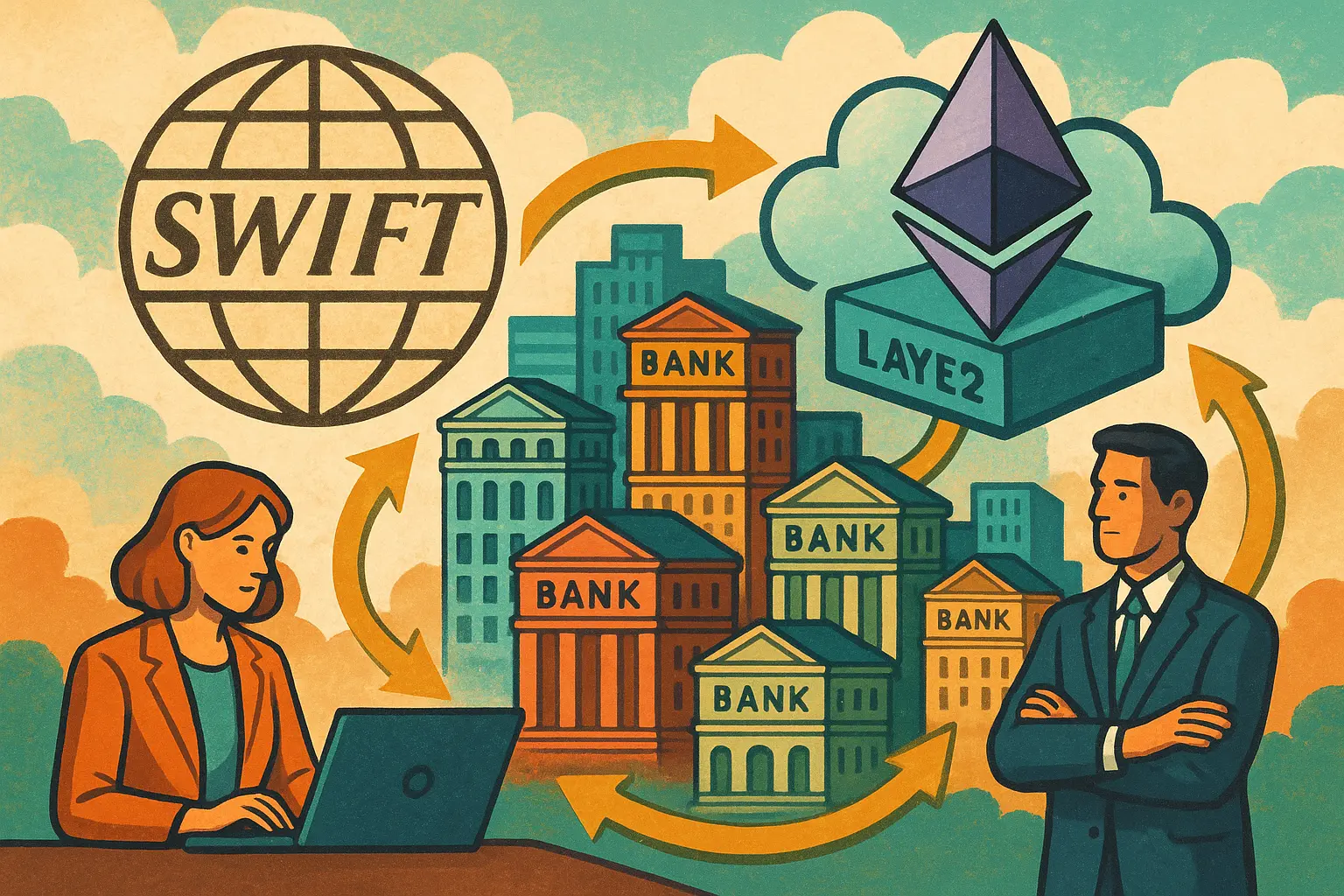
SWIFT confirmed on March 30 that its blockchain-based shared ledger has completed the design phase and has officially entered the development of a minimum viable product (MVP). It is expected to go live and accept real transactions by 2026. The ledger is built on Linea, an Ethereum Layer 2 network developed by ConsenSys. During the design phase, it brought together more than 30 top-tier global financial institutions, including JPMorgan Chase and HSBC.
Technical Architecture: Permissioned Ethereum L2, Not a Public Blockchain
 (Source: Swift X)
SWIFT’s shared ledger is a permissioned private infrastructure, not a public blockchain, and it does not involve the use of any native cryptocurrency. It is built on Linea, an Ethereum Layer 2 (Layer 2) network developed by ConsenSys, and it records, sequences, and verifies transactions between financial institutions through smart contracts.
The ledger supports around-the-clock, real-time transfers of three types of digital assets:
Tokenized deposits: banks tokenize fiat deposits and circulate and settle them directly on the ledger
Regulated stablecoins: fiat-pegged digital tokens that meet regulatory requirements in each jurisdiction
Central bank digital currency (CBDC): sovereign digital fiat money issued by central banks in each country
SWIFT explicitly positions this ledger as a parallel channel to existing messaging infrastructure, not a replacement. Institutions can adopt blockchain settlement directly without having to redesign internal operating workflows or compliance processes, significantly reducing migration costs.
The Core Problem Solved: Structural Bottlenecks in Traditional Cross-Border Payments
Today’s global cross-border payments heavily rely on a correspondent banking network, which comes with multiple structural limitations: it operates only during working hours in each location, involves multiple intermediary institutions, funds are frozen en route for several days, and large reconciliation costs arise because the ledgers of all parties are inconsistent.
By integrating messaging and settlement functions into a single layer, SWIFT’s blockchain ledger compresses this process at its root. Banks can execute payment instructions immediately, gain real-time visibility into liquidity conditions, and significantly reduce reconciliation workload. Global cross-border payments reach an annual scale of $183 trillion; even a marginal efficiency improvement would represent a deep restructuring of the market’s overall cost structure.
30 Major Banks Collaborate to Design It, and an MVP Roadmap Is Set
The lineup participating in the design phase directly determines the ledger’s applicability for institutions. Input from more than 30 of the world’s top-tier financial institutions shapes the ledger’s functionality, governance model, and future development roadmap—ensuring the product meets each institution’s compliance and business needs before launch. In addition to JPMorgan Chase and HSBC, participating institutions include BNP Paribas, Deutsche Bank, and Bank of America, among other globally systemically important banks.
SWIFT said the MVP version is planned to go live in 2026. In the initial phase, it will support interoperability validation between tokenized bank deposits, and it will conduct stress testing with real transactions. Subsequent versions will gradually expand the functional boundaries based on feedback.
Frequently Asked Questions
Does SWIFT’s blockchain ledger mean traditional banks have adopted cryptocurrency?
No. SWIFT’s shared ledger is permissioned private infrastructure. Although it is built using Ethereum L2 technology, it does not use any native cryptocurrency as a value carrier. It supports tokenized fiat assets (deposits, stablecoins, CBDCs)—a tool for digitizing institutional finance—entirely different in nature and goals from decentralized crypto markets (DeFi).
Why did SWIFT choose Ethereum L2 as the underlying technology?
Ethereum’s Layer 2 networks (such as Linea) offer high throughput, low transaction costs, and programmability, while inheriting the security foundation of the Ethereum mainnet. Compared with building a private chain from scratch, adopting a mature L2 infrastructure can greatly shorten the development cycle, and by leveraging the existing smart contract ecosystem, it reduces the complexity of building new functionality.
What concrete changes will happen in the cross-border payments market after the MVP goes live?
In the short term, the MVP mainly focuses on real-transaction validation with the 30 institutions involved in the design phase, and the results still need to be assessed. If the validation succeeds and is rolled out to a wider set of SWIFT member institutions, around-the-clock real-time settlement may gradually replace today’s cross-border payment processes that can take days to complete. At the same time, it would significantly reduce liquidity costs and reconciliation overhead in the correspondent banking system.
Disclaimer: The information on this page may come from third parties and does not represent the views or opinions of Gate. The content displayed on this page is for reference only and does not constitute any financial, investment, or legal advice. Gate does not guarantee the accuracy or completeness of the information and shall not be liable for any losses arising from the use of this information. Virtual asset investments carry high risks and are subject to significant price volatility. You may lose all of your invested principal. Please fully understand the relevant risks and make prudent decisions based on your own financial situation and risk tolerance. For details, please refer to
Disclaimer.


