Data shows that Bitcoin’s total network hashrate fell in the first quarter of this year, marking the first Q1 decline in six years. As Bitcoin mining costs have surged to nearly $90,000 per coin, while the coin price is only $67,000, miners are losing money and collectively bailing out, shifting instead to AI and high-performance computing (HPC) infrastructure with higher profits and greater stability. Bitcoin’s “hashrate growth myth” has officially been declared dead.
According to Glassnode data, Bitcoin’s total network hashrate is currently hovering around 1 Zettahash (ZH/s), down about 4% year to date. Looking back over the past five years, Bitcoin’s hashrate rose from roughly 100 Exahash (EH/s) to today’s Zettahash level, with overall growth of as much as 10x.
In previous years, each year’s first quarter typically maintained strong upward momentum, with full-year increases often exceeding 10%, and even saw astonishing growth that nearly doubled in 2022. However, this momentum has come to an abrupt halt this year.
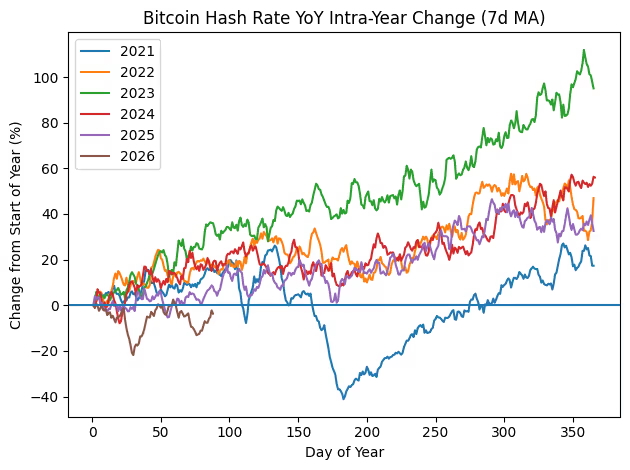 The key reason for the slowdown in hashrate is that the mining industry’s economic model is rapidly deteriorating. By estimates, the average production cost of mining 1 Bitcoin has nearly reached $90,000, but the spot price of Bitcoin is only around $67,000. In other words, once miners turn on their machines, they are already “mining at a loss.”
Facing an existential crisis, many large publicly listed mining companies have begun adjusting their strategies, shifting toward artificial intelligence (AI) and high-performance computing (HPC) infrastructure. Compared with the violent spikes and crashes in coin prices, the return on providing AI computing power services is more stable and more predictable, and has become a new blue ocean for miners to pivot into.
This wave of transformation is mainly supported by “selling coins and taking on debt.” Miners reduce reinvestment in mining rigs, instead offloading the Bitcoin they hold or issuing debt to raise funds for building AI data centers. This strategy greatly increases hashrate’s sensitivity to coin prices; if coin prices remain weak, it could force more smaller individual miners to exit the market, leading to further declines in hashrate.
As hashrate continues to drain away, it inevitably raises market concerns about the security of the Bitcoin network. However, from another angle, the degree of the network’s “decentralization” may be even more important than simply pursuing the absolute size of hashrate.
In the past, just U.S. publicly listed miners alone dominated more than 40% of the global hashrate landscape. Now that these North American giants have shifted their focus to AI, the influence that was once highly concentrated may be diluted as a result. This, in turn, could help redistribute hashrate across the globe, which in the long run is more beneficial for decentralization.
Disclaimer: The information on this page may come from third parties and does not represent the views or opinions of Gate. The content displayed on this page is for reference only and does not constitute any financial, investment, or legal advice. Gate does not guarantee the accuracy or completeness of the information and shall not be liable for any losses arising from the use of this information. Virtual asset investments carry high risks and are subject to significant price volatility. You may lose all of your invested principal. Please fully understand the relevant risks and make prudent decisions based on your own financial situation and risk tolerance. For details, please refer to
Disclaimer.


