
On April 1, an on-chain data analyst, Yu Jin, monitored that an address suspected of manipulation, labeled as SIREN, spent 144,000 USDT to buy back 500,000 SIREN tokens. About 15 days ago, the address had sold the same amount of tokens at $0.947 per SIREN. After this low-price repurchase, the account’s net book profit is about 329,000 USDT. At present, the address still holds approximately 645 million SIREN tokens.
SIREN Manipulation Address Trading Cycle: Stakes Stay Put, Net Profit 329,000 USDT
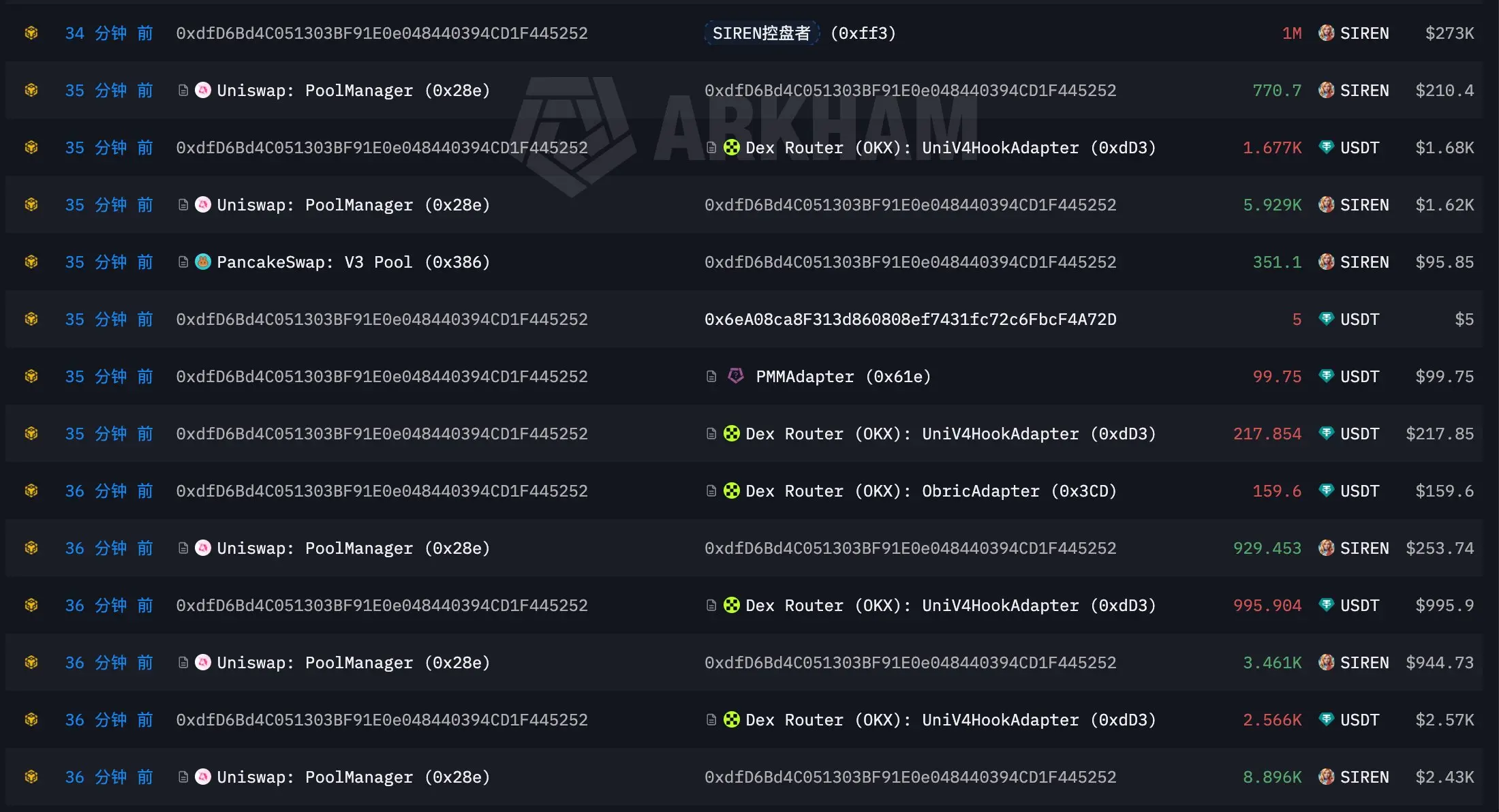 (Source: Arkham)
On-chain tracking records show the complete path of this trading cycle: about 15 days ago, the suspected manipulation address sold 500,000 SIREN at $0.947 per token from the high-price range, receiving 473,000 USDT; after SIREN dropped sharply today, it bought back the same amount of tokens for 144,000 USDT, fully restoring its holdings, with the price difference of 329,000 USDT remaining in the account.
The key premise of this operating pattern is precise control over the direction of price—however, in a highly controlled market structure, on-chain analysts note that “prediction” may not reflect forecasting ability, but rather a result determined proactively by the controlling party.
EmberCN’s On-Chain Analysis: 88.5% Controlling-Shares Suspicion
An on-chain analysis published by EmberCN analyst on March 23 shows that SIREN’s concentration of holdings is far higher than previously expected. The suspected single whale/market-maker controls about 88.5% of the circulating supply, totaling roughly 644 million tokens, with a valuation at the time of about $1.44 billion.
The technical basis for the holdings analysis is as follows: among the top 54 addresses by holdings, excluding the burn address and the Binance Web3 wallet, the remaining 52 addresses are highly related:
48 addresses: Recently accumulated and gathered addresses; highly consistent behavior patterns, showing systematic capital allocation characteristics
4 addresses: The sources of funds are traceable to the same batch of new-position building activities from late June to early July 2023
The analysis indicates that after the market-maker completed the accumulation and concentration of about 66.5% of the tokens, and combined it with centralized exchange (CEX) holdings, the actual controlling proportion was further increased. Some on-chain addresses show signs of association with DWF Labs, the market-making firm’s public wallets, but this link has not yet been officially confirmed. All conclusions are based on public on-chain data and are therefore speculative in nature.
How Thin-Order Spot Drives Futures Harvesting: Mechanism Breakdown
As early as March 5, analyst @c_ckoko publicly pointed out that SIREN has “cross-exchange harvesting” characteristics and described its underlying operating logic: on certain exchanges, the spot order-book depth for SIREN is extremely thin. According to Arkham data, on March 22 the Gate platform’s SIREN spot inventory was only 64,000 tokens. With such weak liquidity, a trading volume of just $100,000 can generate nearly 40% one-minute candlestick volatility, which then affects the price index of Binance perpetual contracts, forming a harvesting route driven by settling contracts via thin spot books.
After @c_ckoko’s post, the method for calculating Binance SIREN contract price index was adjusted twice: Gate spot’s weight was reduced from 50% to 25%, while Binance Alpha’s share increased from 25% to 50%, narrowing the above manipulation space to some extent. Based on open futures contract quantity data, SIREN showed clear anomalies starting February 8. After hovering for a long time around $3.0 million to $5.0 million in contract open interest, it suddenly surged to about $58.83 million—highly consistent with the on-chain analysis above.
Common Questions
How does the SIREN manipulation address profit without increasing its holdings?
According to on-chain tracking, the address first sold 500,000 SIREN at the high price ($0.947) in exchange for 473,000 USDT, then after a sharp drop (to $0.288) bought back an equal amount of tokens for 144,000 USDT. With holdings restored to their original state, the book difference of 329,000 USDT remained. The premise for how this pattern works is the ability to control price movements beyond ordinary prediction.
Has the suspected SIREN manipulator been confirmed?
At present, all analyses are based on address correlation and capital tracking from public on-chain data. The conclusions are speculative in nature and have not received any official confirmation. Some addresses show signs of a link to DWF Labs’ public wallets, but there has likewise been no official response. Investors should assess risk based on information from multiple sources.
Why did SIREN’s one-week market value fall from $1.44 billion to $155 million?
For the same batch of 645 million tokens, the valuation dropped by more than 89% within a week, indicating that SIREN’s token price shrank significantly during that period. On-chain analysts believe this is related to the proactive contraction of spot liquidity in a highly controlled environment, but specific market dynamics require combining with comprehensive trade data for evaluation.
Disclaimer: The information on this page may come from third parties and does not represent the views or opinions of Gate. The content displayed on this page is for reference only and does not constitute any financial, investment, or legal advice. Gate does not guarantee the accuracy or completeness of the information and shall not be liable for any losses arising from the use of this information. Virtual asset investments carry high risks and are subject to significant price volatility. You may lose all of your invested principal. Please fully understand the relevant risks and make prudent decisions based on your own financial situation and risk tolerance. For details, please refer to
Disclaimer.


