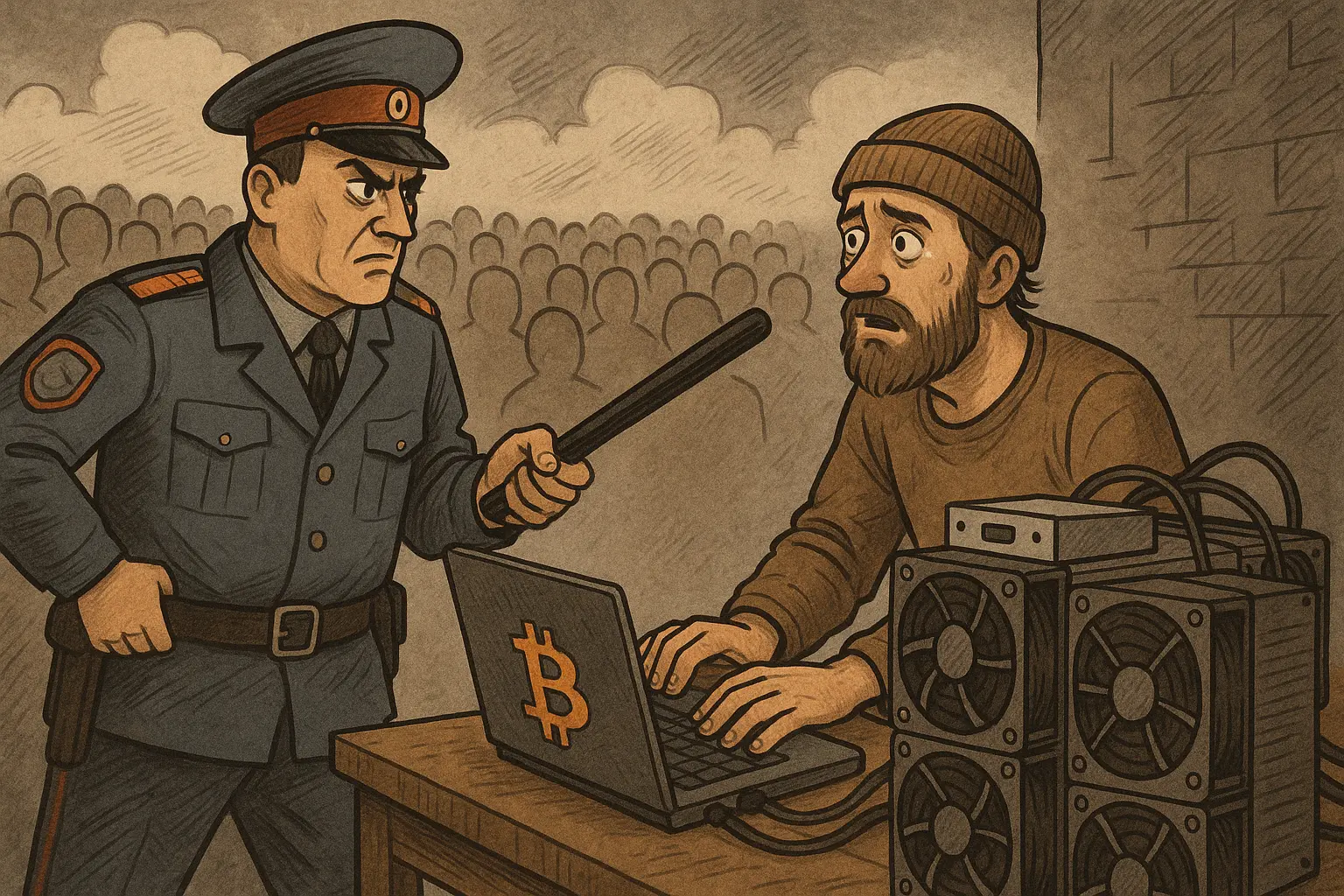
The Russian government has submitted a draft criminal legislation bill to the State Duma, proposing to impose the highest fine of 2 million rubles (about $25,000) and up to 5 years of imprisonment on illegal cryptocurrency mining activities. According to data from the Federal Tax Service (FNS), there are currently about 50,000 individuals and legal entities engaged in mining activities, but fewer than 1,500 have completed legal registration, resulting in a compliance rate of less than 3%.
Draft Legislation: A Tiered Punishment Structure for Criminal Penalties
The bill submitted this time amends Russia’s Criminal Code, adding new offenses for unauthorized service providers operating mining infrastructure. Criminal responsibility is set in tiers based on the scale of the violation and the level of harm. In general cases of violations, the maximum fine is 2 million rubles (about $25,000), and imprisonment may be up to 5 years; if economic losses exceed 13 million rubles, the fine cap increases to 2.5 million rubles, and compulsory labor may be added; for illegal mining carried out by organized criminal groups, if it causes significant losses to individuals, organizations, or the state or generates large-scale income, then the parties face the highest tier of criminal penalties.
At the end of 2024, Russia officially legalized mining, requiring participants to complete registration with the Federal Tax Service (FNS) and pay taxes in accordance with the law. However, since then, registration progress has fallen far short of regulatory expectations—nearly 97% of existing miners remain in a legal gray area without registration.
Comprehensive Mining Bans in 13 Regions: Geographic Distribution and Background of the Bans
Russia’s comprehensive mining ban regions span multiple areas with different political and resource contexts:
Siberian Energy Hubs: The Republic of Buryatia, the Transbaikal Krai (effective from April 1, with the ban running through 2031), and Irkutsk Oblast—these regions had previously imposed seasonal restrictions on the grounds of winter energy supply, but they have now been upgraded to multi-year, year-round bans.
Ukrainian Occupied Regions: Donetsk Oblast, Luhansk Oblast, Zaporizhzhia Oblast, and Kherson Oblast
Caucasus Region: The Republic of Dagestan, the Republic of Ingushetia, the Kabardino-Balkar Republic, the Karachay-Cherkess Republic, and others
Russia’s energy minister for the Moscow region, Sergei Voropanov, has also proposed banning mining in the city of Moscow and the Moscow region, noting that local mining consumes about 1 GW of electricity, “with no positive impact on the regional economy.” According to TASS, local authorities are prepared to take “extreme measures” to reduce the load on the power distribution network.
Potential Impact on the Global Compute Power Landscape: Russia Shifting from Mining to AI
According to a recent report, Russia is the world’s third-largest bitcoin mining destination, behind only the United States, ahead of China. Together, the three countries account for about 68% of global hash power. Russia has abundant energy resources and a cool climate across its vast territory, providing a natural cost advantage for mining.
However, Russia’s government policies are undergoing a structural shift: decision-makers have clearly stated that they will prioritize directing computing resources toward artificial intelligence (AI) applications rather than cryptocurrency mining. This direction may prompt many Russian data centers to accelerate their transformation. Combined with the expanded scope of mining bans and the deterrent effect of criminalized legislation, Russia’s contribution to the global Bitcoin network’s hash power may enter a medium-term contraction channel.
Frequently Asked Questions
How does Russia define “illegal” cryptocurrency mining?
Under the legalization framework that took effect at the end of 2024, mining activities are considered legal only if they are carried out after completing registration with the Federal Tax Service (FNS) and paying taxes in accordance with the law. Individuals or companies that mine without completing registration are deemed illegal and face a maximum fine of 2 million rubles and up to 5 years of imprisonment. Currently, among about 50,000 miners, fewer than 1,500 have registered, for a compliance rate of less than 3%.
What impact do Russia’s comprehensive mining bans in 13 regions have on global hash power?
Russia is the world’s third-largest mining country, and with the United States and China combined it accounts for about 68% of global hash power. If the scope of the bans continues to expand—especially to major power-using centers such as Moscow—Russia’s hash power could experience a significant contraction, with knock-on effects on the distribution of hash power on the global Bitcoin network and adjustments to mining difficulty.
How will Russia’s prioritization of AI computing affect the mining industry?
The Russian government has explicitly stated that it will prioritize using computing resources for AI applications rather than crypto mining. This policy direction may cause data centers to accelerate their transition. Combined with the expansion of mining bans and the deterrent effect of criminal legislation, the scale of mining within Russia faces medium-term structural contraction pressure, further affecting the distribution patterns across the global hash power map.
Disclaimer: The information on this page may come from third parties and does not represent the views or opinions of Gate. The content displayed on this page is for reference only and does not constitute any financial, investment, or legal advice. Gate does not guarantee the accuracy or completeness of the information and shall not be liable for any losses arising from the use of this information. Virtual asset investments carry high risks and are subject to significant price volatility. You may lose all of your invested principal. Please fully understand the relevant risks and make prudent decisions based on your own financial situation and risk tolerance. For details, please refer to
Disclaimer.


