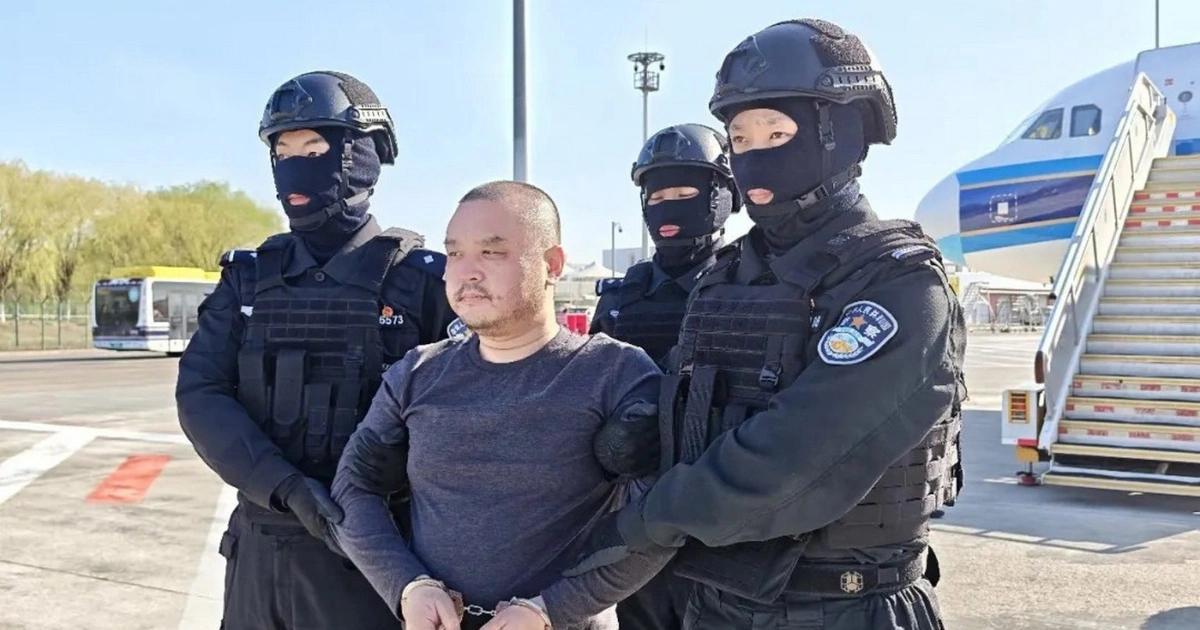
Li Xiong was extradited from Cambodia back to China. The case revealed that the Huaiwan Group was involved in a $4 billion cross-border money laundering network, exposing in full the Southeast Asian scam compound ecosystem and the crypto-linked funding pipeline.
Li Xiong was extradited back to China, and a transnational money laundering case came to light
Recently, the Cambodian government extradited Huaiwan Group’s former chairman Li Xiong (Li Xiong) back to China, marking an important breakthrough in recent years’ efforts in Southeast Asia to combat cross-border money laundering. The Ministry of Public Security of China stated that Li Xiong has been identified as one of the core members of a criminal organization involved in cross-border fraud and illegal business operations, and that he has long assisted the movement of funds through payment and cryptocurrency services.
The case stems from months of joint investigation by China and Cambodia, and was ultimately carried out with Cambodia’s Ministry of Interior coordinating the extradition. The official statement also said that multiple other key members of the criminal network have been detained, indicating that the operation was not a single case, but a systematic crackdown targeting the entire cross-border funding chain.
The amount of funds involved is as high as $4 billion, forming core infrastructure for the scam industry
According to investigations by the Financial Crimes Enforcement Network, from August 2021 to January 2025, the Huaiwan Group processed at least $4 billion in illegal funds—about NT$120 billion—covering criminal activities such as online fraud, hacker attacks, and theft of funds.
Blockchain analysis firms noted that the group not only handled funds, but also played a “infrastructure role” for the entire fraud industry—linking victims’ funds, payment intermediaries, and cash-out channels to form a highly efficient money laundering network. Through cryptocurrency and cross-border payment systems, funds can be transferred and dispersed within a short time, greatly reducing the difficulty of tracing.
Experts said the key value of platforms like this is not in their transaction volume, but in their “node function,” which repeatedly appears across different criminal schemes, becoming a shared layer of money laundering services that supports the operation of the entire underground economy.
Southeast Asian scam compounds expand, and a transnational criminal chain takes shape
This case also reveals an increasingly serious fraud industry chain in Southeast Asia. In recent years, places such as Cambodia and Myanmar have seen large numbers of “scam compounds,” specializing in investment scams and romance scams, and collecting payments and laundering money through cryptocurrency.
Interpol has listed these compounds as a cross-border criminal threat, pointing out that they involve multiple criminal activities such as human trafficking, forced labor, and cyber fraud. The movement of related funds is highly dependent on cryptocurrencies and underground financial systems, making traditional regulatory mechanisms hard to respond to.
In addition, another key figure related to this case—also a China-Cambodia businessman, Chen Zhi—was extradited to China earlier this year. The companies involved in his case were likewise sanctioned by the United States and the United Kingdom, showing that the overall criminal network spans multiple jurisdictions.
Crackdown escalates, but the money laundering network still has a high degree of adaptability
Law enforcement agencies said that recent freezing and seizure actions in Southeast Asia targeting crypto-related crimes have accumulated more than $580 million, or about NT$17.4 billion, showing that international cooperation is being strengthened step by step. However, experts also remind that while such actions can increase the cost and risk of crime, it is still difficult to completely eradicate it.
Blockchain tracking data shows that the scale of the fund flows related to Huaiwan may be far greater than the amount already confirmed, and some observers even indicate that the cumulative amount of funds handled has reached several tens of billions of dollars. After being targeted and hit, these networks often quickly shift to new platforms or substitute services to keep operating.
As the role of cryptocurrency in cross-border fund transfers continues to expand, regulators and law enforcement agencies face a real-world challenge: technology makes funds more transparent, but at the same time makes crime more scalable and efficient. How to build a coordinated regulatory framework across the globe will be key to combating such crimes in the future.
This article is generated by a Crypto Agent compiling information from various parties, and has undergone review and editing by 《Crypto City》. It is still in the training stage and may contain logical deviations or information errors. The content is for reference only and should not be considered investment advice.
Disclaimer: The information on this page may come from third parties and does not represent the views or opinions of Gate. The content displayed on this page is for reference only and does not constitute any financial, investment, or legal advice. Gate does not guarantee the accuracy or completeness of the information and shall not be liable for any losses arising from the use of this information. Virtual asset investments carry high risks and are subject to significant price volatility. You may lose all of your invested principal. Please fully understand the relevant risks and make prudent decisions based on your own financial situation and risk tolerance. For details, please refer to
Disclaimer.


