In recent weeks, international news has been almost entirely dominated by the situation in Iran and by Donald Trump’s seemingly wavering stance on how the war could unfold.
And there’s one thing that, once in 2025 owned the front page as the top headline, is now rarely mentioned by mainstream media—on February 14, a partial government shutdown at the Department of Homeland Security (DHS) was officially triggered after Democrats and Republicans got stuck in a stalemate over a DHS funding bill.
As of today, the shutdown has still not ended.
During these nearly two months of shutdown, more than 100,000 DHS employees have been unable to receive pay, and nearly 11% of Transportation Security Administration (TSA) employees have been absent. In New Orleans, passengers waiting in line for security checks have had to snake from inside the terminal all the way outside—so much so that they even looped around the parking lot seven times before reaching the entrance.
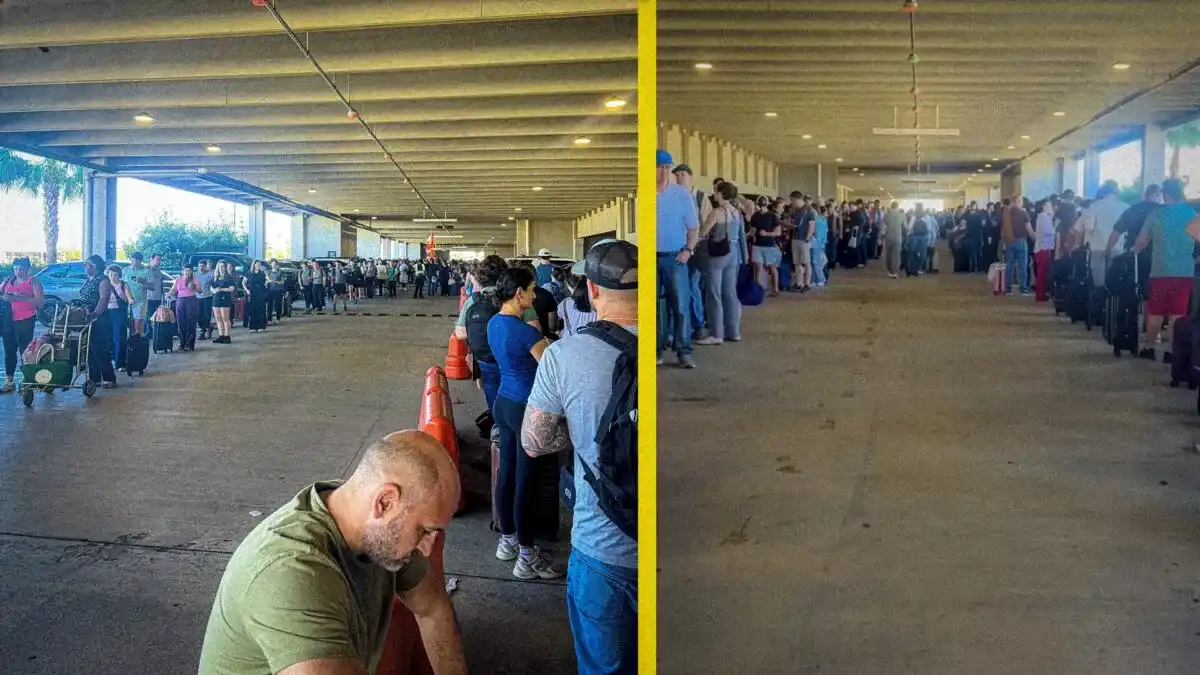
For the United States, which has almost no high-speed rail network and relies heavily on air travel, turbulence in the civil aviation system is deadly. Even Musk has publicly said he is willing to pay the affected TSA employees’ wages out of his own pocket.
And starting in March as well, the prediction market Polymarket launched a weekly-updated event titled “How Many Scheduled Flights This Week Will Be Delayed”—traders can bet on how many flights will be delayed each week; get it right and you make money, get it wrong and you lose everything.
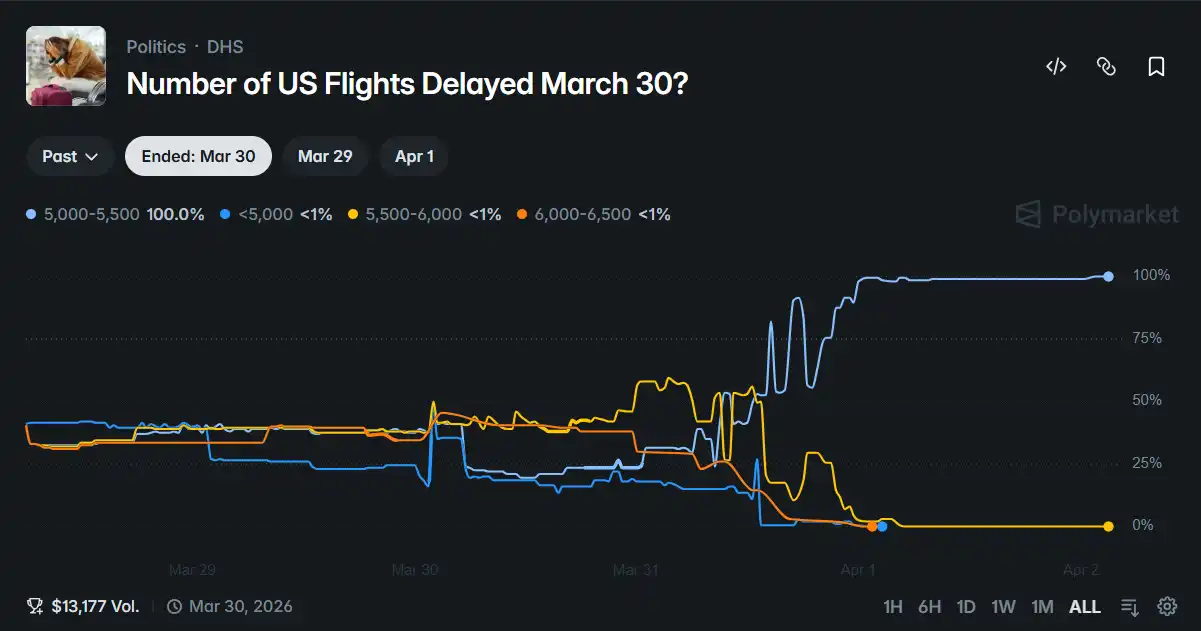
Besides this kind of purely entertainment-oriented event, Polymarket has also rolled out several topics with considerable reference value. By looking at the probabilities reflected in these topics, we can try to interpret the real situation of the current government shutdown—and even America’s domestic politics.
Bargaining Games Between the Two Parties
The length of this shutdown has already broken the 35-day record previously set by Trump. In the situation where flights are broadly delayed and the security screening system is on the verge of collapse, when the shutdown will end is the question most closely watched by the people in the U.S. who are being affected.
At present, Polymarket already has a related event: “The DHS shutdown will end on __.” As of the time of publication, the probability that the shutdown ends between April 5 and April 8 is 44%, and the probability that it does not end in April is 14%.
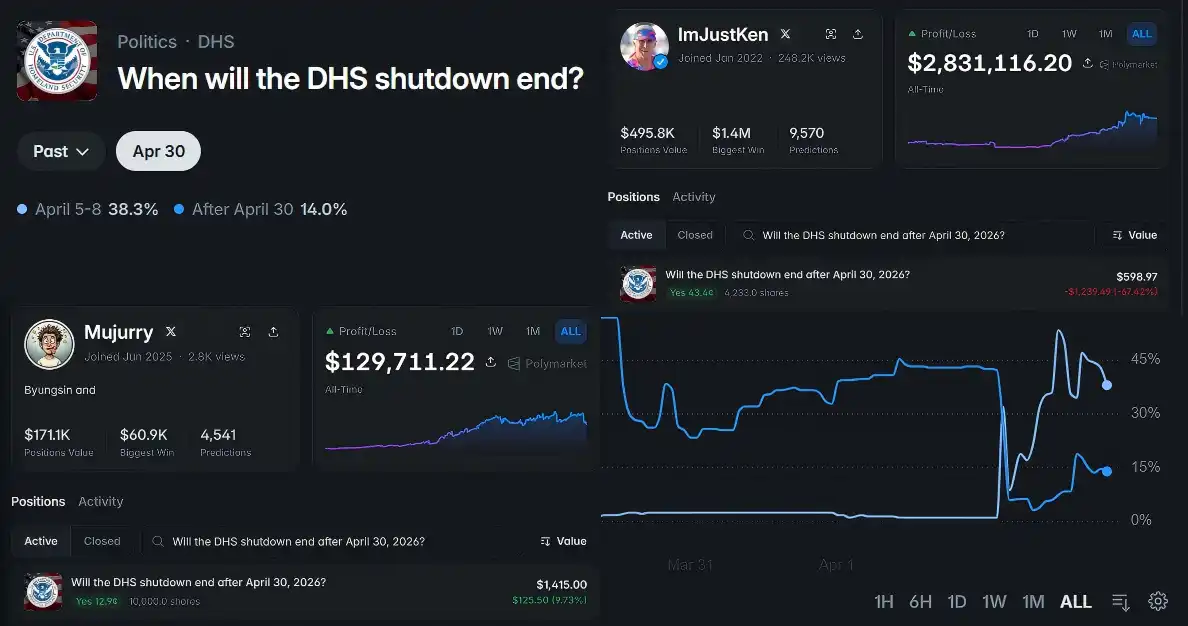
There are quite a few “smart money” players placing bets at these two time points—veteran traders who have historically had high prediction accuracy and have performed profitably in the political category. Behind these trading profiles is a clear logic: if the shutdown does not end within the April 5 to April 8 window, the chances of reaching an agreement within this month will drop dramatically.
April 5 to April 8 also falls right after Congress returns to work following its recess. Both parties will once again put the funding bill back on the table. If they can reach an agreement within those first few days back, the bill can be submitted for signing after passage through both the House and the Senate—at which point the shutdown would be over.
However, if that window is missed again, the House and Senate will each subsequently get pulled into other agenda items. Without strong political pressure, the motivation for the two parties to return to the negotiating table will be greatly weakened.
Musk “paying the bill” and ICE “filling in”
Because TSA staffing continues to dwindle due to resignations, causing severe delays at major airports, on March 21 Musk posted that he was willing to pay TSA personnel’s salaries—prompting Polymarket to launch a trading event: “Will Musk pay TSA employees’ salaries?”
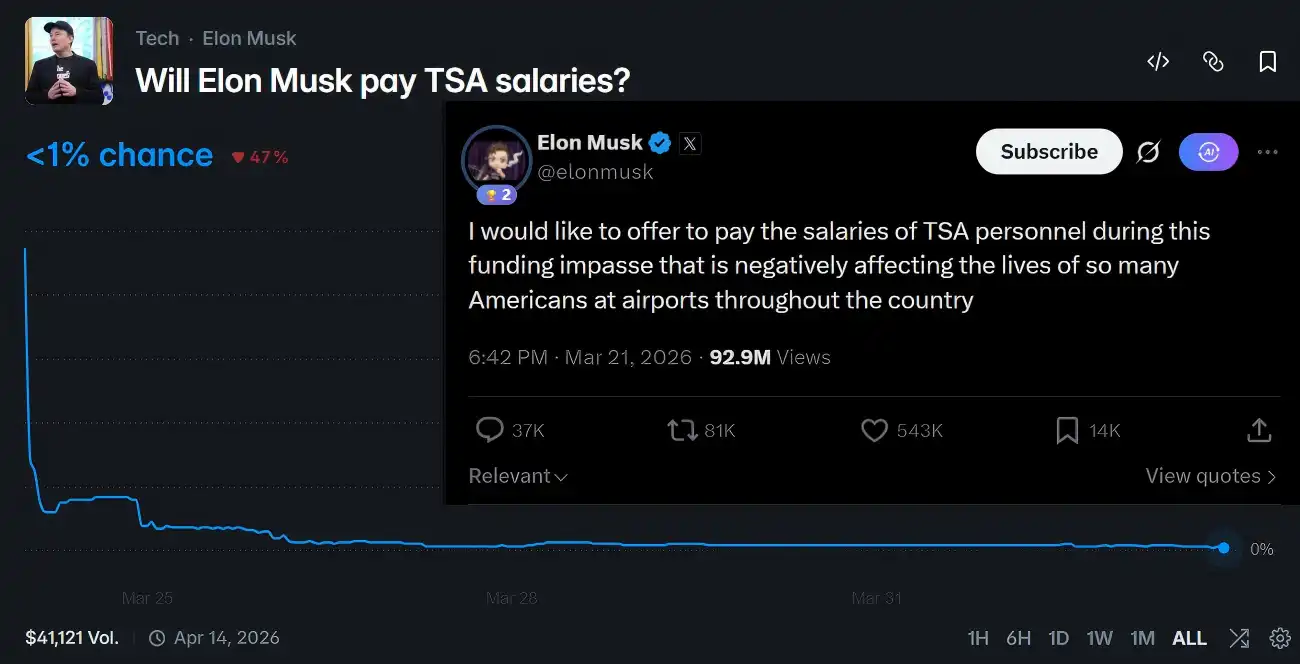
However, not long after Musk’s post, the White House rejected the proposal, citing legal compliance and conflicts of interest. Under U.S. federal law, government employees cannot accept outside compensation related to their public duties. In addition, Musk is deeply involved in federal government contracts, so directly paying wages creates serious conflict-of-interest challenges.
Even though the reasons for refusal are legally grounded, ordinary people still have to live. To reduce—so far as possible—the impact of an aviation-system shutdown on the midterm elections, Trump ordered in late March the deployment of Immigration and Customs Enforcement (ICE) agents to airports to replace TSA employees who had left due to unpaid time.
But once those ICE agents arrived at the airports, the scene that followed made the entire shutdown episode look even more absurd.
After Trump took office, in order to meet the ICE goal of “3000 arrests per day and 1 million deportations per year,” ICE has been significantly compressing the recruitment and training process—planning to hire an additional 10,000 law enforcement personnel and shortening the scheduled in-person training from 16 weeks to 8 weeks.

In short, the professional competence of these ICE agents themselves is already in doubt.
Meanwhile, TSA’s security screening work requires systematic training covering core skills such as operating X-ray machines and detecting explosives—skills ICE agents simply do not have.
And so, a historic scene unfolded: while TSA employees were effectively working without pay, they also had to show ICE agents the security screening procedures and teach them how to maintain order. And most ICE agents did not actually carry out security screenings—instead, they patrolled around in the terminals, using their law-enforcement status to question and detain suspected undocumented immigrants, then carry out deportations.

The data confirms the result of this farce. After ICE moved into the airports, flight delay conditions did not improve noticeably. As of the end of March, the U.S. air system still had several thousand flights delayed per day on average. At Atlanta’s airport, the TSA absence rate was close to 40%, and delays exceeded more than 350 flights in a single day. These figures show that the ICE agents who were supposed to serve as a buffer for the shutdown did not end up playing any role that anyone expected.
The “nuclear option” to break the deadlock
Another trading event related to this government shutdown is: “Will Republicans use the ‘nuclear option’ to break obstruction before December 31, 2026?” The current probability is 31%.
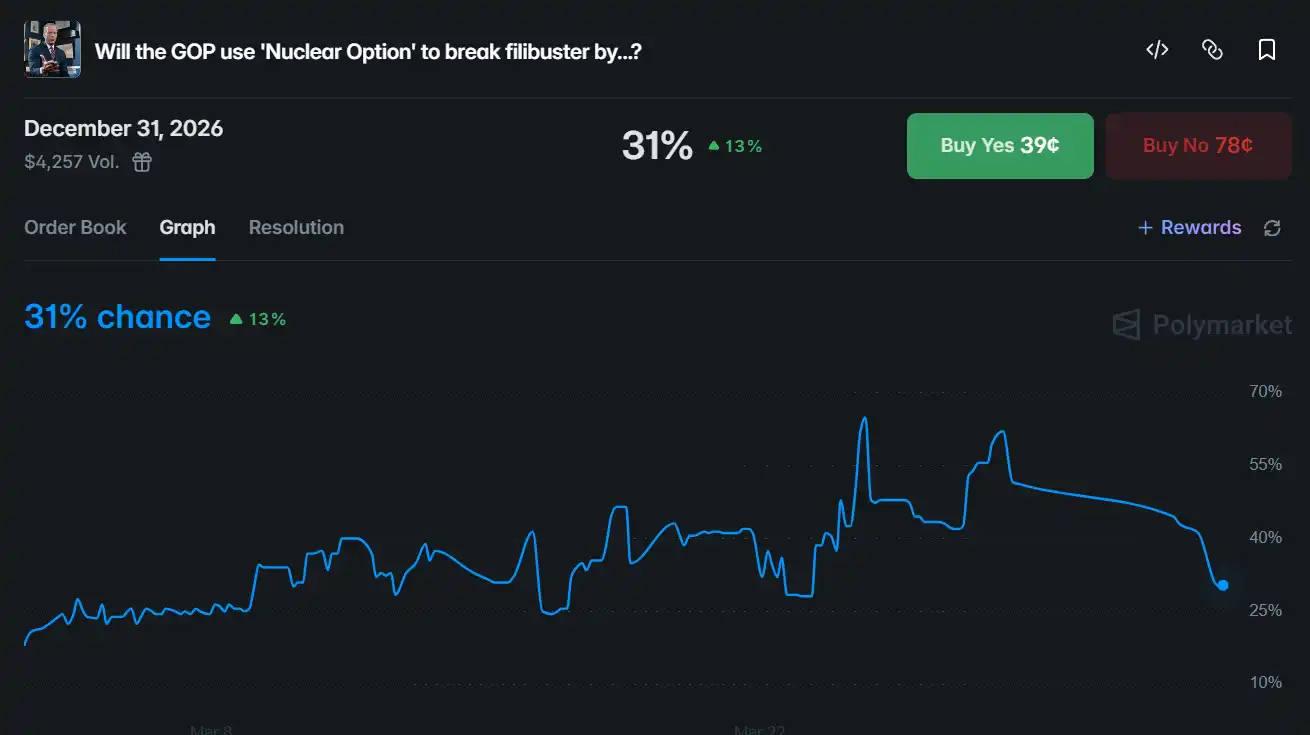
At first glance, the term “nuclear option” sounds quite alarming. But in American politics, it is not a nuclear weapon in the literal sense—it is one of the few exceptionally destructive parliamentary tools Republicans have.
Within the U.S. legislative system, the House is responsible for introducing and drafting appropriations bills, while the Senate is responsible for reviewing and voting on them. Usually, for the Senate to end debate and move forward to a vote requires 60 votes—meaning the minority party only needs to gather 41 votes to block any bill indefinitely by delaying debate.
The “nuclear option” provides a route that bypasses this threshold. A senator can bring a procedural appeal, using a simple majority (51 votes) to overturn the presiding officer’s ruling—thereby forcing the vote threshold required to end debate down from 60 votes.
Currently, Republicans hold 53 seats in the Senate. Once the nuclear option is triggered, the Democrats’ ability to obstruct would be nearly zero.
But that’s why it’s called “nuclear”: it is costly even for the users themselves. By breaking Senate rules of procedure, voters will view it as an abuse of power. More importantly, if Republicans lose their majority in the future, the same rules can be used by Democrats to retaliate.
The hole dug today may be filled by yourself later. The 31% probability is the market’s real pricing of this kind of dilemma.
While this shutdown stalemate remains unresolved, Trump also has to deal with another predicament: the Iran situation continuing to heat up.
One side is the high-pressure standoff between diplomacy and military force; the other is airport lines, unpaid wage slips, and the two parties pulling at each other. The troubles this U.S. administration needs to coordinate are far more than what the headline news suggests. Crises in domestic affairs and foreign policy never wait for the other side to solve things first.
And amid this kind of turbulence, the variety of political and current-events prediction events on the market will continue to serve as an objective mirror—helping us catch the real direction of these narratives.
Click to learn about LyDòng BlockBeats hiring positions
Welcome to join the official LyDòng BlockBeats community:
Telegram subscription group: https://t.me/theblockbeats
Telegram discussion group: https://t.me/BlockBeats_App
Twitter official account: https://twitter.com/BlockBeatsAsia


